A bedroom can be too tight for a nightstand and still need a place for glasses, water, a phone, medicine, a book, or a light. Buying the narrowest table you can find may only create a new problem. Even a small piece of furniture can block a closet, catch a drawer, crowd a radiator, or make getting out of bed awkward.
Start with the functions you need at night, then protect the space the room needs during the day. You may be able to use a dresser that is already there, tuck a caddy against the mattress, or move only the light to the wall. Some beds need a different solution on each side. Some do not need a separate bedside surface at all.
Jump to a section
- Protect the space the room needs to function
- Decide what actually needs to be within reach
- Borrow a surface that is already in the room
- Use a bedside caddy when there is no floor space
- Add a freestanding surface only where it truly fits
- Move one bedside function to the wall when mounting is suitable
- Let the headboard provide storage only when changing the bed already makes sense
- Test the setup from the bed before committing
01
Protect the space the room needs to function
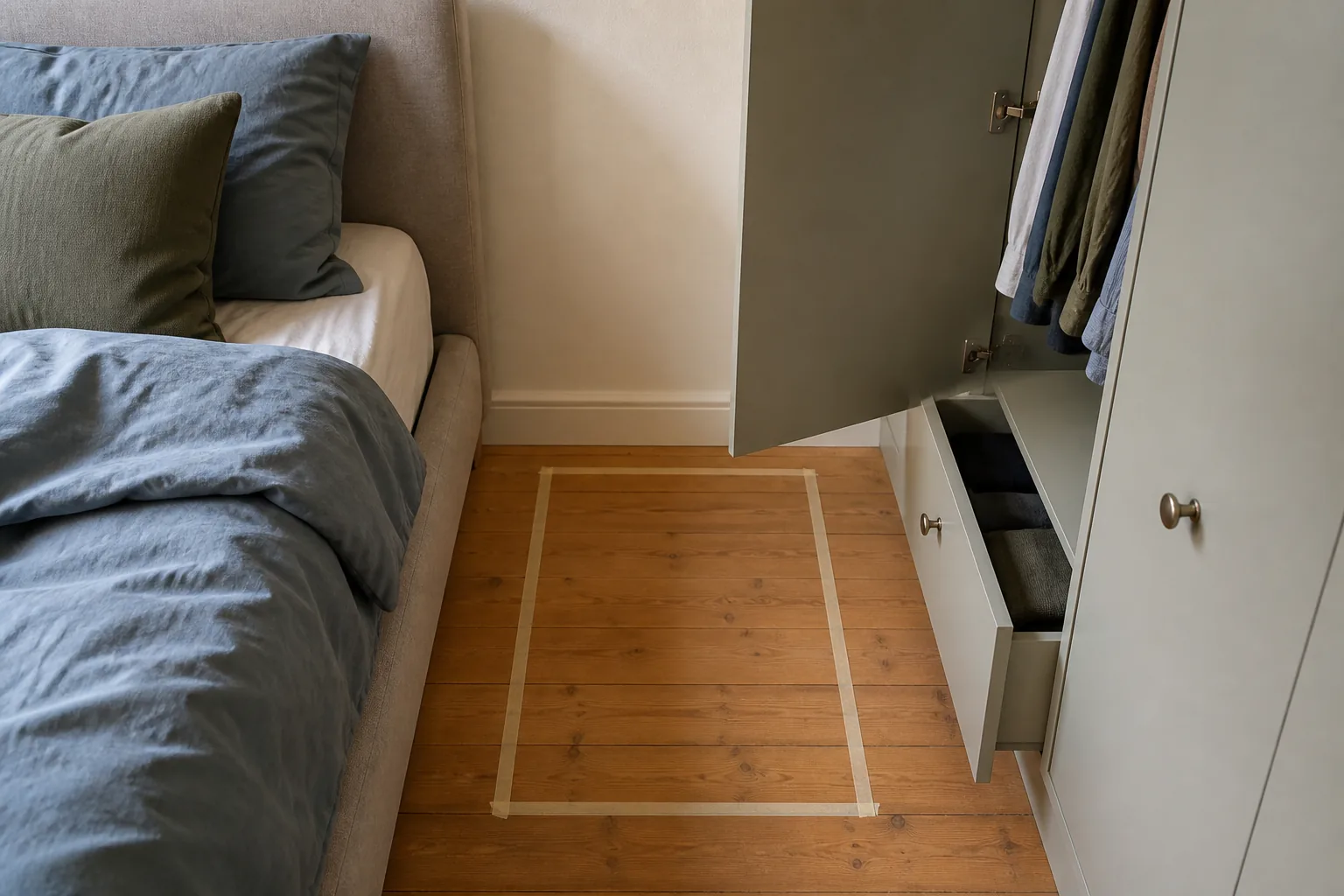
Before adding anything, open every door and drawer near the bed. Walk the route from the doorway to the bed. Get in and out on the side you normally use, pull back the bedding, and notice where your feet land. If a closet, radiator, curtain, or built-in sits beside the bed, include it in the test.
The clear area that remains is the real footprint available for a bedside solution. Measure its width, but also note its depth and shape. A table that is only a few inches wide can still project too far into the room. Splayed legs may catch the route even when the top fits neatly against the wall.
Use painter's tape or a piece of cardboard to mark the complete footprint of anything you are considering. Then live with the outline for a day. If you step over it, kick it, turn sideways to pass, or cannot open a drawer fully, the room has already given you an answer. The narrow-entryway guide uses the same test beside a door where even a shallow object can interrupt the route.
The National Institute on Aging's room-by-room fall-prevention guide recommends keeping electrical cords near walls and furniture out of walking paths. Use that as a safety check for bedside lights and charging cables, then test the actual route in your room.
There is no universal bedside clearance that suits every home. The bed height, door positions, mobility needs, and the way each person enters the room all change what is comfortable. Test the actual movement instead of relying on a single number.
02
Decide what actually needs to be within reach
A nightstand often becomes the default home for everything associated with sleep, though most of it may not need to sit beside the mattress.
Make a short list of what you use after getting into bed and before standing up in the morning. It may include:
- glasses or hearing aids
- water
- medicine that must be accessible at a particular time
- a phone and charging cable
- a book or e-reader
- tissues
- a bedside light
A phone needs charging, but it may not need a table. A wall or clamp light can replace a lamp without creating storage. A book can return to a dresser after reading. Spare cables, hand cream, notebooks, and other occasional items can move to a drawer elsewhere.
This step often reduces the problem from "I need a nightstand" to something more useful: "I need a stable place for a glass and my glasses," or "I only need light and a charging point." A smaller problem has more workable solutions.
If two people share the bed, make two lists. One person may need medicine and water within easy reach while the other only needs a light. Matching furniture is less important than giving each sleeper a setup that works.

03
Borrow a surface that is already in the room
The simplest nightstand alternative may already be close to the bed. A dresser, vanity, deep windowsill, desk, or headboard shelf can hold a few nightly items. Test the reach while lying in your normal sleeping position, not while standing beside the bed. Keep only what you can place and retrieve comfortably. The guide to making an eating place in a small apartment also starts by testing a surface that is already in the room.
Make sure the borrowed surface can still perform its main job. Leave room for a vanity seat and drawers to move, and do not crowd a dresser top until opening it becomes a chore. A windowsill may be unsuitable for medicine, electronics, or anything affected by direct sun, condensation, drafts, or heat.
04
Use a bedside caddy when there is no floor space
A bedside caddy uses the mattress edge or bed frame instead of the floor. It can work in a rental, alcove, or room with drawers under the bed when furniture and wall mounting are both out.
Pocket count matters less than whether the caddy suits the bed and the objects you need to store. Check how it attaches, whether the mattress or frame can hold it securely, and how far it hangs toward the floor. A soft pocket may be fine for a phone, tissues, or an e-reader but a poor place for an open glass of water. A rigid tray may hold a drink more confidently, though it projects farther and needs a secure connection.
It should also stay out of the footpath and remain secure when you turn in bed, change the sheets, or retrieve something with one hand.
For a bed with an exposed rail, the BedShelfie Cable Catch bedside shelf is one rigid option. The selected white plastic version clamps to the rail and has a raised edge with cable-routing cutouts. Amazon's overview lists it at 12.75 inches deep, 9.5 inches wide, and 3 inches high, while the selected size field gives a slightly smaller 12.5-by-9.25-inch footprint. Plan around the larger figures.
The seller describes a 2.8-inch clamp for bed frames with a rail, but that does not establish compatibility with every rail shape, an upholstered frame, or a solid platform. Check the actual bed before ordering. The selected Cable Catch version also lacks the cup holder shown on some other BedShelfie variations, so treat it as a tray for small objects rather than a secure place for a drink.
05
Add a freestanding surface only where it truly fits
If the room has a small but usable patch of floor, a narrow open table or pedestal provides a firm surface for water and glasses.
Judge the whole object, not the number in its width field. A round pedestal may have a wide base. A slim rectangle can fit the wall yet project into the route. A C-shaped table only slides under a bed when the rail, base, and under-bed storage allow it.
Height matters too. Compare the proposed surface with the top of your mattress and test the reach with a box or stool. A surface far below the mattress can be awkward to reach; one much higher may catch the bedding.
An open form can keep the floor visible and easier to clean. If the essentials fit on top, drawers may only make the piece deeper and heavier.
The Vantimo three-tier side table is one example for a room that can accept a narrow rectangular footprint. The selected rustic-brown version is listed at 7.08 by 16.92 inches on the floor and 22.24 inches high. Its images show an open black metal frame, three board surfaces, and feet that remain close to the frame.
The listing swaps the width and depth labels in different sections and includes one unrelated smaller set of dimensions. The physical footprint is consistently presented as 7.08 by 16.92 inches, so tape out that complete rectangle and compare the height with the mattress. Skip it if the 16.92-inch side blocks a door, drawer, under-bed storage, bedding, or the route beside the bed.
06
Move one bedside function to the wall when mounting is suitable
Sometimes the lamp is the object consuming the missing nightstand. A clamp light may suit a compatible headboard or nearby shelf. A plug-in wall light preserves the floor but still needs a safe cord route and mounting surface. A hardwired sconce involves electrical installation.
Check whether the light can be switched off from bed, whether its shade and arm stay out of the path, and whether the light falls where you read rather than into the other sleeper's eyes. Follow the manufacturer's mounting and electrical instructions for the exact fixture. Keep cords away from walking routes, moving drawers, and heat sources.
A small wall ledge can provide a landing place, but the wall construction, fasteners, finished load, and position all matter. Renters need permission where the lease requires it. Adhesive mounting is not universally damage-free or suitable for valuable objects. The corner gallery wall guide shows how to mock up a ledge's projection before drilling.
Be particularly cautious with anything mounted above the pillow. If the only position places a shelf, heavy object, or glass directly over someone sleeping, choose a caddy, borrowed surface, or freestanding option instead.
07
Let the headboard provide storage only when changing the bed already makes sense
A storage headboard is a large response to a small problem. Consider one when the bed is already being replaced or the headboard would solve several needs at once.
Measure the added depth behind the mattress as well as the overall width. A headboard with shelves can push the bed farther into the room, reduce the route at the foot, or cover an outlet. Check that the shelves are reachable from the sleeping positions and that the headboard is compatible with the bed and mattress.
Built-in charging still needs workable outlets, cord paths, replacement parts, and controls. If the current bed fits and only one sleeper needs a place for glasses, a caddy or borrowed surface is a more proportionate answer.
08
Test the setup from the bed before committing
Mock up the proposed height and footprint, then put the actual essentials in place. Lie down, turn off the light, reach for water, connect the charger, and get out of bed without moving the test objects.
Open the closet, drawers, and bedroom door. Change the bedding and clean around the mockup. Check whether a cable crosses the route or gets pinched. If two people use the bed, let both test their sides.
A workable setup should pass four simple tests:
- essential items are reachable from a normal sleeping position
- doors, drawers, bedding, and walking routes still work
- the surface or holder stays stable with the intended objects
- cleaning and charging do not require dismantling the arrangement
If it fails one test, change the solution. The best alternative may be different on each side: a dresser for one person, a caddy for the other, and one shared wall light above neither pillow.