Jump to a section
- Keep wet towels and clean towels separate
- Find the best drying place before adding anything
- Use the back of the door when it has enough clearance
- Check the shower area, but do not trap the towel there
- Look at the side of the vanity
- Move the drying spot outside the bathroom when necessary
- Choose rails when drying matters more than capacity
- Help wet towels dry after a shower
- Store clean towels where they stay clean and dry
- Match the arrangement to the household
01
Keep wet towels and clean towels separate
Clean towels can be folded, rolled, stacked, or placed in a basket. Wet towels cannot. They need to hang with as little folded or bunched fabric as possible.
This distinction changes the room plan. A shelf above the toilet may be useful for clean towels, but it does nothing for the damp towel that needs to dry overnight. A row of small hooks may hold several towels neatly, yet leave each one folded against itself.
Solve the wet-towel problem first. Once every person has a reliable drying place, look for compact storage for the clean supply. The two functions do not have to stay in the same room.
02
Find the best drying place before adding anything
Walk through the bathroom as it is used each morning. Open the door fully. Step out of the shower. Reach for a towel. Use the sink and toilet. Notice which surfaces remain accessible and which ones become crowded.
A practical drying location should meet most of these conditions:
- The towel can hang mostly open rather than folded into a thick bundle.
- It does not touch the floor, toilet, sink, or another towel.
- It stays clear of the door swing and cabinet doors.
- Air can move around it.
- Everyone using the bathroom has a place for their own towel.
- The towel is easy enough to reach that people will actually use the spot.
Check the room after a shower
A towel may fit perfectly while the bathroom is empty but become trapped behind an open door for the rest of the day. A rail inside the shower may seem convenient until the curtain closes around it and keeps the towel in the dampest part of the room.
03
Use the back of the door when it has enough clearance
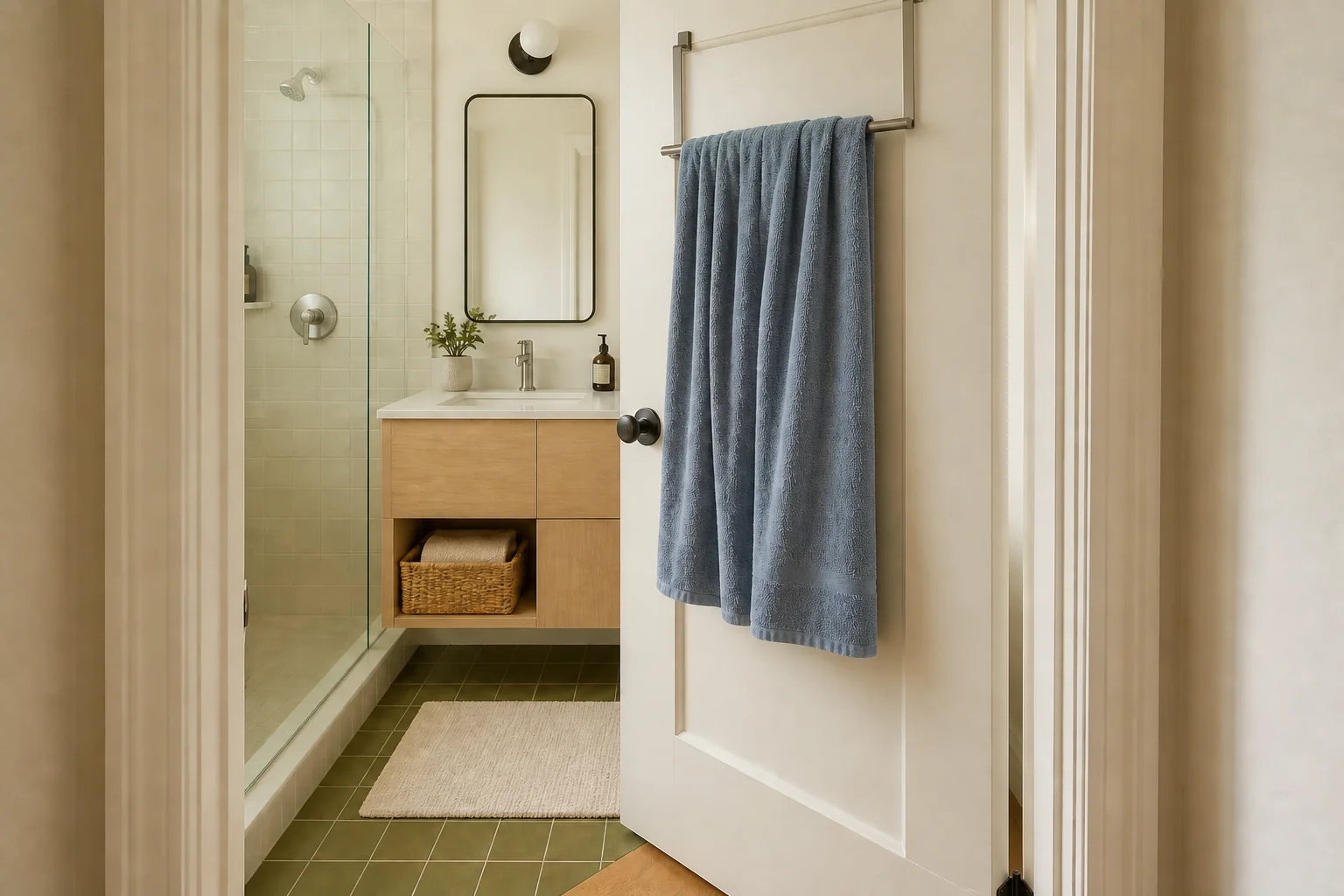
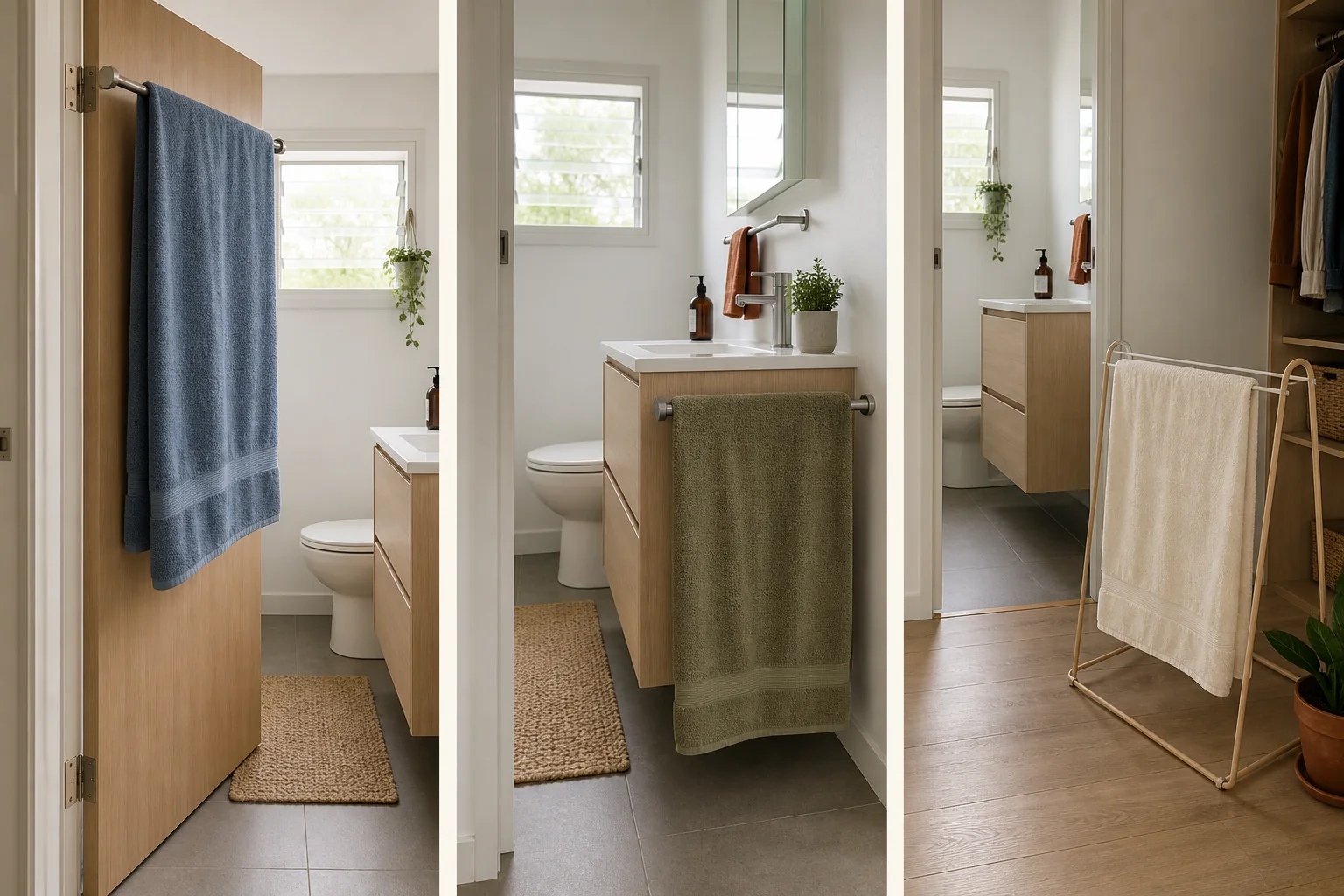
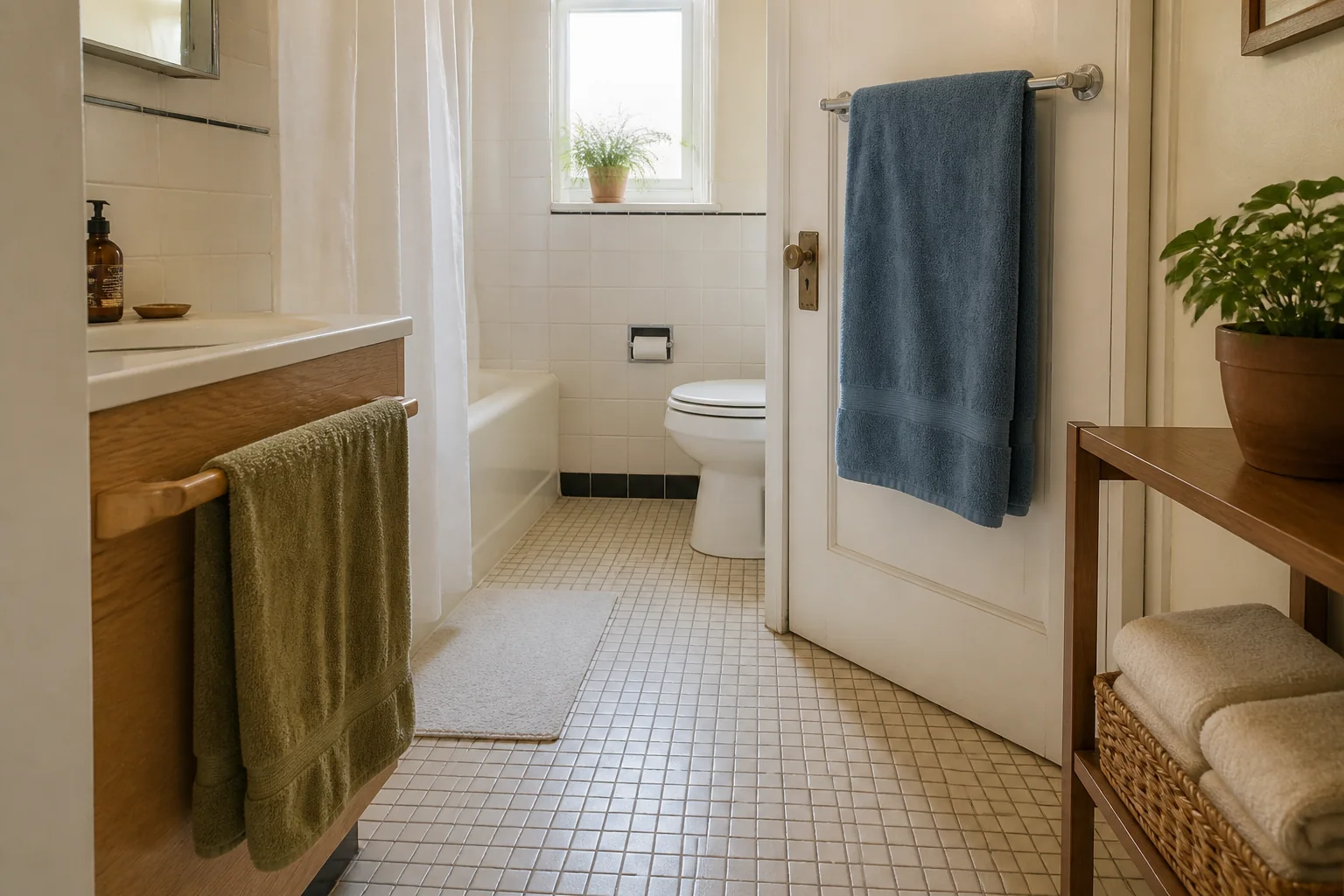
The back of the bathroom door is often the largest unused surface in the room. It can hold a towel rail without taking space from the walls or floor.
Before choosing this location, check how the door behaves throughout the day. If it usually stays open against a wall, the towel may be pressed between the door and wall with little air around it. If the door swings close to the toilet or vanity, a towel hanging from it may brush against those surfaces. The narrow-entryway guide has a fuller door-swing test for anything mounted on or placed beside a door.
A rail generally lets a bath towel spread more fully than a single hook. If several people share the bathroom, multiple rails need enough vertical space so the towels do not overlap. Hanging one towel directly over another creates storage, but not necessarily a good drying arrangement.
An over-door fitting must suit the door's thickness, allow it to close and latch normally, and avoid scraping the frame. If the door stays open most of the time, use the side that remains exposed to the room. If both sides become blocked, use another surface.
The CHJgroup three-tier over-door towel rack is one example. The seller lists it at 22.17 × 18.77 × 6.3 inches (height, width, depth), with hooks for doors up to 1.77 inches thick. Its staggered rails add separation, but the 6.3-inch depth may be a problem in a tight space. Measure the door and the clearance behind it before ordering. Check that the protective pieces hold it still, since movement can mark the door.
04
Check the shower area, but do not trap the towel there
An existing shower rail or a sturdy fixed bar can work when it leaves the towel exposed after the shower. It is less useful when the towel remains inside a closed shower enclosure surrounded by damp surfaces.
If the bathroom clears quickly after use, a towel spread across an outer rail may dry well. If the enclosure remains closed and humid, move the towel to the door or an adjacent room. Avoid placing it where it interferes with the curtain, pulls on a lightweight tension rod, or gets sprayed during the next shower.
In a shared bathroom, the shower area may be suitable for one towel but not three. Trying to fit every towel onto the same rail usually creates overlapping layers. Give each towel its own drying width, even if that means splitting the locations.
05
Look at the side of the vanity
The exposed end of a vanity can provide a useful hanging surface when the walls are already occupied. It works best when there is enough room for the towel to hang without touching the floor or narrowing the route through the bathroom.
Test the position with a towel before installing anything. Open every drawer and cabinet door, and sit on the toilet if it is nearby. The towel should clear the floor and your legs, while the rail holds damp fabric away from the cabinet finish. A vanity end usually suits one towel, not several crowded together. For another tight-space clearance check, see how the nightstand alternatives guide tests doors and drawers beside a bed.
06
Move the drying spot outside the bathroom when necessary
Not every towel has to stay in the bathroom. If the room has poor airflow, no usable mounting surface, or several people competing for one rail, the most effective drying place may be just outside it.
Possible locations include the back of a bedroom door, a rail in a well-ventilated dressing area, or a drying rack in the laundry space. Give each towel a fixed destination rather than letting damp fabric migrate to bedposts and chairs.
If towels need to remain nearby, a narrow freestanding rack outside the bathroom may be more practical than another fixture inside it. Test its footprint with cardboard so it does not become a hallway obstacle. Use the same full-footprint check described for a dog crate in a small living room.
Some bathrooms are simply too small and humid to work as both a bathing space and a drying room.
07
Choose rails when drying matters more than capacity
Hooks are compact and useful for robes, hand towels, or temporarily holding a bath towel. Their weakness is that most of the fabric hangs in folds.
A rail gives the towel more width. A double rail adds capacity only when the towels remain separated rather than pressed together. Hooks can still work when there is no room for a rail, especially if two points hold the fabric slightly open.
Each bath towel needs its own patch of open air. Four hooks squeezed into twelve inches may look efficient, but the towels will compete for the same space. Two well-separated locations can work better than one crowded organizer.
08
Help wet towels dry after a shower
A better hanging place cannot compensate for a bathroom that remains damp for long periods. The U.S. Environmental Protection Agency recommends running the bathroom exhaust fan or opening a window when showering. Its guidance on mold and moisture also identifies ventilation and air movement as ways to reduce bathroom moisture.
If you rent and the exhaust fan does not work, report it through the appropriate maintenance channel. Opening a window can help when weather and outdoor conditions make that practical.
After showering, leave the curtain or enclosure in the position that lets wet surfaces dry. If towels still smell stale despite hanging open and drying fully, placement may not be the only issue. Laundry habits or a wider moisture problem may need separate attention. Do not keep adding rails to solve a problem that begins elsewhere.
09
Store clean towels where they stay clean and dry
Once the used towels have proper drying places, clean towel storage becomes simpler. You do not need to reserve a large wall for both functions.
A shallow shelf, a basket in the vanity, or a nearby linen closet can hold clean towels. Keep only the number the bathroom uses regularly; an entire household supply does not need to consume its limited space.
Keep clean towels outside the splash zone and away from damp fabric. The arrangement should also be simple enough to maintain without moving several containers.
010
Match the arrangement to the household
For one person in a rental, the back of the door may handle the wet towel while clean replacements stay in the vanity or bedroom closet. The main checks are door clearance, mounting permission, and whether the towel remains exposed when the door is open.
For two people sharing a narrow bathroom, split the towels across two surfaces rather than stacking them on one rail. One can hang on the door and the other beside the vanity or outside the shower enclosure. Assigning each person a regular place prevents the rails from becoming interchangeable clutter.
For a family using one small bathroom, drying towels outside the room may be the cleanest answer. Each person can have a designated rail or hook in a bedroom or laundry area. The bathroom then needs only an accessible towel during bathing and compact storage for a few clean replacements.