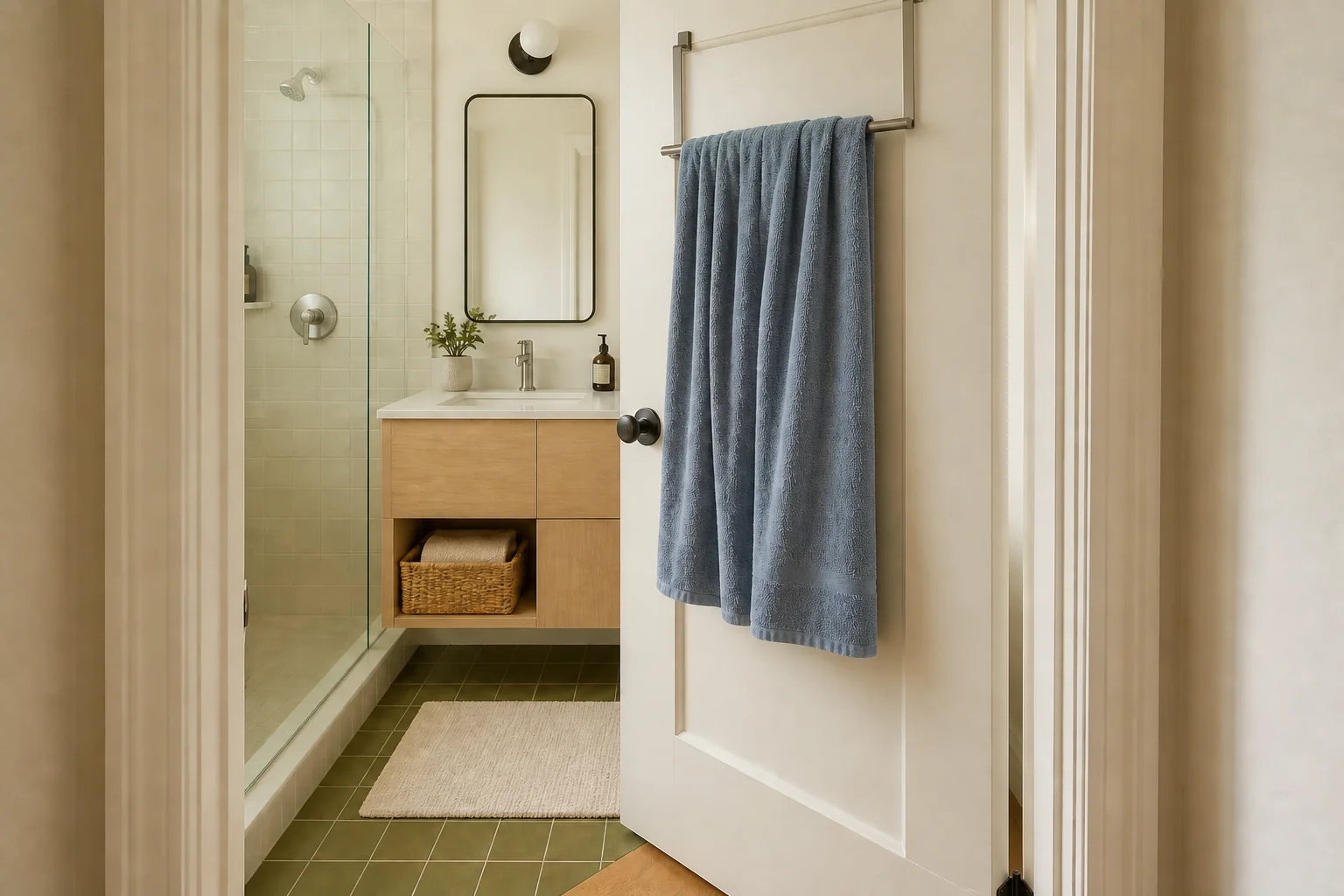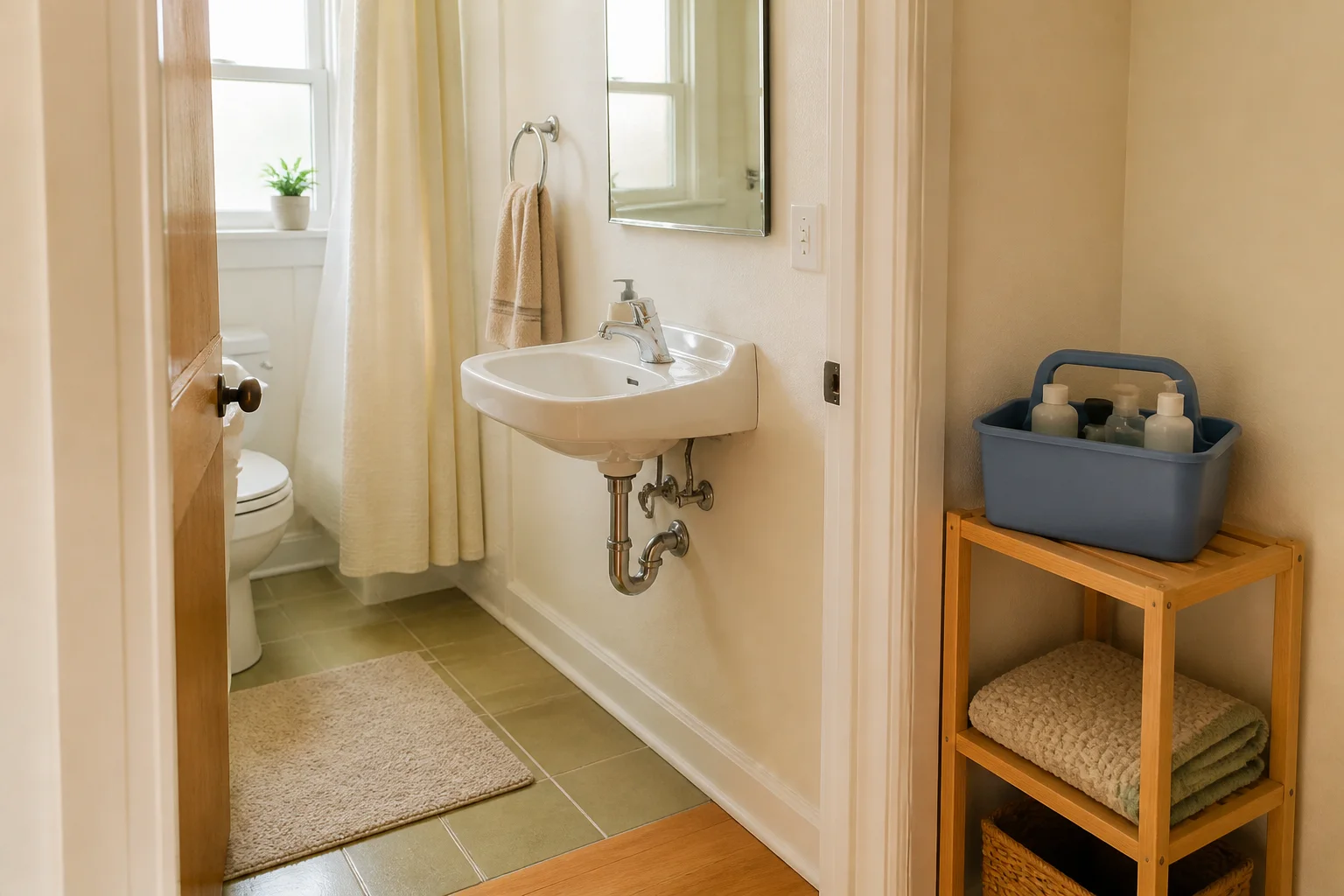
A bathroom with no counter space does not need every toiletry within reach. It needs a home for the few things used at the sink each day, along with enough open space to use them.
Start with that daily routine, then give it the nearest storage home that is easy to reset. Depending on the room, that might be a contained spot beside the sink, a portable caddy, shallow wall storage, an existing drawer, or a shelf just outside the bathroom. Backups, shower products, and occasional tools can live elsewhere.
Jump to a section
- Start with the routine, not the bathroom inventory
- Keep a small landing area available at the sink
- Decide where the daily set should live
- Separate shared items from personal routines
- Measure the organizer's effect on the room
- Move backups and occasional items out of the prime zone
- Test the arrangement before installing storage
01
Start with the routine, not the bathroom inventory
List what you actually use at the sink on an ordinary day. Toothpaste, a toothbrush, face wash, contact-lens supplies, or one skincare product may make the list. A spare bottle of shampoo, a hair tool used twice a month, and three unopened tubes of toothpaste do not.
Keep the list specific. "Skincare" can quietly turn into a dozen containers when the daily routine uses only three. Treat shower products, towels, cleaning supplies, and unopened replacements as separate storage problems.
Not everything used while getting ready has to live in the bathroom. If you use something at a bedroom mirror or can carry it in, a dresser, closet, or hall cupboard may be the better home.
02
Keep a small landing area available at the sink
An empty patch beside the basin is not wasted storage. It is where you set down a lens case, replace a bottle cap, or rest one product while using another. A tiered organizer may add capacity while removing the surface the routine needs.
Notice where you naturally set things down and keep that spot open. A narrow rim may hold one or two shared essentials in a compact container, but not every bottle used in the room. Avoid using the toilet tank as a replacement counter. It interferes with access and adds more objects to move during cleaning.
03
Decide where the daily set should live
Choose the location by how the bathroom works, not by how an organizer looks in a product photo. The best home is close enough to use and easy to reset without getting in the way of the sink, door, cleaning, or foot traffic.
Contained beside the sink
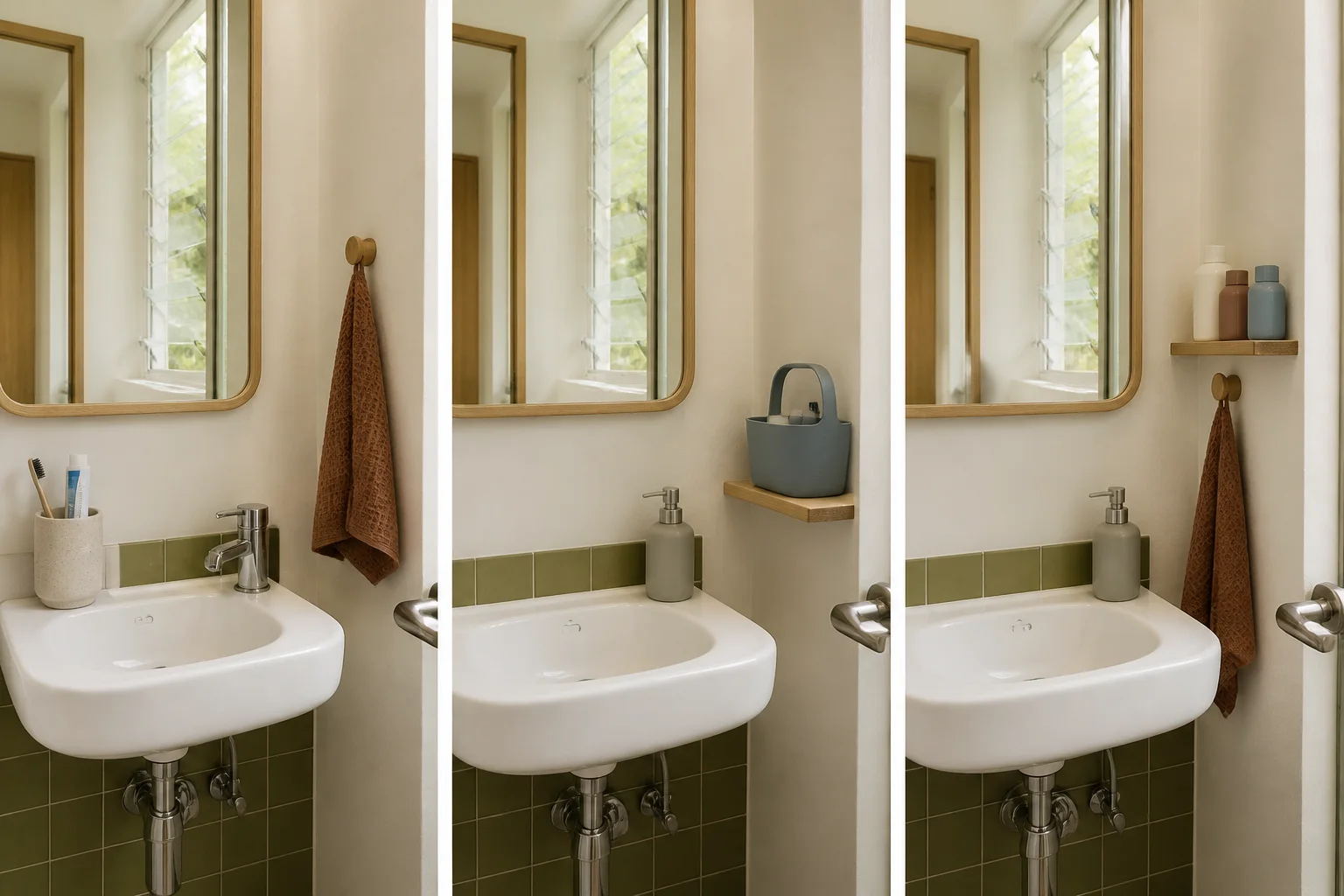
Sink-side storage works when there is a real ledge and the daily set is very small. Keep those items in one holder or tray rather than letting bottles spread across the ledge. If the container occupies the only useful landing spot or must be lifted whenever the sink is cleaned, it is not helping.
A portable routine caddy
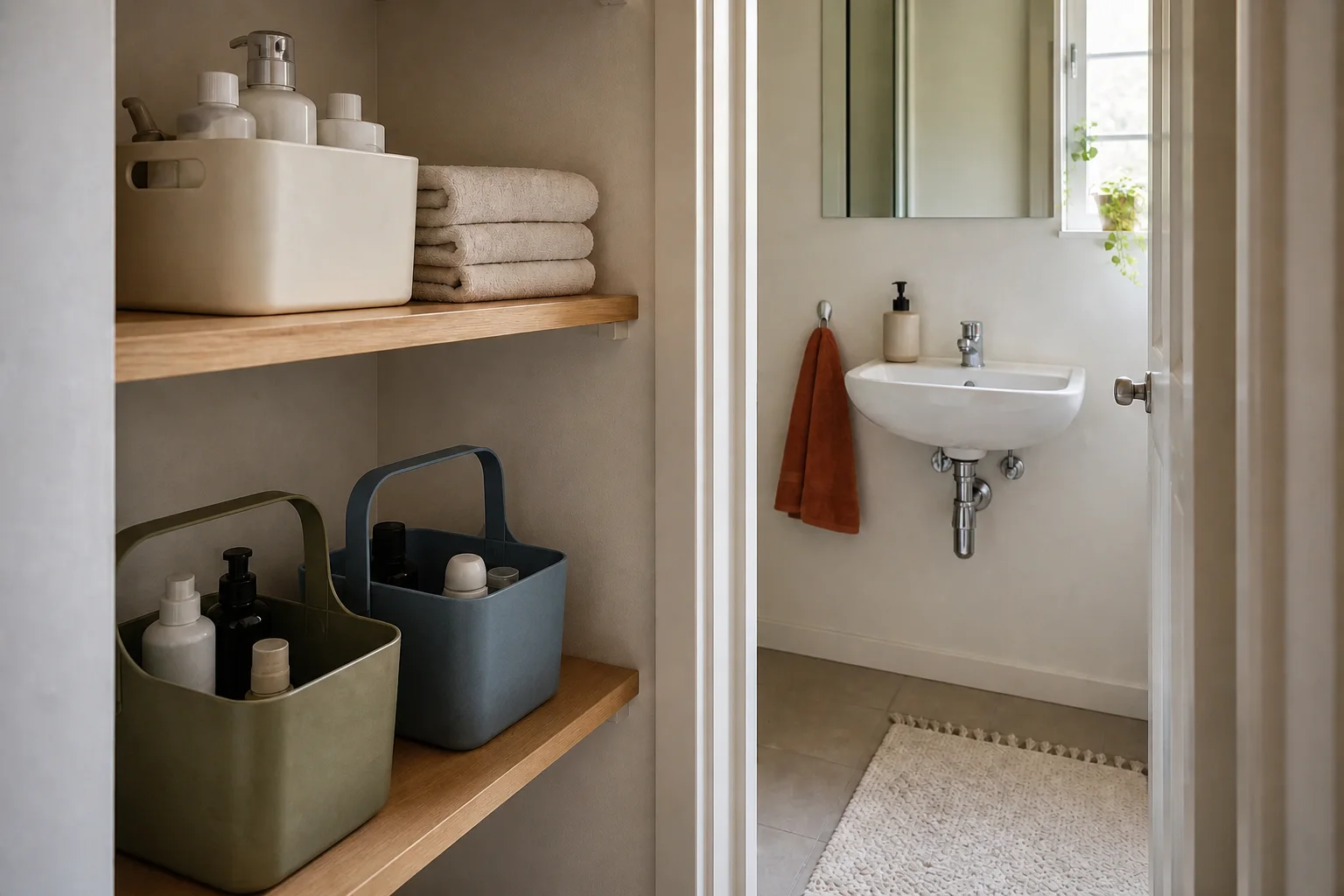
A small washable caddy is useful when the bathroom is shared, permanent mounting is not allowed, or there is no dry surface. Use it to bring the active set to the sink, then return it to a bedroom shelf, hall cupboard, or assigned bathroom spot. A caddy left on the floor is just a new pile with a handle.
The selected Cream version of the rejomiik plastic shower caddy is one compact example. Its listing gives exterior dimensions of 10.8 by 7.7 by 7.4 inches, with the height measured to the top of the wooden handle, and shows three compartments. Measure the shelf or cupboard where it will return. The base has four drainage holes, so choose a contained alternative if a leaking bottle is a concern.
Shallow fixed storage
A shallow shelf or surface-mounted mirror cabinet can keep a small routine within reach without using the sink. It works only when mounting is permitted and the full unit fits that exact position.
Check the full projection, including doors and handles. Confirm the wall surface, hardware, installation instructions, load limit, and moisture claims for the specific product. Do not assume adhesive mounting suits every humid surface or removes without damage.
Existing storage nearby
Before adding anything, test an existing drawer, cabinet shelf, or nearby cupboard. A shallow bin can keep the active set together inside a deep drawer. The same use-what-already-fits principle applies to bedside storage when there is no room for a nightstand.
Storage immediately outside the bathroom also counts. The extra few steps matter less than whether every item reliably returns after use. If no internal position works, let the routine travel into the room instead of forcing permanent storage into an awkward place.
04
Separate shared items from personal routines
Keep only genuinely shared essentials in the common sink zone. Soap may belong there. Four separate skincare routines probably do not.
Give each person an assigned caddy, drawer section, or shelf area. This makes putting things away more obvious, and no one has to rummage through one mixed container. The containers do not have to match when the routines differ.
05
Measure the organizer's effect on the room
An organizer can fit the empty dimensions and still make the bathroom harder to use. For wall storage, check width, total projection, door or cabinet swing, outlets, and cleaning access. Bottles may stand above a shelf edge, and an open door may project much farther than the closed unit.
A rolling cart needs a permanent parking place that does not block doors, drawers, fixtures, or the normal walking route. The route-first test for a narrow entryway works here, too. An over-door organizer needs brackets that fit without stopping the door from closing or causing the contents to strike the wall.
Check moisture claims on the specific product, too. Material alone does not show how a finished organizer will handle a damp room. Treat missing listing or care information as unknown, and follow the manufacturer's mounting and load instructions.
06
Move backups and occasional items out of the prime zone
The nearest storage should hold the active routine. Move unopened refills, spare soap, extra towels, travel toiletries, and occasional grooming tools to a less convenient cabinet or another room. A high shelf may suit a sealed refill but not contact-lens supplies used every morning.
Treat medicine as a separate category. MedlinePlus warns that bathroom heat and moisture can damage medicines, while the FDA advises following the storage directions on the label. Many medicines belong in a cool, dry place, but the instructions for the specific medicine should decide.
Hair dryers, curling irons, and electric razors also need more than a spare basket near the basin. The U.S. Consumer Product Safety Commission advises unplugging these appliances when they are not in use and warns about the shock risk if a plugged-in appliance falls into water. Store them where they cannot fall or be pulled into the sink or tub, and follow the manufacturer's instructions.
Keep towel drying separate from dry product storage. A shelf that holds toiletries does not provide airflow around a damp towel. If that is another pressure point in the room, see Where to Hang Wet Towels in a Small Bathroom When There Is No Wall Space.
07
Test the arrangement before installing storage
Simulate the setup for a week with something you own. A basket can stand in for a caddy, while a cardboard box can show how far a wall cabinet would project. Notice which items fail to return, whether the landing area stays clear, and what has to move during cleaning.
If the arrangement works, you know the maximum dimensions, contents, location, and necessary features. If it fails, change the location before buying a polished version of the same problem.