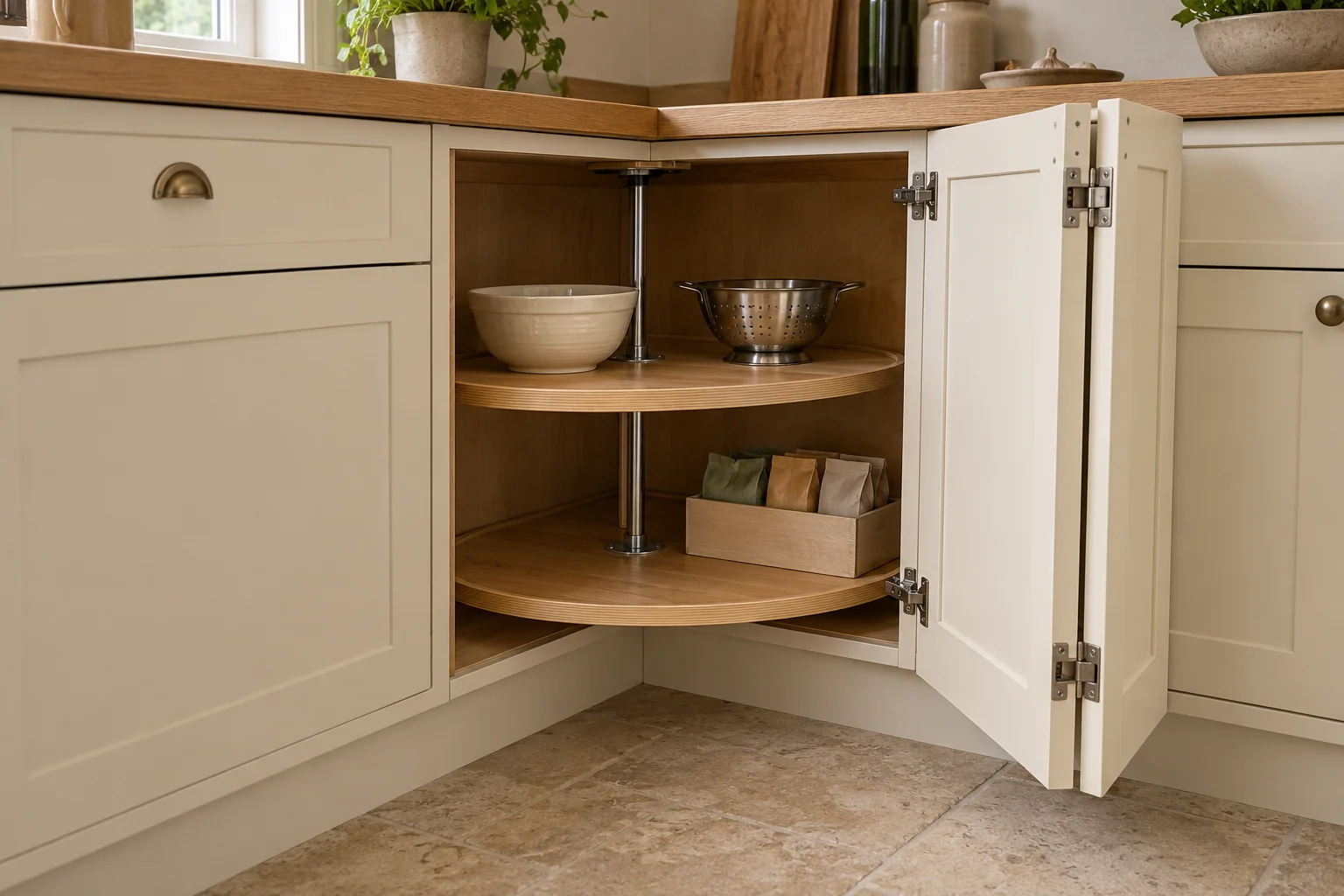
To organize a lazy Susan cabinet, check that each item goes through the opening, turns on the shelf and comes back out with its neighbours in place. Use those checks to choose what belongs there. A container can help with loose items, but try it full.
Start with the belongings and containers you already have in your lower corner cabinet. Keep anything that works well on its rotating shelves.
In this guide
01
Check the opening, the turn and the way out
Before emptying the whole cabinet, notice what goes wrong. A handle hitting a hinge needs a different response from a packet falling behind the shelf. You might be able to reach a bowl yet struggle to lift it out. Buying a set of bins won't necessarily solve any of these problems.
Before trying heavy items, confirm the manufacturer's load guidance for your mechanism. Clear enough space to try one troublesome item, keeping a record of what you remove. Open the doors as far as you normally can with the surrounding kitchen in use. A door held unusually wide for a tidy-up can give a misleading impression of access.
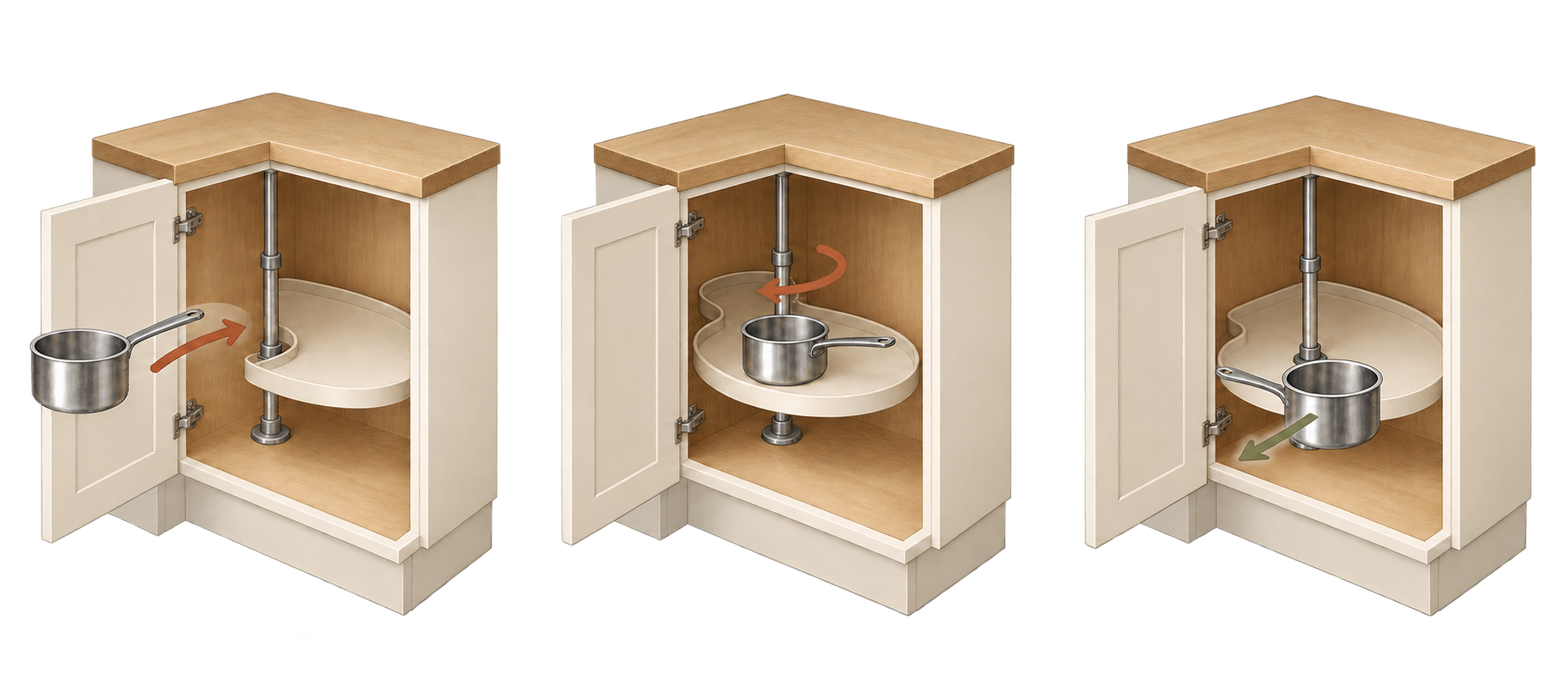
Then check three movements:
- Entry: Put the item through the opening in the way you would normally return it. Include its lid or other parts stored with it. Notice whether you need to tip it awkwardly or change your grip inside the cabinet.
- Rotation: Set it on the shelf and turn slowly, watching its outer edges, handles and lid. Stop if it catches; try a different position rather than pushing it past the obstruction.
- Removal: Put neighbouring items back and bring the wanted piece to the opening. Take it out using a comfortable grip. The space your hand needs is part of the arrangement.
A piece might pass the first two checks and still fail the third. For example, you may be able to slide a bowl into a narrow gap while holding its rim, then find that adjacent containers leave nowhere to grasp it when you want it back.
Keep hardware problems separate. If the shelf is loose, tilted or binding even when contents aren't catching, check the mechanism's instructions or arrange an assessment before planning around it. Passing the access checks does not establish that the shelf can support a particular load.
02
Choose what to store by how you use it
Keep items here when their shape and your use of them suit the access you have. You don't need to change a successful cupboard just because someone else's lazy Susan holds a different category.
In Erika Tracy's cabinet makeover for The Kitchn, casserole stacks caught during rotation and were awkward to remove; different cookware worked better in her cabinet. Janine Waite at Happy Happy Nester found that storing daily cookware here caused congestion when her family cooked together, and preferred less frequently used appliances. Each arrangement suited a particular kitchen. Neither tells you which category belongs in yours.
For your own contents, check what each group asks of the space:
Pots and pans
- What to check before keeping them here
- Handles clear the turn, the shelf is suitable for the load, and you can lift the wanted piece without dismantling a heavy stack.
Small appliances
- What to check before keeping them here
- The whole appliance comes through the opening comfortably, with its stored accessories and cord contained. Consider where you will set it down after lifting it out.
Bowls and baking equipment
- What to check before keeping them here
- The piece you use most can come out without repeatedly unloading the pieces above it.
Packets and small containers
- What to check before keeping them here
- You can see what you have, and loose pieces stay on the shelf while it turns. A removable group may be easier to handle.
| Possible contents | What to check before keeping them here |
|---|---|
| Pots and pans | Handles clear the turn, the shelf is suitable for the load, and you can lift the wanted piece without dismantling a heavy stack. |
| Small appliances | The whole appliance comes through the opening comfortably, with its stored accessories and cord contained. Consider where you will set it down after lifting it out. |
| Bowls and baking equipment | The piece you use most can come out without repeatedly unloading the pieces above it. |
| Packets and small containers | You can see what you have, and loose pieces stay on the shelf while it turns. A removable group may be easier to handle. |
A mixing bowl you use occasionally might be fine beneath another bowl. The saucepan you reach for every evening may deserve its own position. Decide which small inconvenience you can live with; some stacks will be worth keeping.
Also notice the floor space in front of the cabinet. If opening it blocks the person preparing food beside you, moving an often-used item may help even when the shelf itself works well.
For an occasionally used coffee maker, check both the cabinet access and the counter space needed to fill, brew, and clean it before choosing to store it between uses.
03
Add a container only when it makes retrieval easier
Try a container you already own before choosing organizers. It might keep several small packets together so you can lift them out as a group. Put the packets inside and try removing it next to the other things you plan to store.
The useful size is the one you can remove. A broad container can sit neatly on a rotating shelf yet be awkward to bring through the door once loaded. A narrower box might hold fewer things but let you grasp both sides and lift it straight out. If the only way to retrieve the group is to empty it inside the cabinet first, reconsider the container.
Check wedge-shaped bins in the same way. Following the shelf's curve doesn't tell you whether a bin clears the opening or leaves its handle accessible. You still need to lift it comfortably with the contents inside. Check its shape and removal path before buying a matching set.
You may only need a container for one loose group. Pots that already stay put don't automatically need a bin beneath them. Leave room where it helps you grasp an item or turn it into position; a fully covered shelf isn't the goal.
04
Compare two arrangements with the same belongings
Compare the effect on the adjoining cupboard as well as the lazy Susan. Moving an awkward pan elsewhere only helps if that destination works too.
Consider this illustrative planning example, rather than a tested makeover. The lazy Susan holds a long-handled saucepan, a compact mixing bowl and four small baking packets. An adjacent ordinary cupboard holds a colander. Everything else in both cupboards stays in place.
In the starting arrangement, suppose the saucepan handle catches during rotation. The packets sit in a broad box that turns but cannot be lifted out comfortably while loaded. Those observations suggest two changes to try: swap the saucepan with the colander, and put the packets in a narrower existing box.
Long-handled saucepan
- Starting arrangement
- Lazy Susan; handle catches
- Proposed arrangement
- Colander's former place in the ordinary cupboard
Colander
- Starting arrangement
- Ordinary cupboard
- Proposed arrangement
- Saucepan's former place on the lazy Susan
Compact mixing bowl
- Starting arrangement
- Lazy Susan
- Proposed arrangement
- Stays on the lazy Susan
Four baking packets
- Starting arrangement
- Broad box on the lazy Susan
- Proposed arrangement
- Narrower box on the lazy Susan
| Belonging | Starting arrangement | Proposed arrangement |
|---|---|---|
| Long-handled saucepan | Lazy Susan; handle catches | Colander's former place in the ordinary cupboard |
| Colander | Ordinary cupboard | Saucepan's former place on the lazy Susan |
| Compact mixing bowl | Lazy Susan | Stays on the lazy Susan |
| Four baking packets | Broad box on the lazy Susan | Narrower box on the lazy Susan |
Keep the swap only if the colander passes entry, rotation and removal beside the bowl and packets, and the saucepan fits the vacated cupboard position without obstructing anything else. Check the saucepan's handle there too. The narrower box must hold all four packets and come out loaded. An empty-box trial won't establish that.
The saucepan uses the colander's vacated place, so the cookware swap doesn't assume extra cupboard space. The empty broad box needs a home too. Try nesting it with spare containers where the narrower box was stored. If it won't fit there, find another real destination before accepting the change. Account for every necessary belonging and both boxes.
If the colander won't clear the lazy Susan opening, the swap fails. If the saucepan crowds the ordinary cupboard, it fails there instead. Keep the better parts of the original arrangement and try another pairing. This example shows how to evaluate a change; it cannot establish which pieces will fit your cabinet.
05
Check the arrangement during an ordinary kitchen task
With the proposed contents back in place, retrieve what you need for a familiar task. Bring out the bowl or pan, take out the packet group, and return each item when you're finished. Notice what you have to move along the way.
Pay attention when putting things back. If a handle has to sit carefully behind another object, it's easy to undo the arrangement while putting dishes away. Give the troublesome piece a position you can recognize and use without restacking its neighbours each time.
If one item still causes trouble, you have a specific decision to make: accept the extra handling because you rarely need it, change its neighbours, or find it another workable home. You can make that choice without replacing the whole cabinet or filling it with organizers.