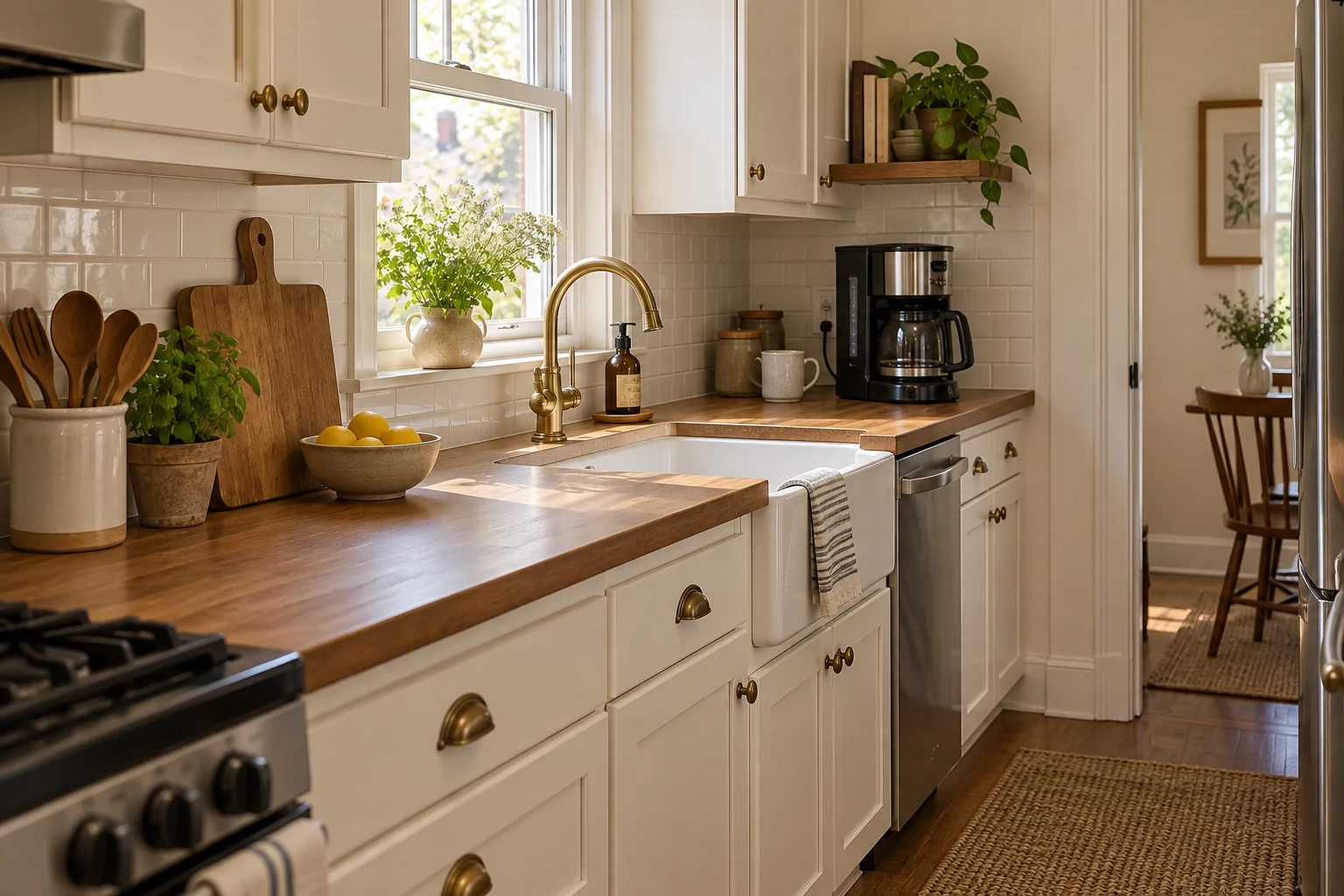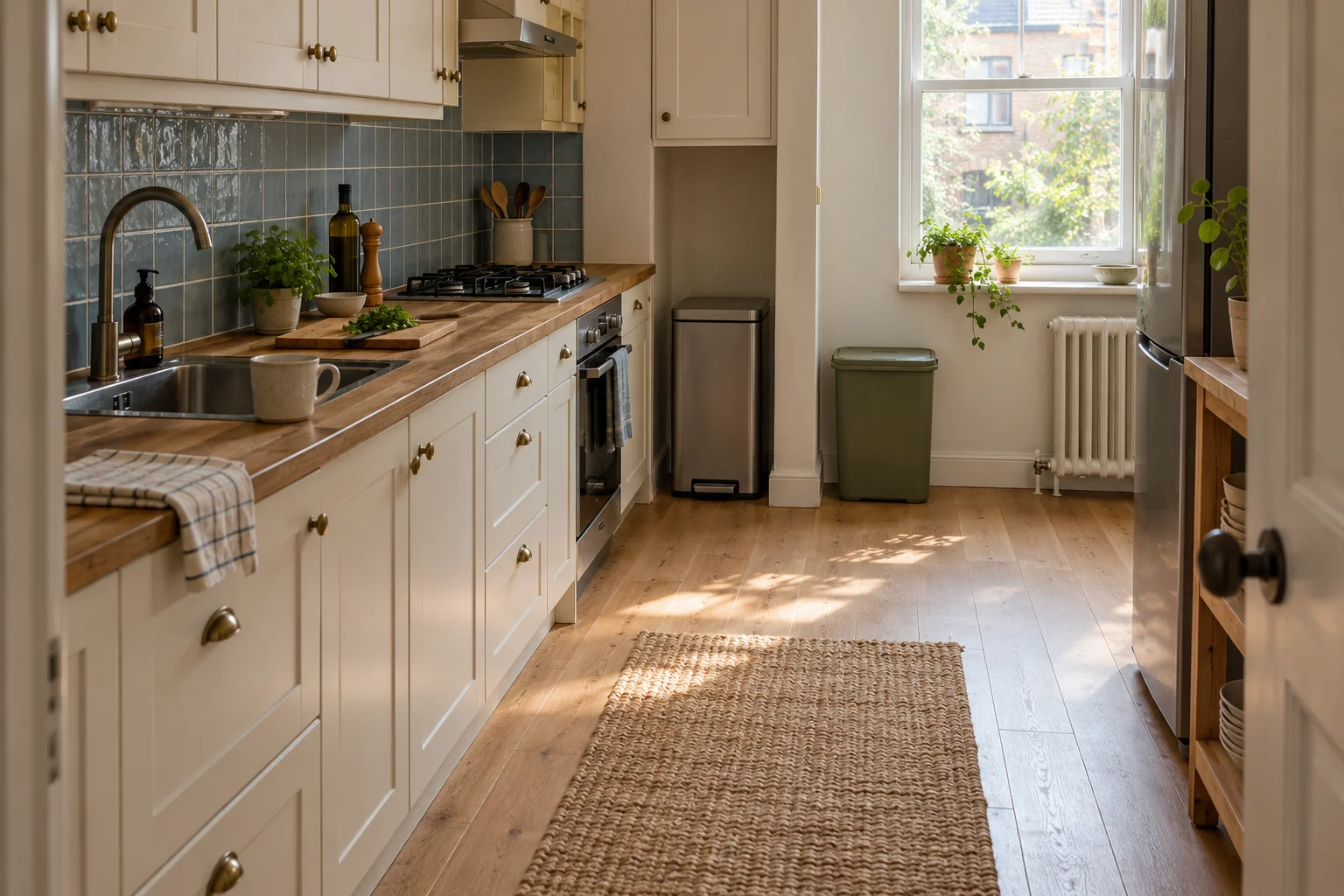
The pots already fill the lower cabinets. Cleaning supplies occupy the space beneath the sink. Your trash can has a workable home, but bottles and cartons wait beside it because a second bin would crowd the kitchen.
Work out how much trash and recycling you need to hold between trips outside, then compare separate containers, a divided bin and a vertical unit in the space available. Check them open as well as closed, so you know you can use and empty them after dinner.
01
Decide how much waste needs to stay in the kitchen
Watch how your containers fill between ordinary emptying trips. Bulky boxes may take up most of the recycling space while the trash can stays half empty. Note whether the kitchen needs to hold everything until collection day or whether you can transfer it to another container.
Choose the container size around those trips. A small container can work when you already pass the building’s recycling area each day. It is less useful when emptying it involves several flights of stairs or a special trip.
Check whether your collection service accepts recyclables together or requires separate containers. The EPA advises checking with your local recycling provider because accepted materials and preparation requirements vary.
02
Find space the kitchen can actually spare
Look for an area where a container can stay through a normal cooking session. The end of a cabinet run or a short wall beside the kitchen entrance may be useful, but check what already happens there.
Open the refrigerator and dishwasher, pull out the nearest drawer, and carry groceries through the room. A bin beside the refrigerator might fit against the wall yet prevent the door from opening far enough to use its drawers. Include space to stand in front of a pedal can or reach a top-opening container.
Be wary of putting recycling on the only clear counter. Protect usable prep space in a small kitchen, including the surfaces you need for groceries and draining dishes.
Measure the available width, depth and height, then record what limits each one. A note such as "The refrigerator door crosses this corner" explains a restriction that a depth measurement alone would miss.
03
Compare separate, divided and vertical arrangements
Separate containers
- Useful when
- Trash and recycling need different sizes, or have different workable locations
- Tradeoff to check
- Combined width if placed together; access to both if separated
One divided bin
- Useful when
- Both streams need one accessible location
- Tradeoff to check
- Capacity of each compartment, whether the divider adjusts, and how each liner comes out
Purpose-built vertical sorting unit
- Useful when
- Width is tight and there is usable height
- Tradeoff to check
- Lower-compartment opening space, upper-lid clearance and bucket removal
| Arrangement | Useful when | Tradeoff to check |
|---|---|---|
| Separate containers | Trash and recycling need different sizes, or have different workable locations | Combined width if placed together; access to both if separated |
| One divided bin | Both streams need one accessible location | Capacity of each compartment, whether the divider adjusts, and how each liner comes out |
| Purpose-built vertical sorting unit | Width is tight and there is usable height | Lower-compartment opening space, upper-lid clearance and bucket removal |
Separate containers don't need to match. Keep a working trash can and add recycling where it fits. If placing them together, measure their combined footprint, including projecting lids and handles. Two "slim" containers may still be too wide as a pair.
For a divided bin, check each compartment’s capacity rather than the total in the product name. An equal split may leave unused space on one side while the other overflows. Verify whether the split is fixed before counting on changing it.
For vertical sorting, look at whether the lower section slides, tilts or lifts out. Allow room for that movement and for emptying it.
Follow the instructions for a purpose-built vertical unit. Don't assume that stacking ordinary bins will give you a stable arrangement you can easily reach into.
The Joseph Joseph Totem Max 60L has two 30-liter main compartments, with recycling in the lower pull-out section. Joseph Joseph’s specifications give an open-lid height of 111 cm, approximately 44 inches. Check overhead space against that height and the lower drawer’s projection separately; its full opening clearance is not established here. Its equal capacity split also needs to suit your household.
The Step N’ Sort 70L tower has a lower compartment that tilts forward. The listing specifies a 40-liter upper compartment and a 30-liter lower one, with an optional separator that divides the upper space into 30 and 10 liters. Consider it when that allocation is useful, but check the tilted section and container-removal space; the listing does not establish the full clearance required.
04
Work through the same tight space three ways
Imagine a kitchen with an 18-inch-wide wall-end space beside the refrigerator. The space can accommodate a container 17 inches deep, but anything extending farther forward enters the refrigerator door’s path. There is no overhanging cabinet.
The household’s existing containers suggest it needs roughly 25 liters for trash and 10 liters for recycling between its usual trips outside.
These are hypothetical room conditions and container specifications, used to demonstrate the comparison. They are not product recommendations or tested clearances.

Two separate containers: enough capacity, too much width
Suppose the trash can is 13 inches wide and the recycling container is 9 inches wide. Each is shallow enough for the location, and each holds the amount the household needs.
Together, they occupy at least 22 inches of width before allowing for anything projecting from their sides. They cannot sit together in the 18-inch space.
If the existing trash can already fits elsewhere, the 9-inch recycling container could use the wall-end space alone. Check that option before searching for an even narrower pair.
A divided bin: fits the space, wrong capacity split
Now suppose a divided bin is 17 inches wide and 15 inches deep, with two 15-liter compartments. Its opening and liner-removal movements fit the available area.
Its 15-liter trash compartment falls short of the assumed 25-liter requirement. It could work if you empty trash more often. If that change is unrealistic, look for a larger trash compartment. For a household whose two streams each need less than 15 liters, the same bin might be suitable.
A vertical unit: fits closed, conflicts when open
Finally, suppose a vertical unit is 14 inches wide and 16 inches deep, with enough capacity in each compartment. Its upper lid opens freely, but pulling out the lower section brings its total depth to 24 inches.
The open drawer occupies the refrigerator door’s path. Check whether that conflict occurs whenever you add recycling or only during occasional emptying. A drawer left open while someone needs the refrigerator is a different inconvenience from a bucket briefly removed during cleanup.
If access requires repeatedly moving the entire unit, reject this location. A different mechanism might work, but the narrow closed footprint is not enough to decide.
05
Check that the choice works when it is full
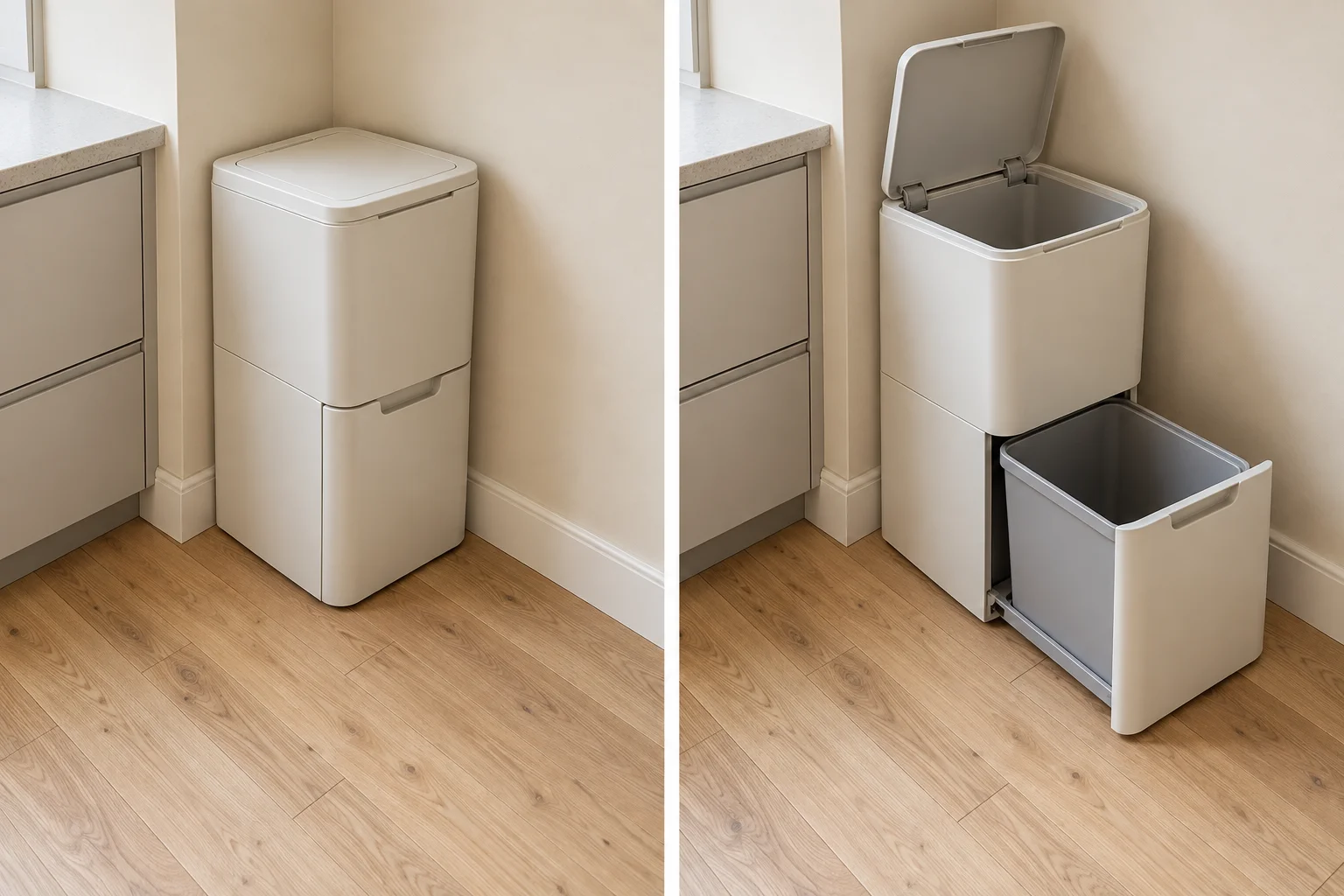
Before buying, mock up the closed footprint with boxes or an outline on the floor, then represent the open lid or extended lower compartment. Use the full footprint test worksheet to record these dimensions and conflicts with nearby doors and drawers.
For an existing container, try the emptying movement in the proposed location. For a possible purchase, consult the dimensions and instructions for that exact configuration. Do not assume a removable bucket can be lifted vertically if a lid or frame must first move aside.
Check that you can:
- Reach and open both containers or compartments while standing comfortably, without moving another container.
- Remove a liner or bucket, carry it away and return it without catching it beneath a shelf or shifting the arrangement.
- Reach the interior for cleaning.
Once it is in place, notice what gets left beside the bin. The cause may be an awkward opening or insufficient capacity.
If every arrangement fails, revisit how much needs to remain in the kitchen. A smaller recycling container emptied more often may help when there is a suitable destination. Without other accessible storage, you may need to free a location or accept more frequent emptying.