To organize open kitchen shelves, first decide which food and dishes belong there and what can realistically fit behind doors. Then arrange the contents into clear groups. You need to be able to cook from the shelves and put things back without losing the order as soon as the groceries come home.
In this guide
01
Count what needs a home before clearing the shelves
Include everything the kitchen has to store: daily plates and bowls, mugs, food packages and occasional pieces you actually use. Set aside genuine surplus, but keep the useful, awkward-looking things in the plan. The cereal box still needs a home when it doesn’t match the dishes.
Look inside the closed cabinets too. A cupboard full of pans has no spare space for groceries, however much hiding them would improve the view. Moving the pans onto the counter simply transfers the problem.
For each group you want to remove from the shelves, name its destination. “The cupboard beside the sink” is a possible answer; “somewhere out of sight” needs more work. Check the receiving space with its existing contents in place, including whether the packages fit through the opening and remain easy to take out.
In one open-shelf kitchen discussion, a renter described keeping food on open shelves and dishes in glass-front cabinets, with no pantry. They reported forgetting food stored in baskets. Their question was practical: where did ordinary groceries go in all those neatly styled kitchens?
Settle where those groceries will go before choosing a row of matching containers.
02
Decide whether food, dishes or both belong on the open shelves
Choose the arrangement that gives all the necessary contents a usable home. Putting dishes on display can make the shelves look more consistent, but only if the food has somewhere suitable to go.
Before moving dish stacks or a baking dish onto a shelf, check the load and mounting guidance for the existing shelf. If its capacity is unknown, have it assessed before adding that load. Physical space alone does not establish that a shelf can support the proposed contents.
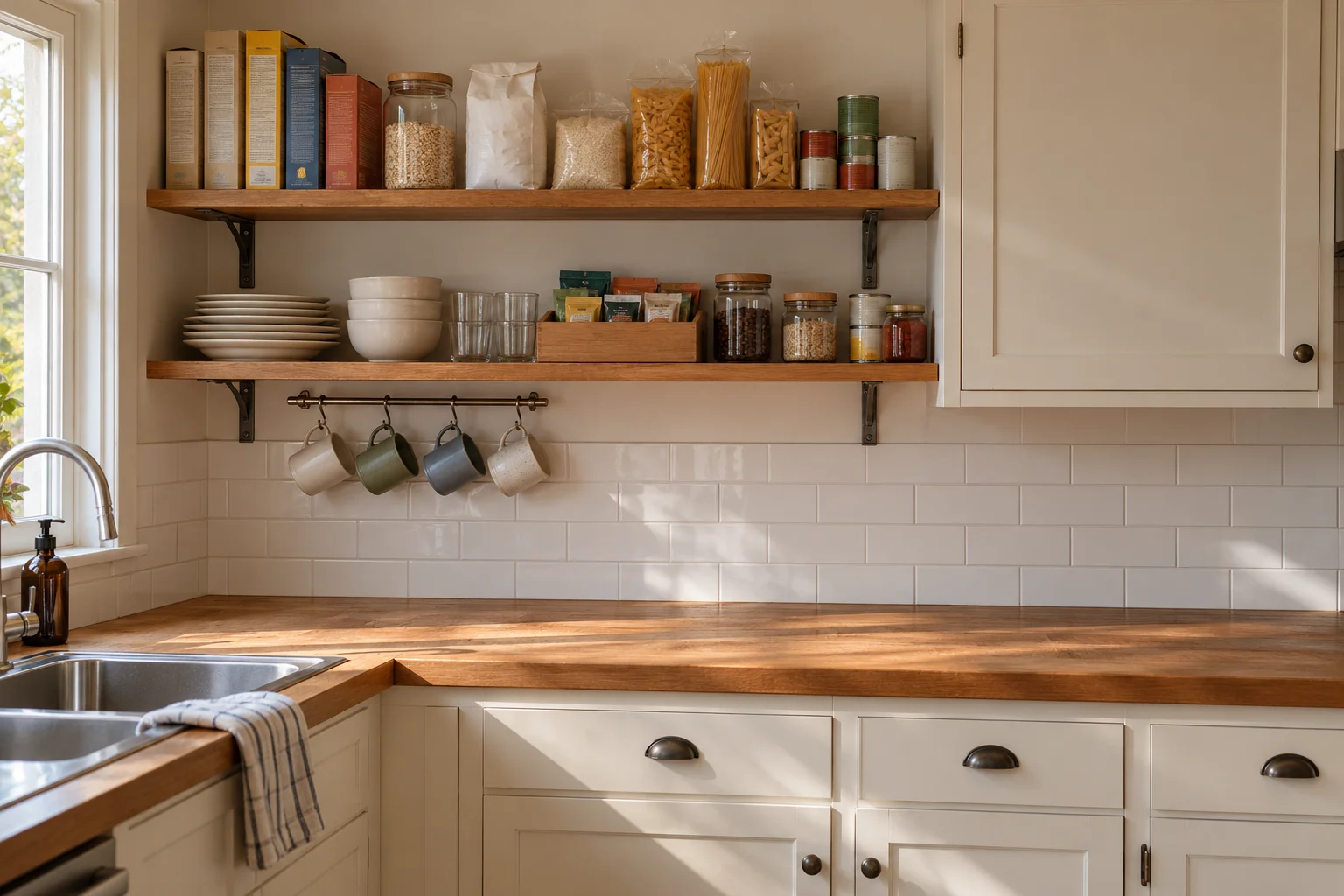
Consider an illustrative kitchen with two open shelves and a closed cupboard beside the sink. The shelves currently hold breakfast food, meal staples and baking supplies. The cupboard holds plates and bowls alongside a baking dish. Mugs have their own rail; pans occupy a separate lower cabinet. There is no pantry.
The same belongings appear in all three illustrations. Mugs stay on their rail, pans stay in the lower cabinet, and the worktop remains clear. These are planning examples, not a kitchen we have physically tested; actual fit and shelf capacity still need checking.
Dishes open, food behind doors
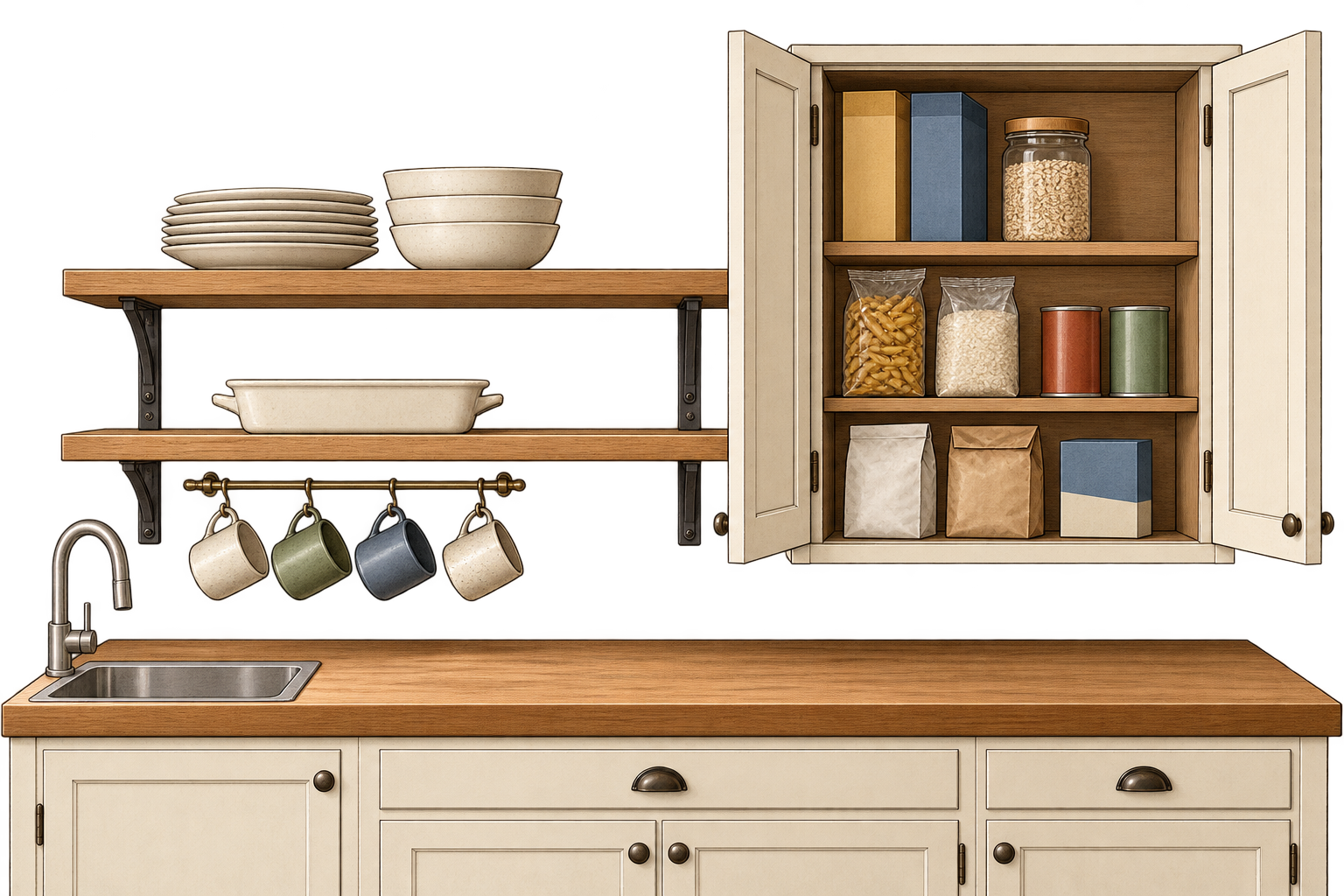
A complete swap would put the plates, bowls and baking dish on the open shelves and all three food groups in the cupboard. First check whether the cupboard accepts the groceries with enough room to retrieve them. If cereal boxes cannot stand there, this version needs changing. Moving the boxes onto the worktop leaves the swap unfinished.
Food stays on open shelves
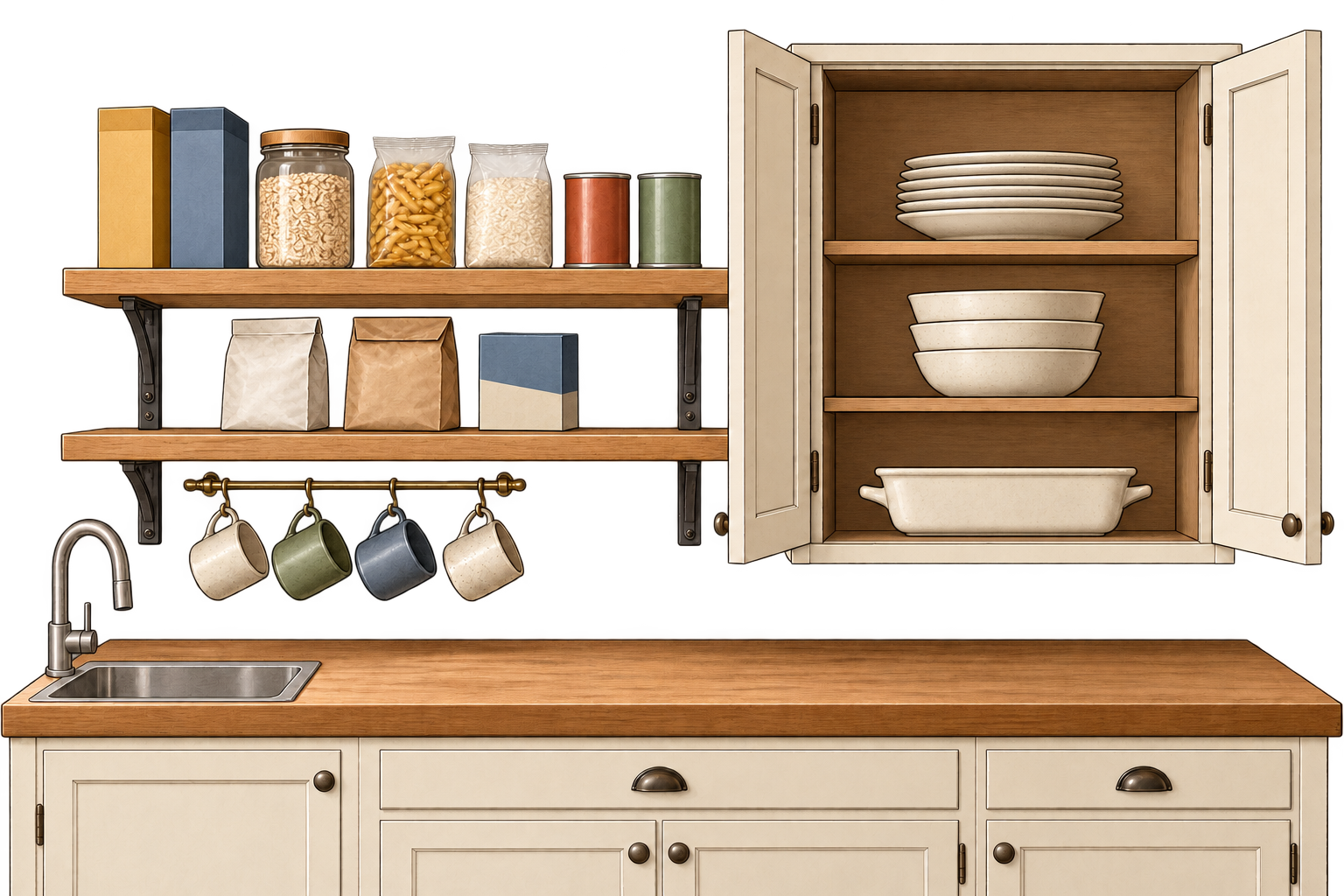
Keeping food open leaves the dishes and baking dish in their existing cupboard. Breakfast food gets one defined area, meal staples another, and baking supplies stay together. Nothing needs to be displaced. This may be the better arrangement if seeing the food matters more to the household than seeing matching dish stacks.
A selective swap
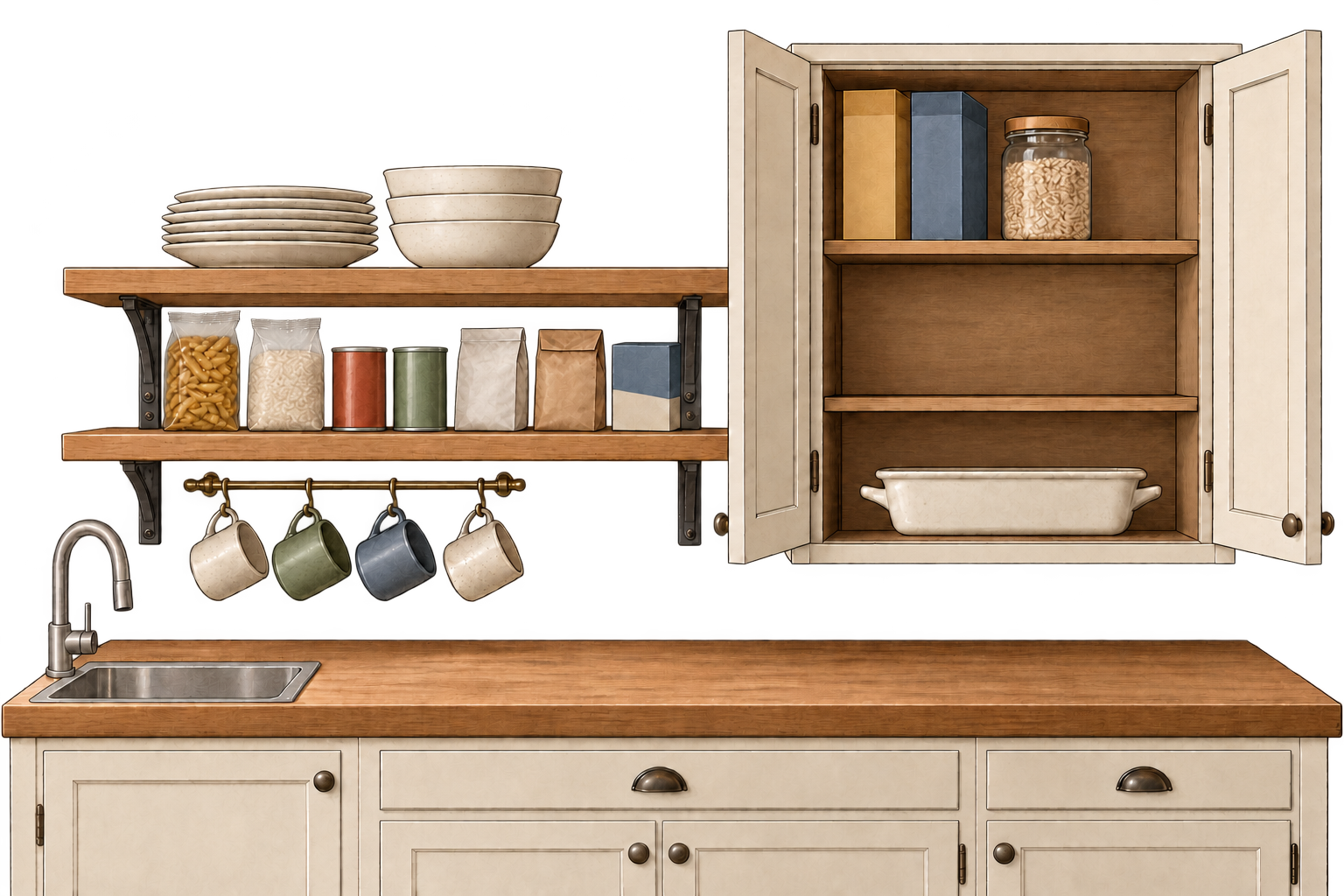
A partial swap could put the plates and bowls on the upper open shelf, with meal staples and baking supplies together below. Breakfast food takes the cupboard space vacated by the plates and bowls; the baking dish stays in the cupboard. Mugs and pans keep their existing places.
Check that both receiving spaces accommodate their new contents. A partial swap lets you change one part of the kitchen without finding cupboard space for every food package.
If none of the arrangements holds everything you need within comfortable reach, identify what still lacks space. It might be the usual backstock, a large appliance or the everyday groceries themselves. Resolve that shortage before trying to leave decorative gaps.
03
Give everyday items positions that are easy to use and refill
Give frequently used items positions where you can comfortably take them out and put them back. Follow the way your household makes breakfast, prepares meals and puts clean dishes away.
If bowls move out of a cupboard, check the new position while unloading the dishwasher or drying rack. An attractive stack that requires you to shift a food basket each time may be a poor exchange. Likewise, a cooking ingredient used daily needs a place you can return it to without rebuilding the shelf around it.
Try taking an item out and putting it back with its neighbors in place. A package may fit on a shelf yet be awkward to remove from behind a tall box. A basket may slide in neatly but need more room to pull out than the surrounding arrangement allows.
Keep the worktop available during these checks. If shelf contents repeatedly land beside the chopping board, revisit their storage position. Our guide to placing a coffee maker without losing prep space looks at the same competition for useful counter area.
04
Make the workable arrangement look calmer
Once everything has a usable home, bring scattered items together. Put breakfast boxes beside each other and keep meal staples in one section, with bowls in a recognizable stack. A full shelf can look clearer when you can see where each group belongs.
Use the belongings you already have to establish some repetition. A few similar dish stacks can give a mixed shelf a steady shape. Keeping small packets together prevents them from appearing in every gap between larger objects. You do not need to replace a serviceable collection of dishes to achieve this.
Try an existing bin or basket with the group you want it to hold. Check whether you can see what is there and reach the item you want without catching it on the rim. Keep the container if it makes that group easier to manage.
If covered baskets have previously hidden groceries from you, try a shallower open container or leave that food visible. Labels can identify a category, but you still need a way to notice what is left inside. Some packages may work best standing together in their original form.
You can organize the shelves without decanting every ingredient. Try grouping the packages and changing their positions first, using containers where they help. Transferring everything adds another job before you know whether the arrangement works.
Add decorative pieces only where space remains after the necessary contents fit. A small object that must be moved whenever you reach for breakfast is occupying working storage. You can leave it elsewhere and let the dishes provide the decoration.
05
Check the arrangement with groceries and clean dishes
Judge the shelves when they hold the household’s usual contents. A shelf arranged just before grocery shopping may look spacious and become impractical as soon as the next shop comes home.
Put away the food you normally buy, find the ingredients for a familiar meal, and return a batch of clean dishes. Notice where you hesitate, what you must move and which items are difficult to put back.
If a group fails this check, change its position or allocation before buying more containers. Breakfast food might need to return to the open shelf while a less frequently used category takes its cupboard space. A dish stack may need a different spot so it can be reached without disturbing the food beside it.