To make high kitchen cabinets easier to reach, first identify what blocks access. Start by finding a workable home for everyday items or lowering an adjustable shelf where that helps. Then consider an access aid for any difficulty that remains. Think about putting things away, too: a stack you can just manage to take down may be awkward to return.
Start with one group of belongings, such as the daily dishes, so you can improve its storage without reorganizing the whole kitchen.
In this guide
01
Work out what is blocking access
Think about where you run into difficulty during normal use. You don't need to attempt an awkward reach to prove that something is inaccessible. Look at the shelf's position and what stands between you and it separately.
The shelf holding the contents is too high
- Change worth considering
- Lower a permitted adjustable shelf, or move the contents
- What that change leaves unresolved
- The cabinet base sets a limit on how low an internal shelf can sit.
The counter separates you from the contents
- Change worth considering
- Relocate daily items; investigate a suitable pull-down fitting if needed
- What that change leaves unresolved
- A higher standing position does not remove the counter's depth.
A door or adjacent appliance restricts your approach
- Change worth considering
- Use another accessible cupboard bay; investigate permitted hardware changes separately
- What that change leaves unresolved
- A lower shelf does not remove the object blocking the approach.
| What makes the cupboard difficult | Change worth considering | What that change leaves unresolved |
|---|---|---|
| The shelf holding the contents is too high | Lower a permitted adjustable shelf, or move the contents | The cabinet base sets a limit on how low an internal shelf can sit. |
| The counter separates you from the contents | Relocate daily items; investigate a suitable pull-down fitting if needed | A higher standing position does not remove the counter's depth. |
| A door or adjacent appliance restricts your approach | Use another accessible cupboard bay; investigate permitted hardware changes separately | A lower shelf does not remove the object blocking the approach. |
Several conditions may apply to one cupboard. Lowering the plate shelf could help with height while leaving the plates beyond comfortable access across the sink.
Shelf height
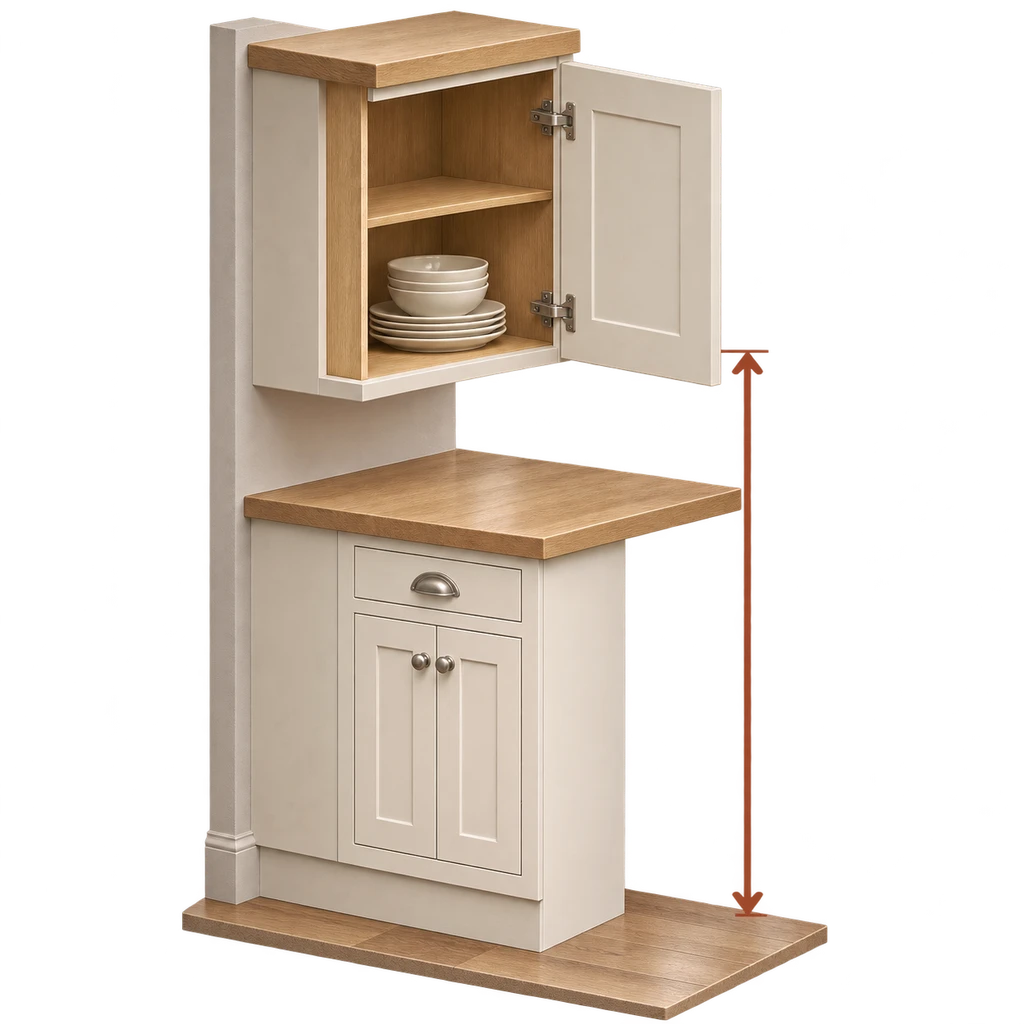
Check the shelf's height above the floor. Lowering an internal shelf cannot lower the cabinet itself.
Counter setback
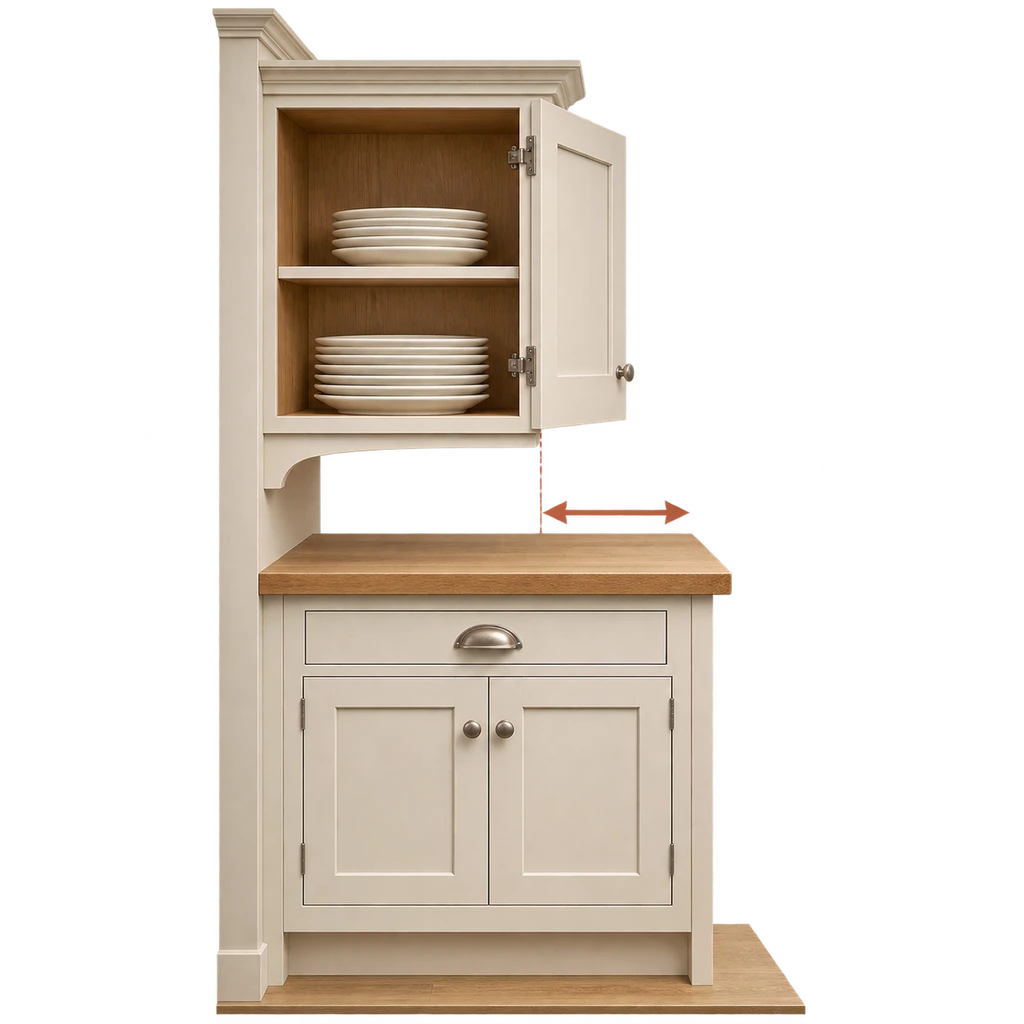
The projecting counter keeps you back from the cupboard. Lowering the shelf does not remove that gap.
Door clearance
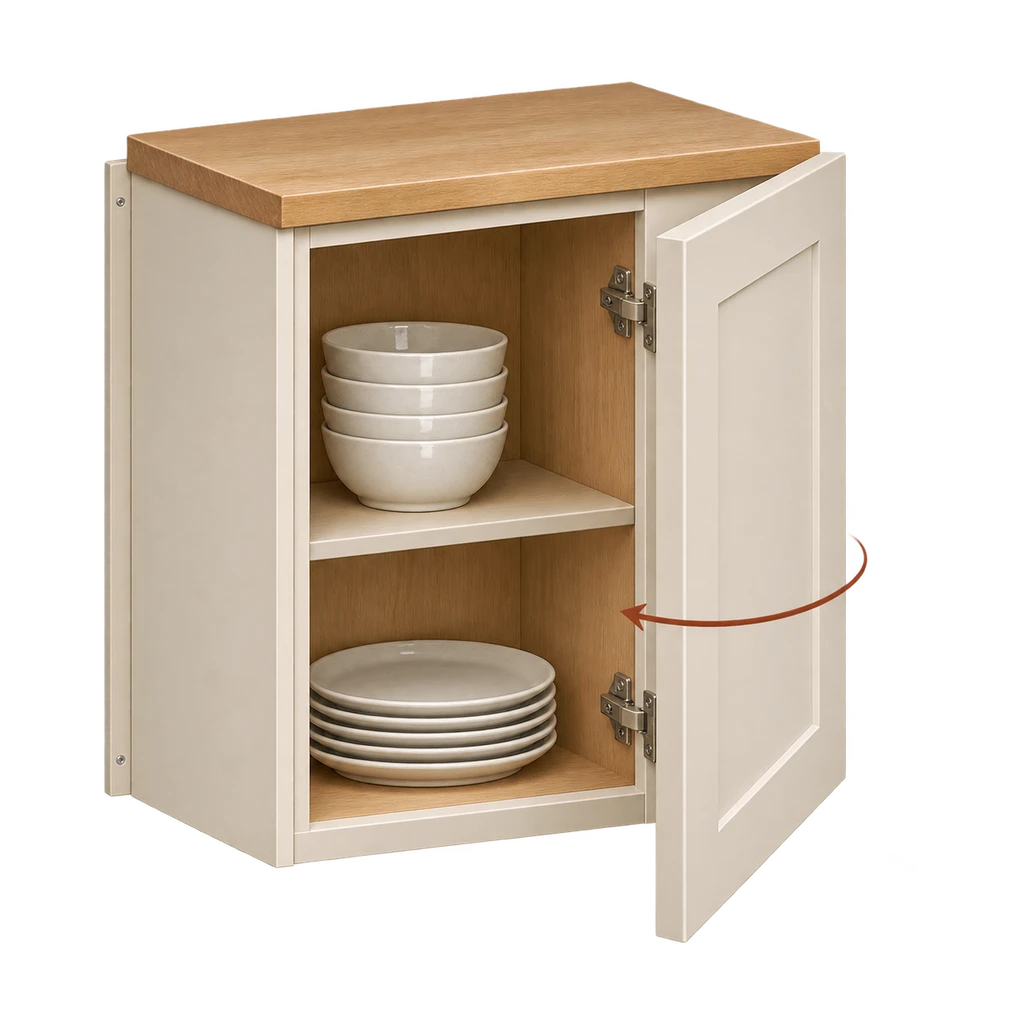
Check how far the door opens; lowering a shelf won't change its swing.
Consider what you need to take out. Reaching one mug at the front is a different task from lifting a stack of bowls out of the back. The arrangement needs to work for those belongings with their neighbours in place.
02
Give the daily dishes a workable home
Before buying an organizer, look for a better location for one frequently used group. Choose a real destination and account for what is already there.
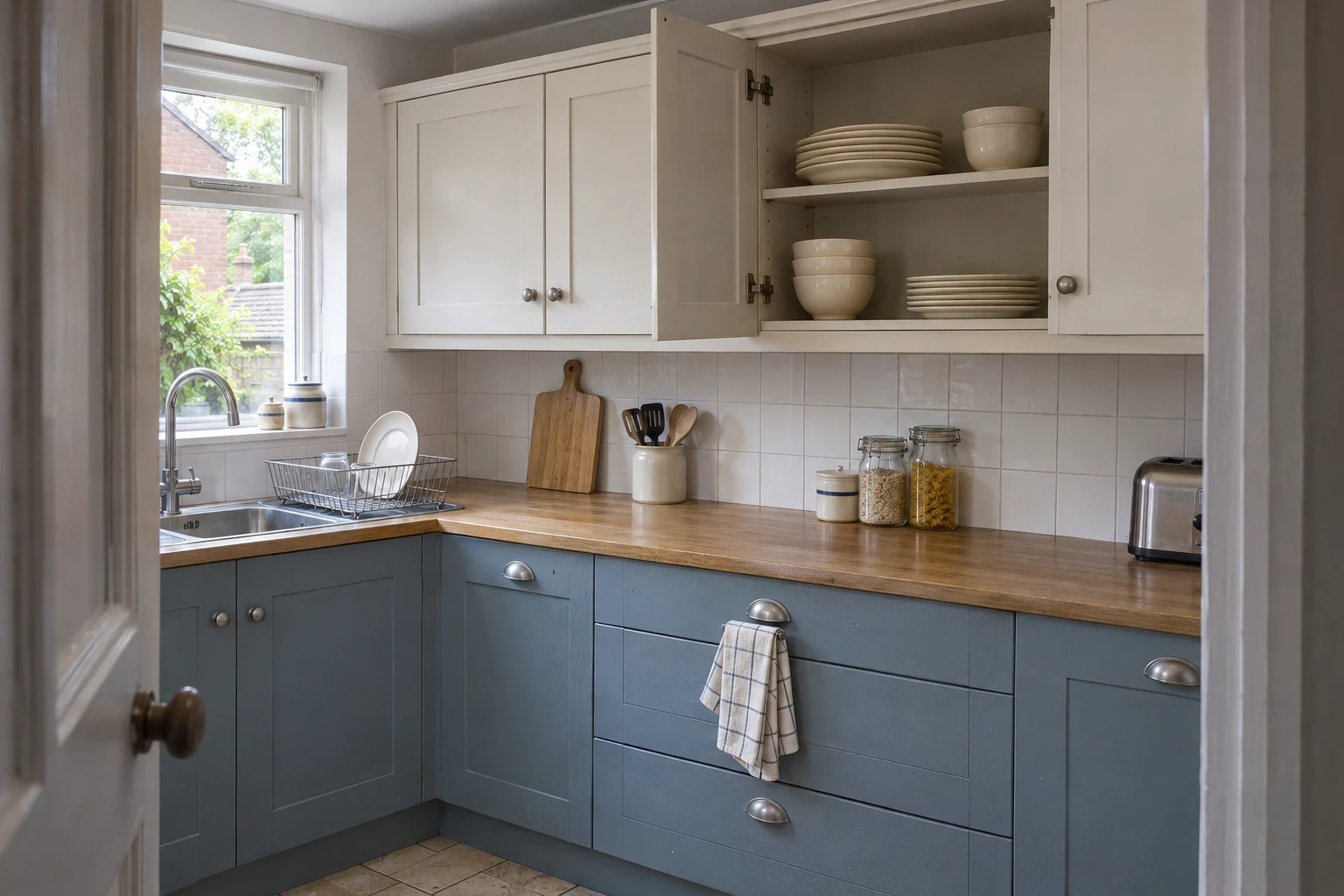
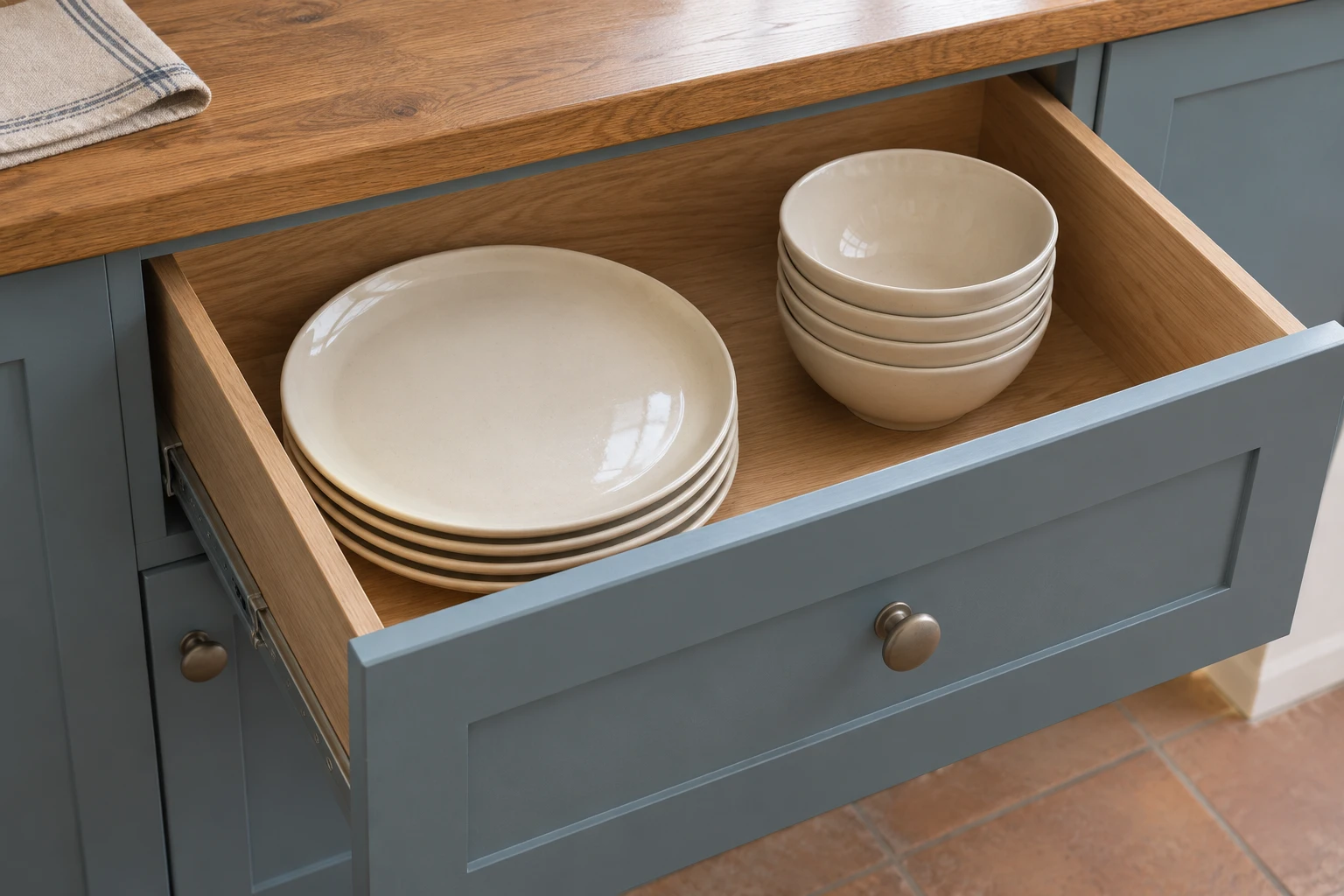
In this illustrative kitchen, an upper cupboard over a counter holds four everyday plates and four bowls. A lower drawer holds two serving platters used occasionally. The pans stay in their own cabinet. This is a planning example, not a tested makeover, and there is no empty cupboard waiting to receive the dishes.
A possible swap puts the daily dishes in the drawer and the serving platters in the upper cupboard. That proposal has two conditions:
- The drawer must accommodate the plates and bowls within its specified loading limits, with room to remove and return them.
- The upper cupboard must accommodate the platters, and there must be a suitable way to retrieve and replace them when needed. Occasional use does not make an inaccessible location acceptable.
If you cannot manage the platters in the upper cupboard, the swap fails. Leaving them on the prep counter would leave the storage problem unfinished. Look for another exchange, or keep the original arrangement while considering a different change.
Keep the worktop available for preparing food. If appliances already occupy the useful stretch, our guide to placing a coffee maker without losing prep space helps assess that separate layout decision.
Think through washing up and putting the dishes away in the new location. A drawer that only opens when the dishwasher is shut may be manageable, but account for that extra step. Check whether the change would leave another household member unable to reach something they use every day.
You might move only the breakfast bowls and leave less frequently used dishes where they are. A smaller change is worthwhile when it improves a repeated task without displacing another necessary group into a worse place.
03
Lower an adjustable shelf when height is the problem
An adjustable shelf can help when the dishes sit unnecessarily high inside a cupboard you can otherwise approach. It cannot lower the cupboard itself.
For the same four plates and four bowls, look for unused shelf positions below their current shelf. A lower position may help, provided everything underneath still fits and there is room to lift out the dishes above.
Check the cupboard's instructions before changing supports or loading. Some shelves are fixed; visible panels are not an invitation to remove or drill them. For an adjustable shelf, use the specified supports and loading guidance. If you cannot identify how it is intended to adjust, get advice from the cabinet supplier or a qualified installer.
Avoid adding a shelf riser to this particular problem without considering its effect. A riser gives you another storage level by raising some contents. That may separate stacks, but it does not lower those contents or remove the counter between you and the cupboard.
If the dishes remain inaccessible at the lowest available position, changing shelf spacing has reached its limit. They need another location or a different form of access.
04
Address the counter or door that gets in the way
A cupboard can be low enough in principle yet difficult to use from the position available beside it. Changing its contents' height may leave that problem untouched.
In the example kitchen, lowering the dish shelf does not move the counter between the person and the cupboard. Bringing dishes toward the shelf front may reduce how far inside the cupboard they sit, but it does not remove the counter underneath. Do not accept an arrangement that still depends on leaning across it.
If another cupboard bay offers a clearer approach, compare moving the same daily group there. Include any contents it displaces, just as you would for the lower-drawer swap. An apparently convenient cupboard is not available storage until its existing belongings have somewhere suitable to go.
If a microwave beside the cupboard forces an angled approach, a lower shelf may leave you reaching around the same obstruction. Look for another bay for daily items before assuming that a new organizer will help.
A door that restricts the opening may justify asking the cabinet supplier about compatible hardware. Keep that separate from moving appliances or removing doors: changing one part of the kitchen can introduce other clearance or installation requirements. A hardware change is useful only if it resolves the actual restriction.
05
Choose an access aid for the remaining problem
Before comparing access aids, decide what one would need to change in your kitchen. It needs to suit the cupboard and its contents, and you need to be able to operate it.
A stepladder changes standing height. It does not remove a counter or an appliance. It also needs a suitable place to be used and stored, which can be a significant constraint in a small kitchen.
Follow the equipment manufacturer's instructions. The UK Health and Safety Executive's workplace stepladder guidance warns against extending your body beyond a stable working position and sets out conditions for maintaining support while working. It is workplace guidance, rather than a household product recommendation, but it makes the limitation clear: a higher position is not permission to stretch farther. If handling the dishes would prevent you from following the equipment's instructions, change their storage location.
A pull-down fitting changes where its shelves move. Assess the exact model's requirements before treating it as an answer. You need to know the required cabinet opening and internal space, the mounting requirements, the permitted load, and the path it takes through the kitchen.
Include the handle's starting position and the space occupied when the fitting is lowered. A fitting that fits inside a closed cupboard may still conflict with a tap, an appliance or the place you need to stand. Consider returning the loaded shelves as carefully as bringing them down. Get the manufacturer or installer to confirm suitability where the specifications leave that unclear.
The Rev-A-Shelf 5PD-24CRN in Chrome is one example to investigate. Its two wire baskets and front handle show the arrangement to look for; the manufacturer's 5PD installation instructions show cabinet mounting using bottom or side brackets. It needs a compatible cabinet and installation, so it is worth considering when moving the daily dishes elsewhere has not resolved access.
Check the exact model number rather than relying on the listing's “24-inch” title. The listing and available documents give differing dimensions or movement figures, and Amazon links an older manual with a different model designation. Obtain current specifications for the unit being supplied before ordering, including its load limit and full movement path. Skip this fitting if the handle remains inaccessible or its lowered position conflicts with your counter, tap or standing space.
For the four plates and four bowls, the useful comparison is whether the complete arrangement makes their daily removal and return workable. Buying a mechanism is unnecessary if a sound storage swap already achieves that. Equally, a swap that merely moves the difficulty elsewhere is no improvement.