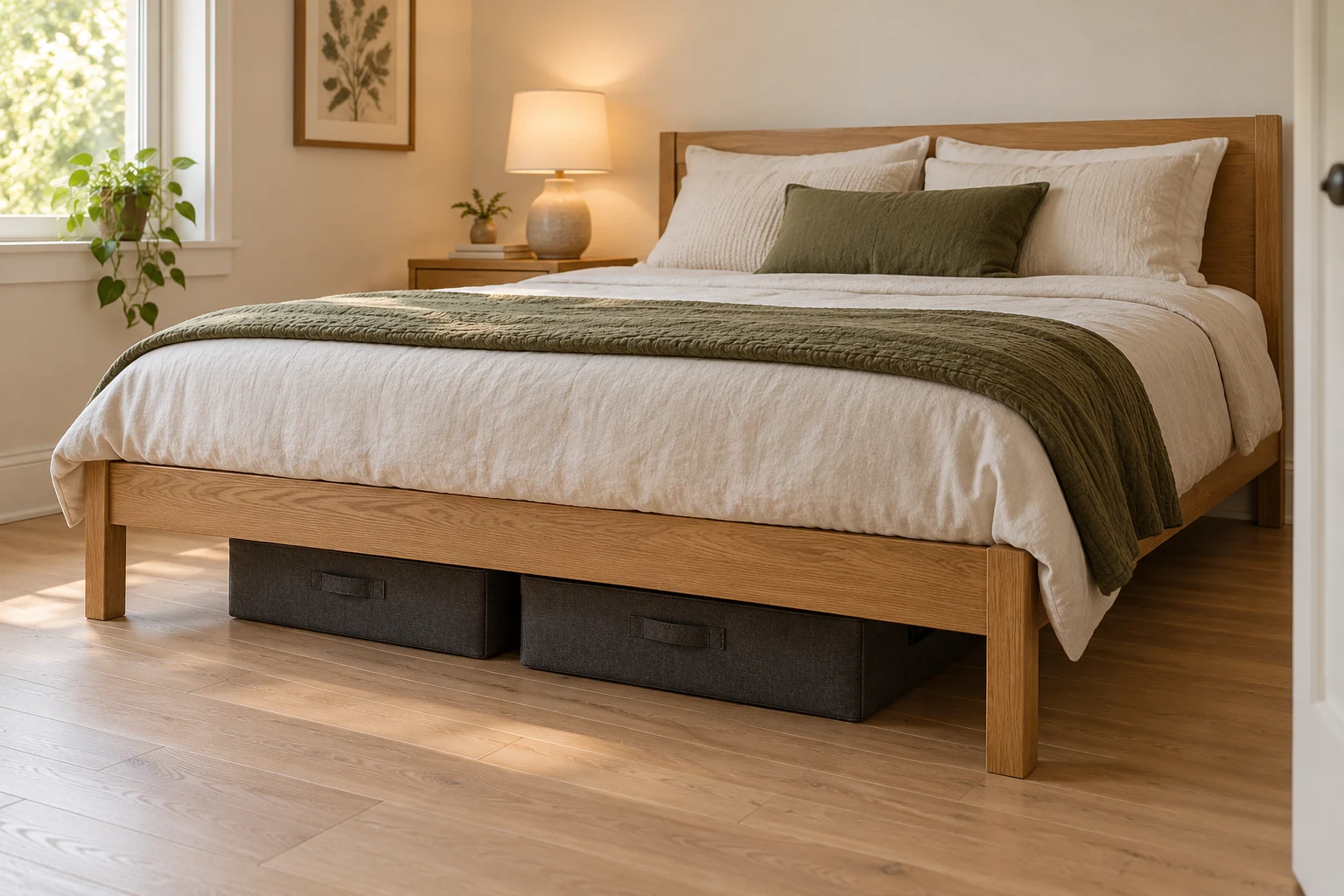
Try moving your existing containers farther back first. If they're still visible or become difficult to reach, consider a skirt that fits your frame or containers you're happy to leave on show. Keep the frame details you enjoy, but make sure the belongings still fit and you can get them out.
In this guide
01
Decide which parts of the bed you want to keep visible
A skirt that hides the boxes may also hide the legs and side rails. Decide whether that would bother you before looking at fabrics or storage baskets.
On a simple metal frame, covering the whole base might be welcome. On a wooden frame with a broad rail and angled legs, those details may be what you like most. An upholstered surround might already give the bed a finished edge, leaving only a narrow opening below it.
Look at three separate parts of your bed:
- The visible surround: the wood, metal or upholstery you might want to leave exposed.
- The skirt's support position: where a particular skirt is designed to rest or fit around the bed.
- The container opening: the gap through which a filled box, including its lid and handles, must pass.
Check these separately. A box can fit beneath the rail even when an elastic skirt won't stay in place around the frame. And a skirt that reaches the floor may cover the wood you wanted to show.
A fitted cover made only to enclose a box spring won't conceal storage below the frame. Check what the fabric actually covers rather than treating a box-spring cover as a bed skirt.
02
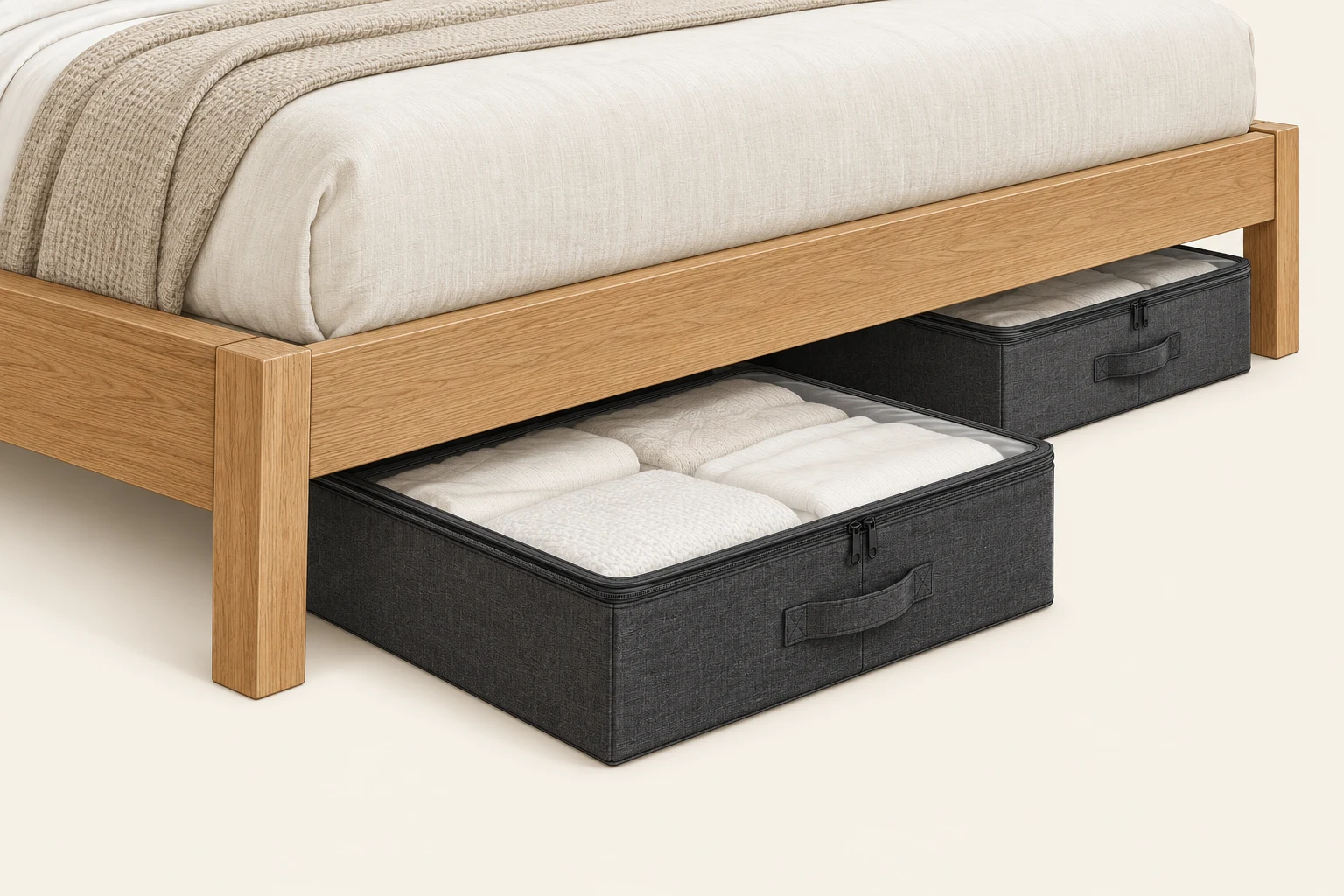
Try recessing your current containers first
Moving containers away from the outer edge may be enough to take them out of your usual view. Try this before replacing anything.
Push one filled container farther beneath the bed, keeping it within reach. Look from the doorway, then from beside the bed and from any chair where you regularly sit. A box hidden from a standing position may still be obvious from a lower seat. Concentrate on the views you actually use rather than trying to make the underside invisible from the floor.
Now pull the container out. Can you reach its handle without moving another box? Does it clear the bed's legs? Is there room to remove it beside the bed, or does nearby furniture stop it halfway? If the bedside area is already crowded, consider the obstruction alongside your nightstand arrangement.
Put everything back under the bed before judging the result. Containers on opposite sides may meet near the middle before they're far enough back to disappear. A suitcase might fit only when a smaller box stays near the edge. If recessing leaves one container outside, its contents still need a home.
For belongings you use often, a visible handle within easy reach can be a better compromise than a perfectly clear view beneath the rail.
03
Use a bed skirt only when it suits the actual frame
The absence of a box spring doesn't automatically rule out a skirt. It does mean you need to check how that particular skirt is meant to fit.
Some skirts have a flat fabric deck beneath the mattress; others wrap around a compatible base. Neither description guarantees a good fit on every platform frame. A projecting surround, footboard or leg can change where the fabric falls.
For example, Bemz's bed-skirt guide describes a lining that rests on the bed base or frame beneath the mattress, but excludes footboards and protruding exterior frames from its own skirts. Those are restrictions for its products, rather than a rule for every brand. Check the instructions for both your bed and the skirt you are considering.
Find where the skirt is meant to sit before measuring down to its hem. For a skirt supported beneath the mattress, don't include the mattress thickness or use the open gap below the side rail as the full drop. Follow the skirt maker's measuring method for the compatible arrangement.
Look at where the fabric would fall. It might hang outside the rail and cover it, or the frame might push it outward. If you want fabric inside a wooden surround, check that the bed and skirt instructions allow that arrangement. A gap beside the mattress isn't enough to establish a suitable place to tuck or fasten fabric.
Bemz also notes that its fitted straight style is less convenient for frequent under-bed access than some of its other styles. Picture yourself lifting or parting the fabric to pull a container out, then putting it back. Would you have to straighten the skirt each time?
Avoid making an unsuitable skirt fit by altering supports or adding unverified fixings. If the compatible option covers more of the bed than you want, return to the storage arrangement rather than forcing the fabric around the frame.
04
Compare the options with the same bed and belongings
Consider an illustrative small bedroom with a wooden platform frame, visible legs and four filled containers. Two hold spare bedding and two hold seasonal clothes. All four must remain under this bed. This is a planning example, not a tested installation.
Suppose you push all four containers back. The two nearest the doorway move out of view, but the opposite pair stop them going any farther. One corner still shows from the chair beside the window. The doorway view looks better, though you can still see some storage from the chair.
For comparison, suppose a skirt is approved for use with this illustrative frame and hangs outside the wooden rail. It may hide all four containers while also covering the rail and legs. That arrangement meets the storage need, but changes the bed's appearance. An inside-hanging alternative belongs in the comparison only if its support and fit are confirmed; it isn't an automatic way to preserve the wood.
Another option is to leave the frame exposed and change only the distracting container. Perhaps one visible clear box could be exchanged for an opaque container of suitable dimensions, while the other three stay. The replacement must hold the same belongings and pass through the same opening. If you need a fifth box elsewhere for the overflow, you haven't kept all the storage under this bed.
Recess the containers
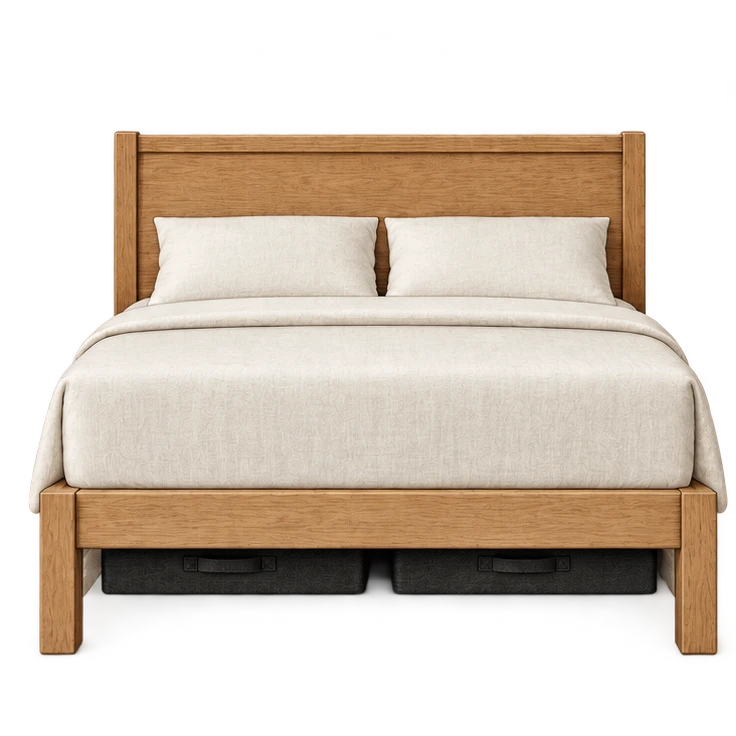
Cover the bed base
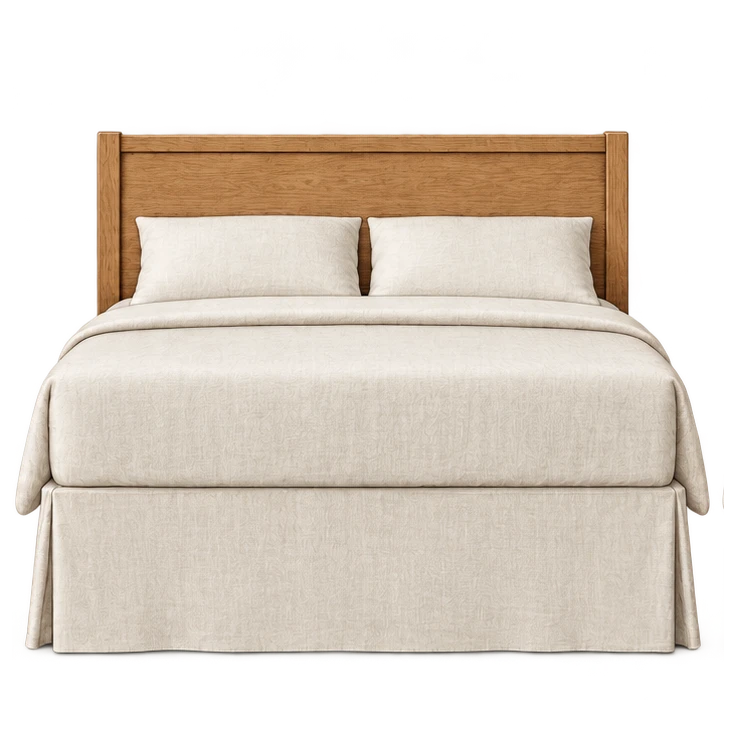
Keep storage visible
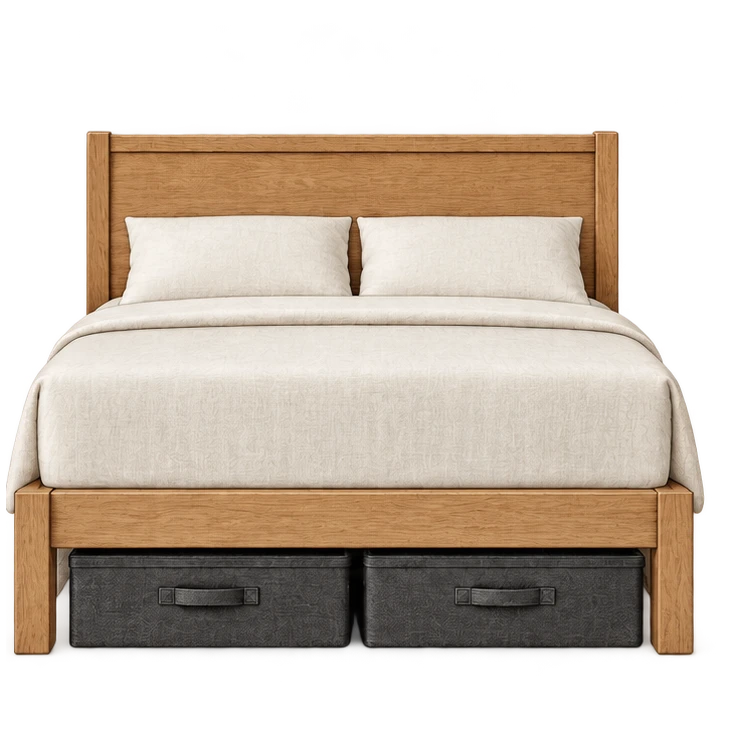
Recess the current containers
- What remains visible
- Frame details; possibly a box corner or handle
- What to check before choosing
- All belongings still fit, and each container remains reachable
Use a compatible external skirt
- What remains visible
- Fabric across the base of the bed
- What to check before choosing
- Whether losing the exposed rail and legs is acceptable, and containers remain accessible
Coordinate exposed containers
- What remains visible
- Frame and storage containers
- What to check before choosing
- The visible finish suits the room without reducing useful capacity
| Approach | What remains visible | What to check before choosing |
|---|---|---|
| Recess the current containers | Frame details; possibly a box corner or handle | All belongings still fit, and each container remains reachable |
| Use a compatible external skirt | Fabric across the base of the bed | Whether losing the exposed rail and legs is acceptable, and containers remain accessible |
| Coordinate exposed containers | Frame and storage containers | The visible finish suits the room without reducing useful capacity |
On a bed with a projecting upholstered surround, the same skirt might catch on the frame or drape over it. Check its fit separately, even if you want the same finished look. The frame's construction can change which arrangement works.
05
When full concealment costs too much, make visible storage quieter
If hiding everything means losing useful storage or covering the bed's best feature, you can choose to leave the containers visible.
Start with the most exposed side. Keep containers that disappear into shadow, and look at what draws attention to the rest: transparent sides showing assorted contents, a bright lid, a loose bag protruding past the rail or several handles facing different directions. Tidying those details may be enough without buying a matching set.
An opaque container hides its contents, even though the container itself remains on show. Before replacing a clear box, check whether a suitable opaque container already elsewhere in the home could be swapped without creating another storage problem. Retain any useful lid and opening mechanism; appearance alone isn't a reason to make daily access harder.
If you do need replacements, compare their filled capacity and retrieval with what you have. A woven basket may look appealing yet hold less than the rectangular box it replaces. A rolling drawer may fit beneath the bed but need more space beside it to come all the way out.
The TidyCorner gray two-pack is a shallow option without wheels. The selected 4.5-inch version is listed at 33.6 by 17 by 4.5 inches, with fabric sides, handles and a clear zippered top. Its sides screen the contents, but you can still see them through the top. Compare that whole footprint with your current boxes, and leave room to slide it out and open the lid.
If you prefer wheels, the KitHero white two-pack has fabric sides and a clear lid rather than a wooden drawer front. Its listing calls the selected version 6 inches tall, but the specifications give 6.3 inches. Don't plan around a 6-inch opening; confirm the assembled height, including wheels, if clearance is close. This example changes how the container moves, not whether it disappears beneath your frame. Skip it if the clear top remains visible or you cannot pull it far enough out to open.
Oversized bedding is another possible cover, but it can conceal the frame as well as the boxes, and the view changes whenever the bedding shifts. Judge it against the same priorities rather than expecting it to preserve the bed's exposed outline.
If you prefer to keep a sheet or thin blanket, our guide to making a bed look finished without a duvet or comforter covers arranging the bedding you already use before buying a larger cover.