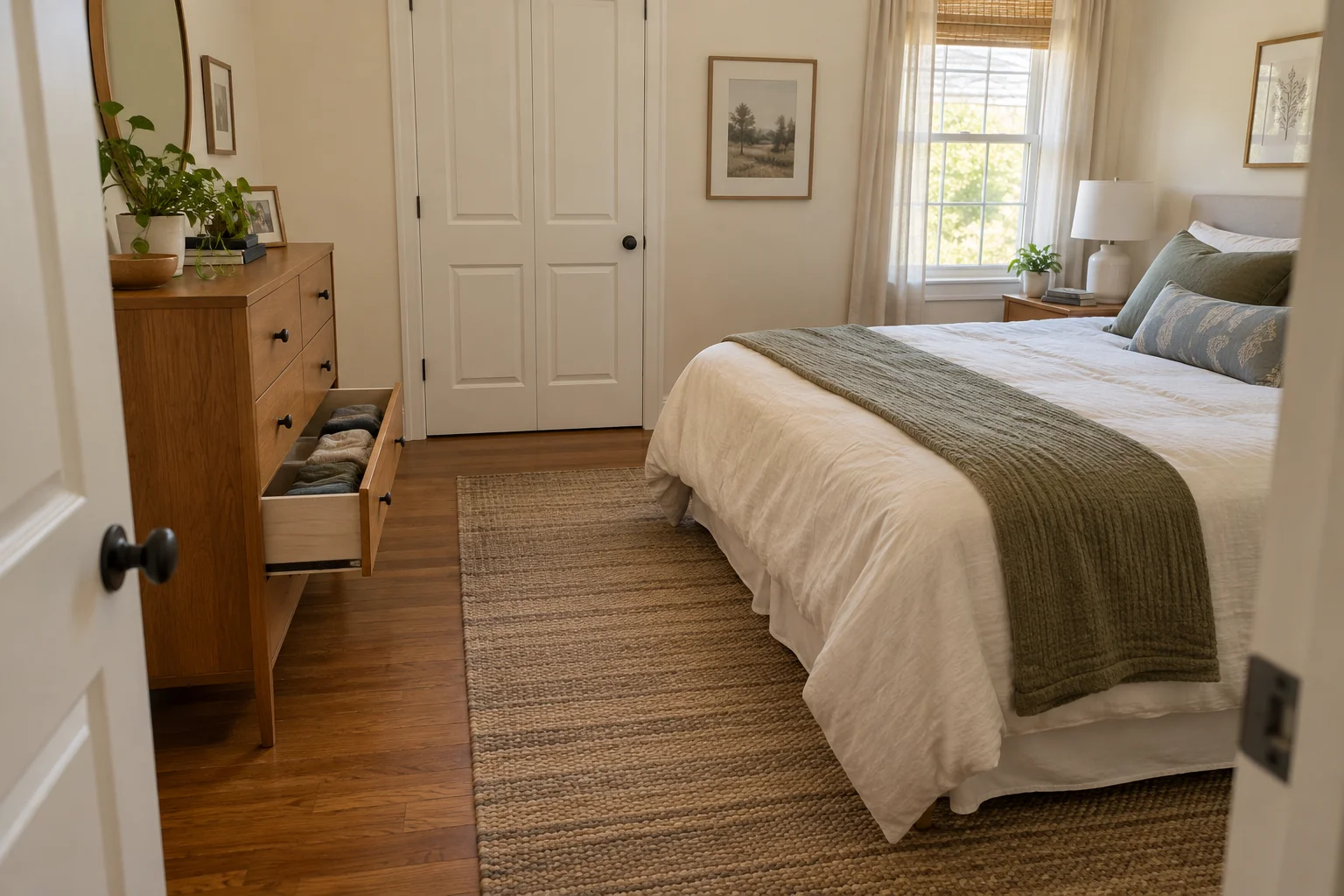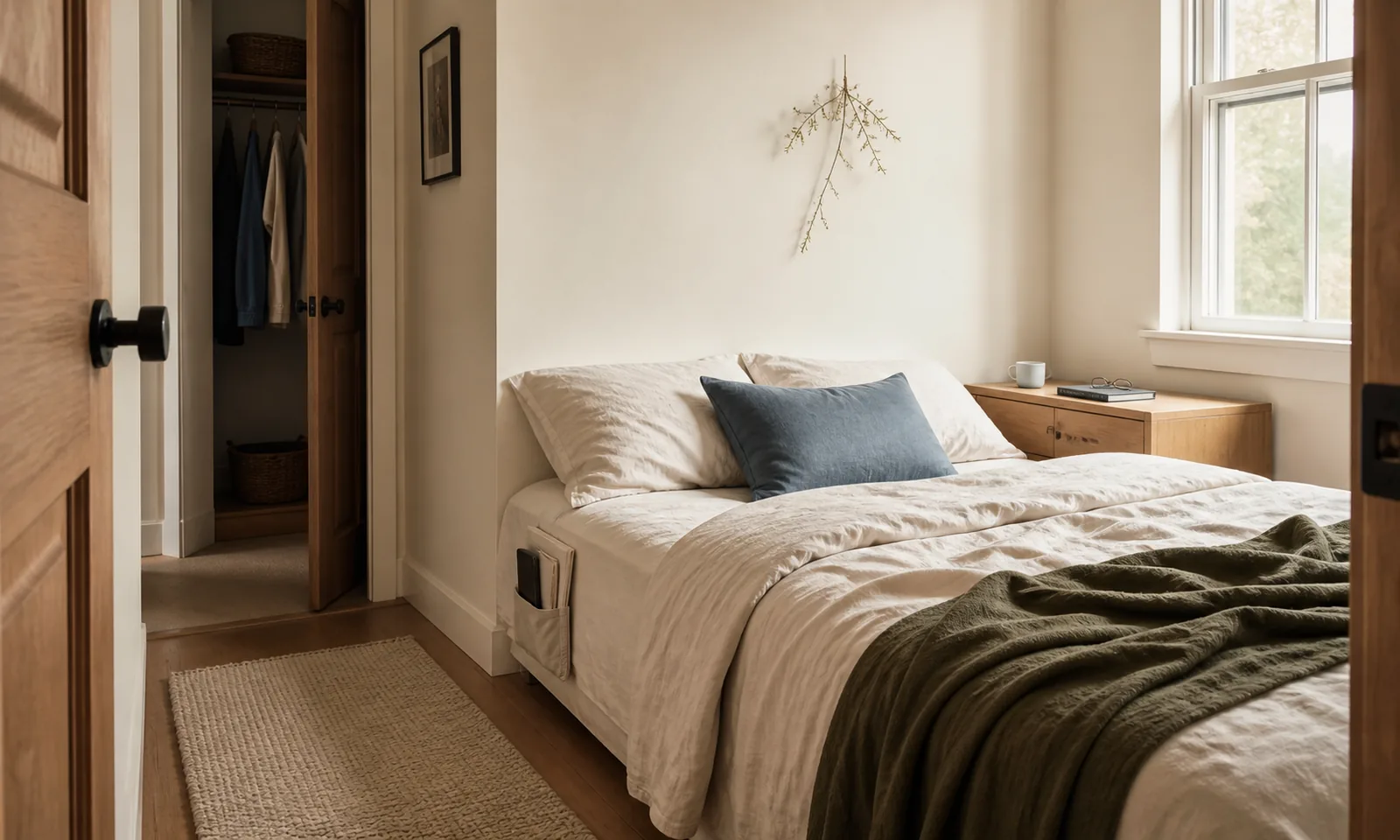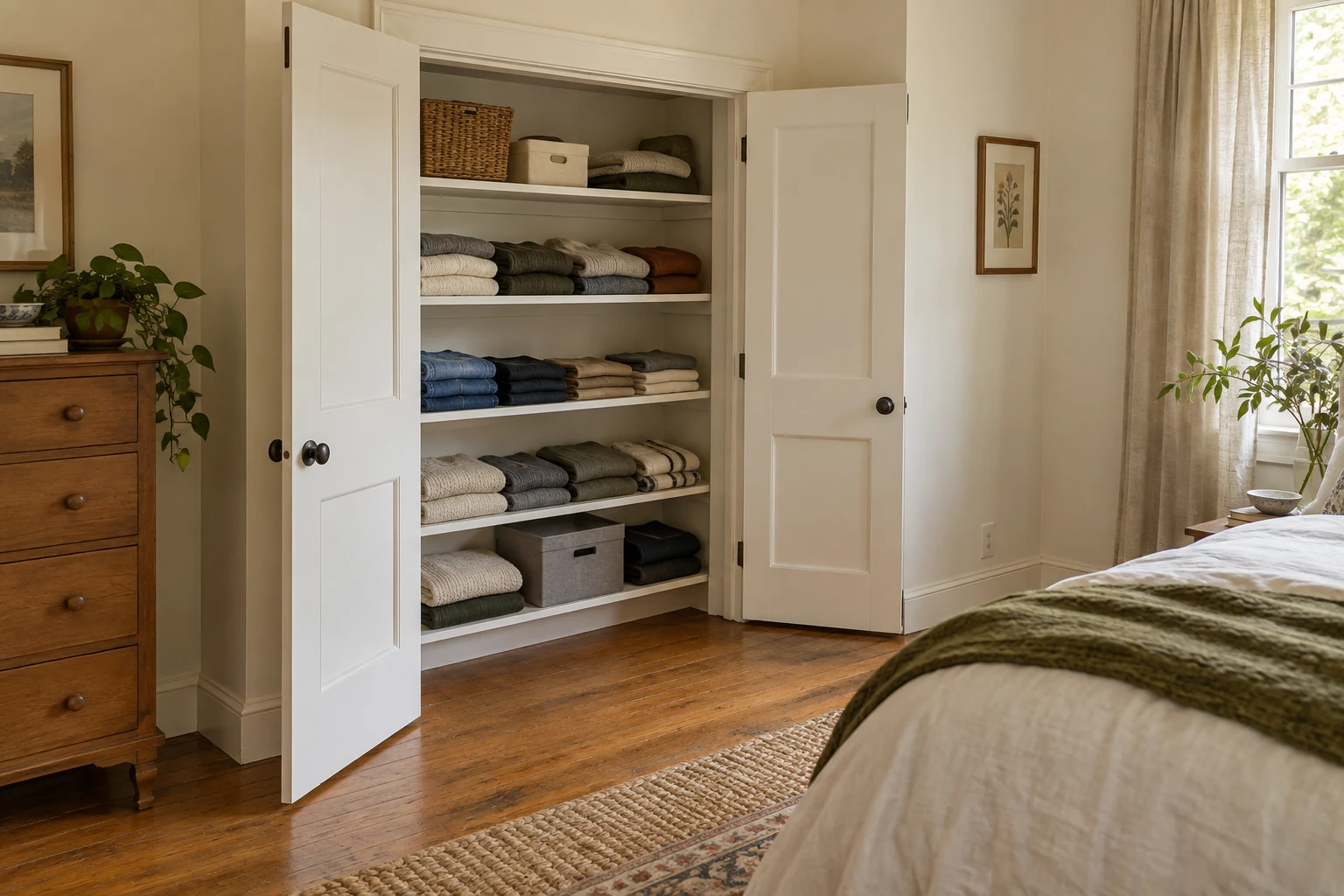
The closet rod has space left, but your shirts still brush the door. A jacket catches when you slide it closed. Even taking out half the clothes doesn't help much: there isn't enough depth between the back wall and the door.
For a shallow bedroom closet, start with a garment on its usual hanger. Check whether it fits with the door closed, then whether you can take it out comfortably. If ordinary hanging fails, compare front-facing hanging with folded storage. A split arrangement can also work: use the shallow closet for what fits there and give only the clothes that need hanging another home.
01
Find what stops the clothes from fitting
Test a shirt and your bulkiest regularly worn jacket separately. Hang each as you normally would and gently close the door. Watch where the fabric catches: at the front, against the back wall, or on a hinge or sliding-door overlap. Don't force the door against the garment.
Measure the usable depth where the fabric catches, allowing for anything that projects into the closet. Measuring the closet from the outside won't tell you whether a sleeve clears the closed door.
A thinner hanger may reduce crowding along the rod, but a slim profile doesn't necessarily mean a narrower shoulder span. Check the actual garment-and-hanger combination before replacing a whole set. An empty hanger fitting is only the first part of the test.
Also measure the clear opening with the doors in their normal open position. A wide closet behind a narrow central doorway can have side spaces you can reach into but can't easily see. Those spaces need a different storage plan from the area directly in front of you.
If one loaded hanger fits but a row does not, investigate crowding first. If even one garment presses against the closed door, adding more rod space won't resolve that depth problem.
02
Decide which clothes need hanging space
Sort the clothes according to how you wear and store them. Set aside the pieces that need hanging to stay ready to wear, then look at what you already keep folded in a drawer. Jeans, T-shirts and sleepwear may be easy to fold; a jacket you wear to work may need the hanging space more.
Keep fabric care in the decision. For wool, Woolmark advises hanging woven garments on shaped or padded hangers and gently folding knitted garments. Don't apply one folding rule to every fabric or construction; use any garment-specific care guidance you have.
Check your existing dresser before adding shelves. If the folded clothes fit comfortably there, you can reserve the closet for a smaller group on hangers. Moving more clothes into an overflowing dresser only shifts the problem.
Decide where any clothes you move will hang. Putting a few jackets in an existing deeper closet asks less of the bedroom than adding a new wardrobe beside the bed. If the change affects the dresser's position, check that its drawers and standing space still work.
03
Compare hanging and folded storage in the same closet
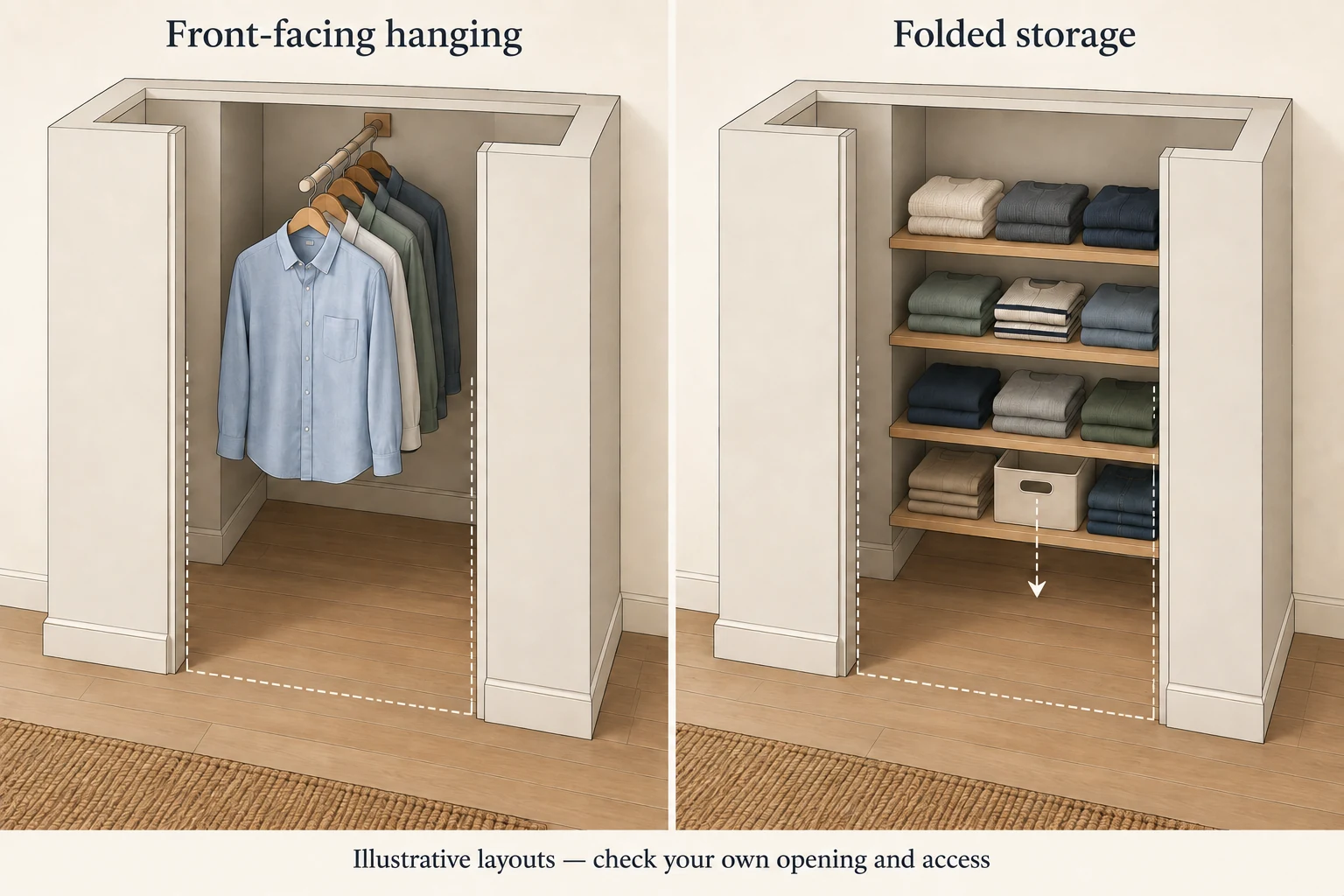
Imagine a shallow built-in closet with a central doorway, enclosed spaces to either side, and a bed nearby. A loaded adult hanger doesn't fit across its depth with the doors closed. This is an illustrative room, not a measured installation. Keep that same enclosure and bedroom layout in mind for each option.
Front-facing hanging
A front-to-back rail turns the clothes so their fronts face the doorway. The hanger's shoulder span now runs across the closet's width, while the row of garments occupies its depth. Purpose-made rails use this arrangement in shallow wardrobes, but compatibility matters: IKEA's shallow-frame rail, for example, is specified for a particular PAX frame. It isn't a general fitting for any built-in closet.
In the example closet, try this directly behind the central opening. Check that the garment on its hanger clears both sides and stays behind the closed door.
A fixed rail leaves the rear clothes behind the front ones. Try retrieving the back shirt without taking the whole row out. A rail that extends toward you could change that access, but only if its specified travel, mounting requirements and loaded clearance suit the closet and bedroom.
One example to examine is the MAFAGE top-mounted pull-out clothes rail in the 292 mm/11.5-inch size. It attaches beneath the top of a cabinet and brings the hanging row forward. Its supplied manual lists an 11.5-inch item length and a wardrobe interior depth of 11.8–13.7 inches for that version. However, the listing's separate dimensions table says 14 inches long by 4 inches wide. Confirm the selected version's closed and fully extended dimensions before ordering; don't treat either figure as a guaranteed fit. Skip this type of fitting if there is no suitable overhead support, installation permission, or room to use it with the clothes extended.
The clothes may fit inside and still be hard to take out because the doorway or front garments get in the way. Another rail tucked into a side space won't help if you can't reach the clothes on it.
Shallow shelves for folded clothes
Folded clothes can use the same enclosure without needing a full hanger span across its depth. Choosing shelves means changing what the closet holds.
Start with the folds you normally use. Check their depth and height before choosing shelf spacing. Keep daily clothes where you can see and reach them, and avoid putting a second stack behind the first if getting dressed means dismantling both.
A shelf can extend behind the wall beside the doorway, but you still need to get a container out of that side space. Check it when filled: can you grip it and turn it through the opening? Being able to reach the handle isn't enough.
Shelves are unsuitable if they leave your hanging clothes without a workable home, or if most of the folded storage becomes awkward to retrieve.
A split arrangement
Use an accessible front-facing rail for a small hanging group, with folded storage in the remaining usable space. Move only the garments that still don't fit or can't be reached to the destination you checked earlier.
In the example closet, the opening may limit how much hanging and shelving can sit side by side. Don't squeeze a shelf beside the rail if it blocks your hand or catches the garment as you lift it out. An all-shelf closet with hanging elsewhere may work better than a cramped combination.
Front-facing hanging
- What it could solve
- Garments cannot fit across the closet's depth
- What would rule it out
- Rear clothes are inaccessible or an extending rail conflicts with the room
Folded storage
- What it could solve
- Much of the clothing can be stored without hangers
- What would rule it out
- Shelves or containers are hard to reach, or essential hanging has no destination
Split storage
- What it could solve
- Only part of the wardrobe needs hanging
- What would rule it out
- The two storage types obstruct each other or the overflow crowds the bedroom
| Arrangement | What it could solve | What would rule it out |
|---|---|---|
| Front-facing hanging | Garments cannot fit across the closet's depth | Rear clothes are inaccessible or an extending rail conflicts with the room |
| Folded storage | Much of the clothing can be stored without hangers | Shelves or containers are hard to reach, or essential hanging has no destination |
| Split storage | Only part of the wardrobe needs hanging | The two storage types obstruct each other or the overflow crowds the bedroom |
04
Check the opening and the room outside it
Try taking out the least accessible item. On a rail, that's the rear garment; on shelves, it may be a filled container tucked to one side. Follow the whole movement from its stored position to your hands outside the closet.
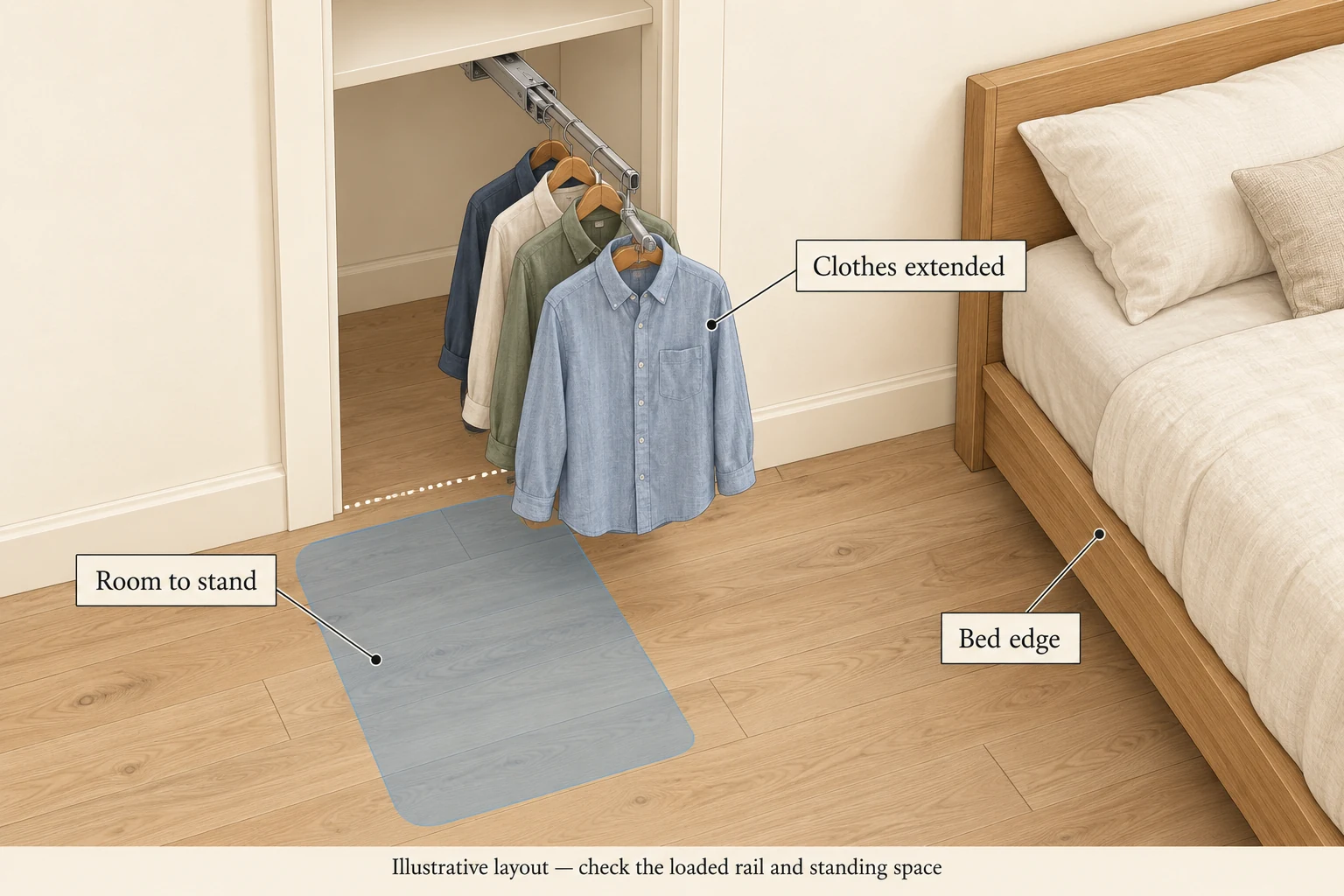
If you're considering an extending fitting, use its manufacturer's dimensions to mark the space it will occupy when open. Include the clothes and where you'll stand. Don't measure only the bare rail.
Open the bedroom door and closet doors as you normally use them. Check the bed corner, bedside table and walking route. A fitting that extends over the bed may still be inconvenient to load; a bin that clears the doorway may leave you nowhere to stand with it.
The full-footprint worksheet can help you mark the stored position, open position and space needed to use the arrangement. If everyday access requires moving the bedside table, reconsider the storage layout.
05
Try ordinary clothing use before committing
Before buying fittings, use your clothes and measured outlines to rehearse the proposed arrangement. Hold a loaded hanger in the new orientation, or place folded clothes in the intended shelf area where there is already suitable support. Don't hang a loaded rail from improvised fixings for a trial.
Choose a frequently worn item from the least convenient position and take it out. Then try putting clean laundry away. The nearest shirt might be easy to grab even when returning clothes to the back is awkward.
Before permanent installation, confirm permission to alter the closet and follow the selected system's instructions for support, fixings and load limits. A closet wall or existing shelf shouldn't be assumed suitable merely because there is room for the fitting.
For the MAFAGE example, the manual also warns to keep fingers and loose fabric away from the sliding joints and to stop rather than force the rail if it resists.
If no hanging arrangement passes the fit and access checks, give the enclosure a different job. Useful folded storage is a better outcome than hanging space you avoid using. Recheck the clothes' new destination so the solution doesn't leave a crowded rack beside the bed.