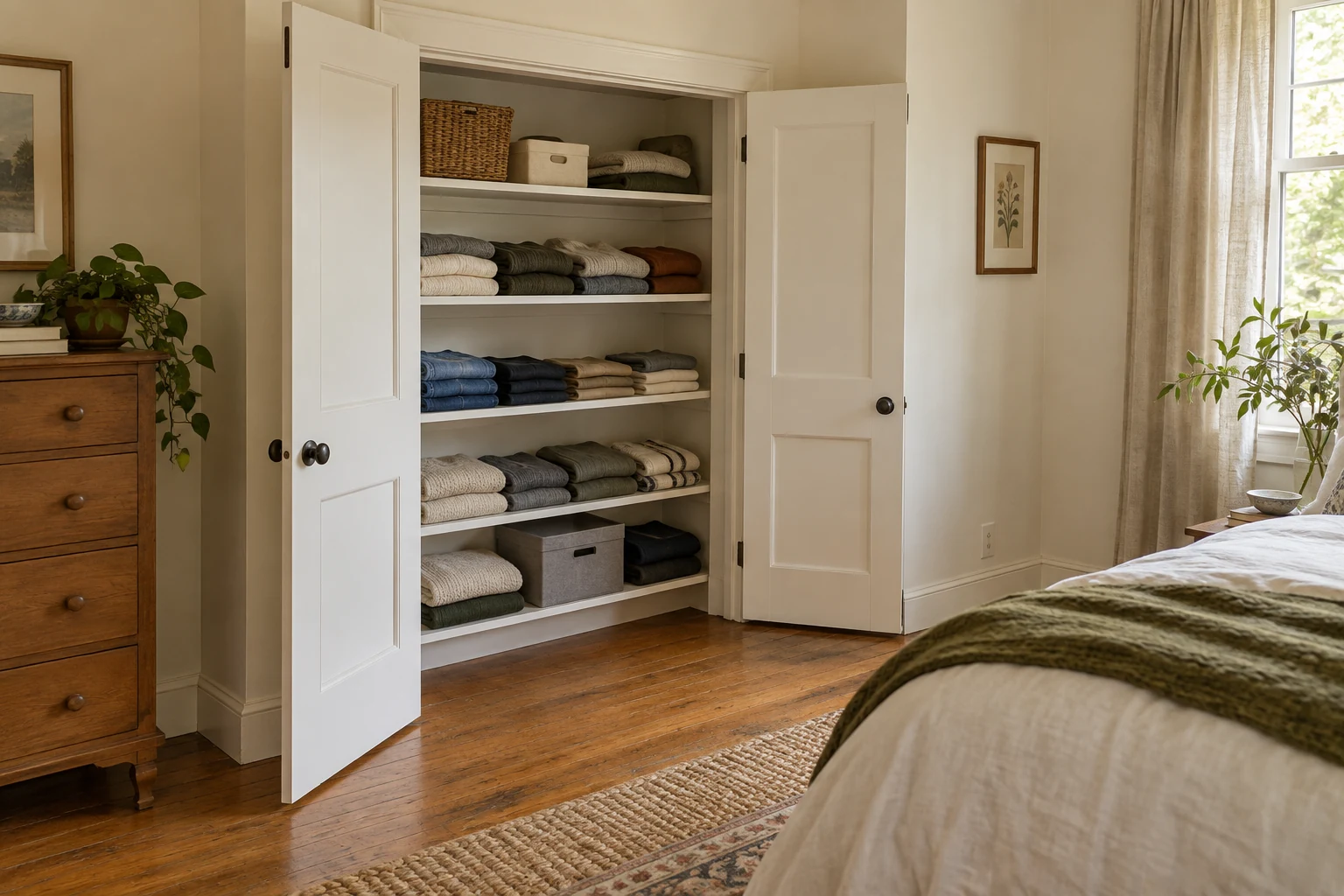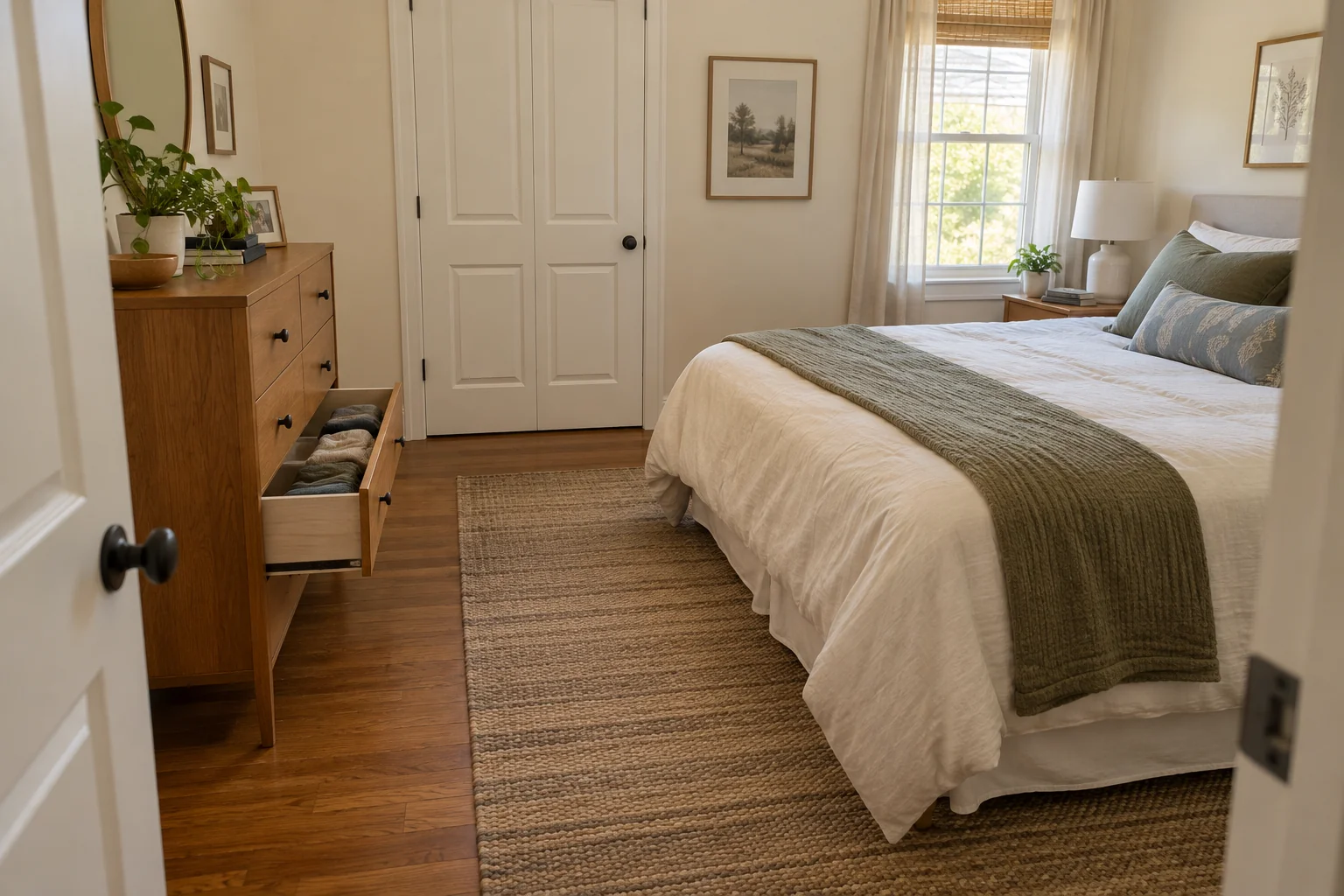
Curtains instead of closet doors can make sense when they improve access and suit the bedroom both open and closed. First, work out what bothers you about the doors: faulty hardware, the opening they leave, or their appearance. Repair may be enough if the hardware is the problem. For the other complaints, compare what curtains would change before removing anything.
In this guide
01
Work out what you need the doors to do differently
Start with the moment that annoys you. Does a panel come off its track? Do you keep moving a door back and forth to reach clothes? Or do you dislike the large expanse of doors beside the bed?
If faulty hardware is the main annoyance, have the existing door system assessed for repair. That may be enough if you're otherwise happy with the closet. Repair won't necessarily change how much of the opening you can use at once.
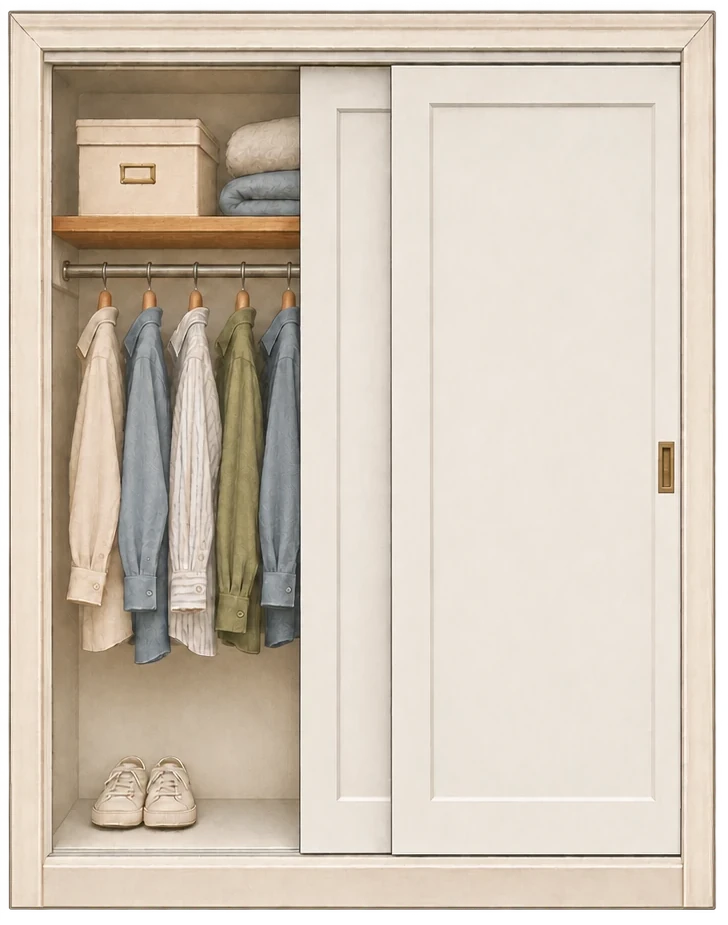
Consider the bedroom shown here: a closet with two overlapping bypass doors, everyday clothes inside, a bed nearby and curtains at the window. The room is illustrative, not a tested installation. Keep those same conditions in mind for each option.
Suppose the closet panels are awkward to slide. If they moved smoothly, would you be happy using them? You might still need to shift them repeatedly to reach your clothes, even after a successful repair.
Check the instructions for your particular door system before deciding what can be adjusted or repaired. For example, Johnson Hardware's 1166 documentation describes height and alignment adjustments for that system. Those instructions don't tell you which repair, if any, suits your doors, and restoring movement won't necessarily give you a different opening.
If the doors catch because clothes project too far forward, check how the clothes fit inside. Our guide to a bedroom closet that's too shallow for hangers covers that problem. Leave room for the clothes behind a curtain too.
02
Compare the opening with the closet in use
Judge curtains by where the fabric goes when you open them. A covered closet can look generous in a photograph while the gathered panels sit in front of the clothes you reach for most.
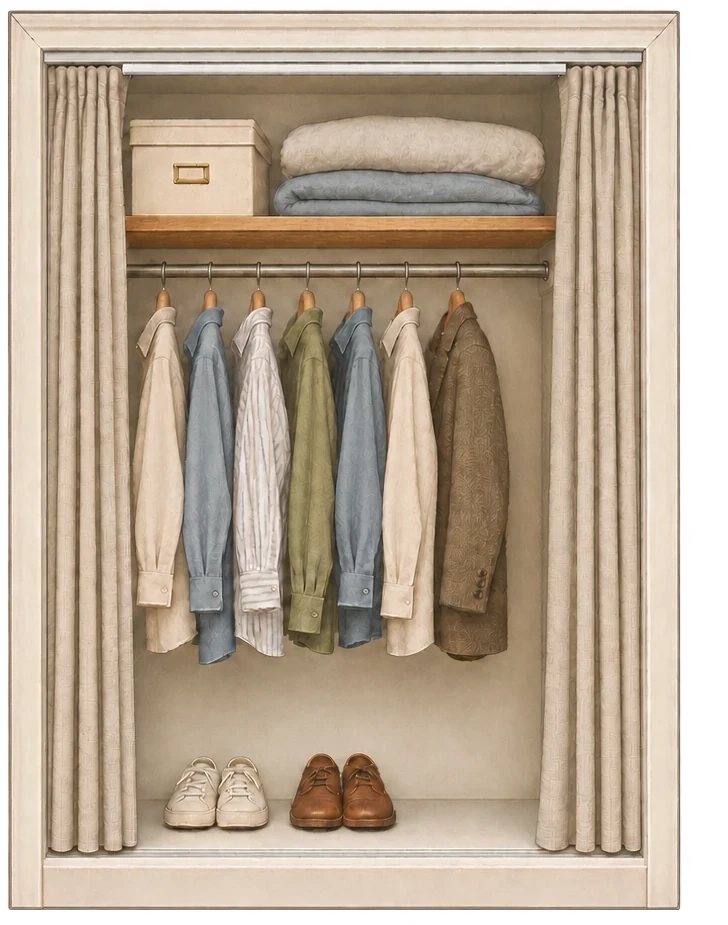
In this bedroom, imagine taking a shirt from the middle, then a jacket from either end. With the bypass doors, you move the panels to expose the part you need. With curtains, you move fabric instead. Compare how easily you could take out and return each garment, including one behind the gathered curtain.
A pair of panels could gather at opposite sides and leave the middle accessible, if the selected track and heading allow that movement. A single panel gathered at one end might suit you better if you mostly need access at the other. Choose around the clothes you reach for, then confirm that the hardware supports that movement.
If the proposed rod or track extends outside the frame, look at where the curtain would gather. In this bedroom, it might sit close to the bed or beside another piece of furniture. Moving fabric out of the opening still leaves it occupying part of the room.
The bypass doors in this example already slide rather than swing into the bedroom, so replacing them doesn't remove a door swing. Curtains may give you better access, but that depends on where the fabric rests when open. The swap doesn't always save useful space.
Before buying, ask the curtain supplier for the gathered width of the actual panel and heading on the proposed mounting system, or check a representative sample where available. Don't choose from the closed width alone or assume a fixed proportion will remain clear. Compare the resulting opening with the closet holding its normal clothes.
Doors open
Curtains open
03
Judge the curtains from the rest of the bedroom
A closet curtain becomes a substantial part of the room when it's closed. Assess it from the entrance and the bed, with the existing window treatment in view.
A close-up of attractive fabric can't settle how two curtained areas will look together. Include both the window and closet in the view before deciding whether to repeat the fabric.
A closet curtain close to the wall color could make the enclosure less prominent. Repeating the window fabric could connect the two areas, though that much of the same pattern might feel overwhelming. You could also choose a quieter fabric that shares a color with the window treatment.
Hold a sample beside the window curtains and look from the entrance and bed. Keep your existing bedding and furniture in view. Judge the fabric with the room you have before considering other changes to make it work.
Also decide how fully you want to conceal the contents. If seeing clothes through the fabric would bother you, evaluate the material under the room's lighting before committing. Check the proposed closed arrangement at the middle and sides, where an unwanted gap could leave the closet visible.
Generous folds may look good when closed and leave too much fabric in the way when open. A long hem that appeals in a photograph may be inconvenient beside the bed. Choose fullness and length with opening, closing and cleaning in mind, as well as the closed view.
Keep the doors
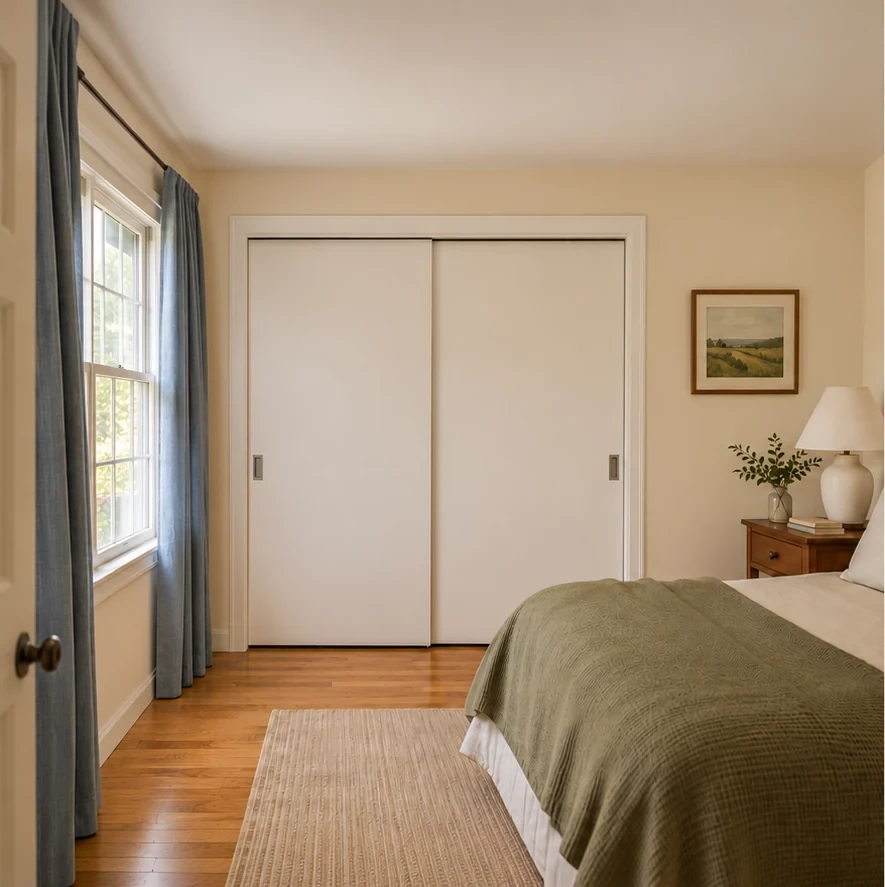
Switch to curtains

04
Check what the swap would require
Work out where you can mount the curtain before ordering panels. That position affects where the fabric hangs and gathers, and which dimensions you'll need.
A rod, ceiling track or tension-mounted arrangement each needs to suit its particular location and intended use. Follow the selected manufacturer's requirements for support, fixings and capacity. Don't assume an existing frame can take a new fitting, or that a tension rod is suitable simply because it spans the opening.
Fixings must suit the mounting surface as well as the fitting. IKEA's VIDGA instructions, for example, explain that wall materials differ and advise getting help with suitable screws. That guidance illustrates the check; use the requirements for the system you actually choose.
The Houmiggle white curtain-track kit in the 6–9 ft, one-pack option is one example to examine. Its listing describes straight sections joined with connectors and cut to length where needed, with both ceiling- and wall-mount brackets and three hook styles. The size range describes the kit option; it isn't a telescoping rail. Curtains are sold separately.
Before ordering, confirm the fixing requirements for your mounting surface, the attachment needed for your curtain heading, and whether the carriers can travel across the joins as your panel arrangement requires. The listing doesn't establish the gathered width of your curtains or guarantee a clear opening. Skip this system if you cannot confirm suitable mounting or the movement needed to reach your clothes.
If you rent, check the requirements for altering the closet and reinstating it. The fact that fabric can be removed doesn't establish permission to remove doors or install hardware.
Decide where the doors will go before taking them down. Name an actual storage location and check the door manufacturer's handling and storage instructions, as well as the system's removal and reinstallation instructions. Keep the hardware identified for reinstallation. Doors left occupying another useful part of a small home are a cost of the swap, even if they no longer crowd the bedroom. If you cannot identify the system or safely manage the panels, get a qualified installer to assess removal.
If the mounting or storage question has no workable answer, pause the replacement. Buying panels won't resolve it.
05
Decide whether to keep, repair or replace
Compare each option against the complaint that started this. Keep the remaining compromise in view too.
The doors suit the room, and faulty operation is the main annoyance
- Direction worth pursuing
- Assess repair of the existing system
- What still needs to work
- The repaired doors must provide acceptable everyday access.
Functioning doors still make reaching clothes awkward
- Direction worth pursuing
- Compare a curtain arrangement
- What still needs to work
- Gathered fabric must leave the needed clothes accessible and fit beside the furniture.
The main objection is appearance
- Direction worth pursuing
- Compare the closed views before removing anything
- What still needs to work
- The proposed fabric must suit the bedroom, including its existing window treatment.
Curtains would obstruct access, lack suitable mounting or leave nowhere to store the doors
- Direction worth pursuing
- Keep the doors while resolving the actual problem
- What still needs to work
- A replacement should improve the room enough to justify what it introduces.
| What you find | Direction worth pursuing | What still needs to work |
|---|---|---|
| The doors suit the room, and faulty operation is the main annoyance | Assess repair of the existing system | The repaired doors must provide acceptable everyday access. |
| Functioning doors still make reaching clothes awkward | Compare a curtain arrangement | Gathered fabric must leave the needed clothes accessible and fit beside the furniture. |
| The main objection is appearance | Compare the closed views before removing anything | The proposed fabric must suit the bedroom, including its existing window treatment. |
| Curtains would obstruct access, lack suitable mounting or leave nowhere to store the doors | Keep the doors while resolving the actual problem | A replacement should improve the room enough to justify what it introduces. |
In this bedroom, repair could be enough if smooth operation makes dressing easy and you prefer the doors' appearance. Curtains could be the better choice if moving the panels remains inconvenient and the gathered fabric stays out of the way. What bothers you about the closet matters as much as the opening itself.