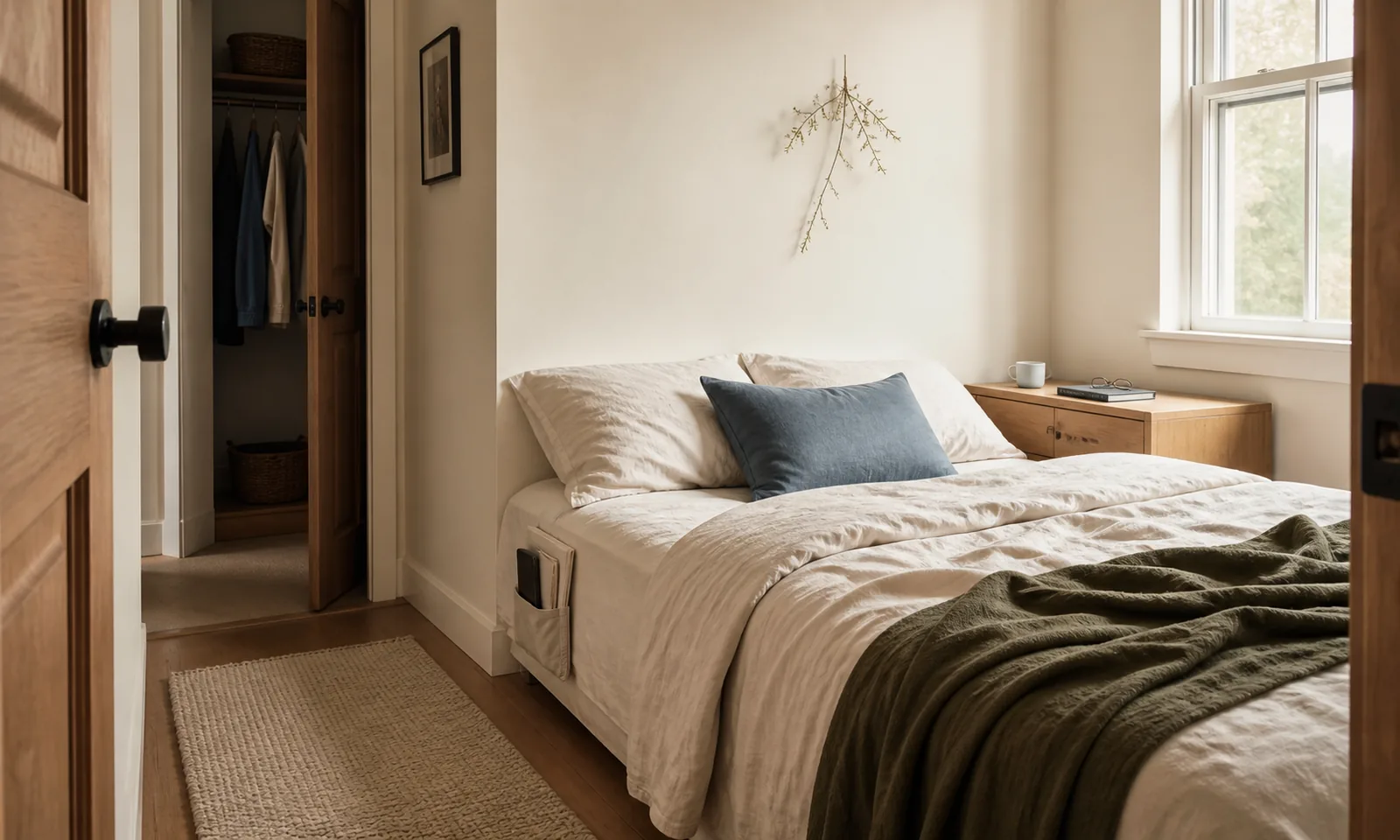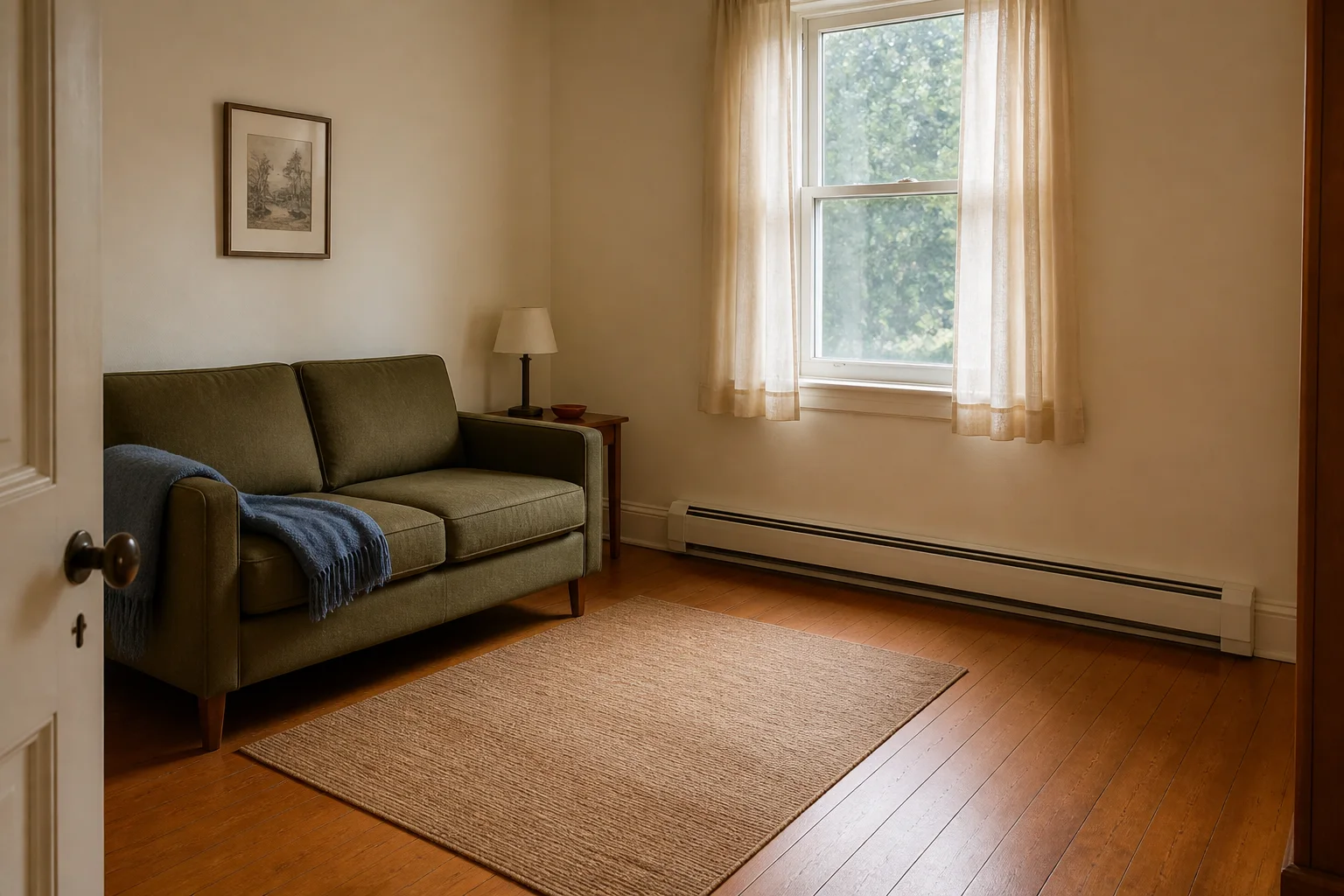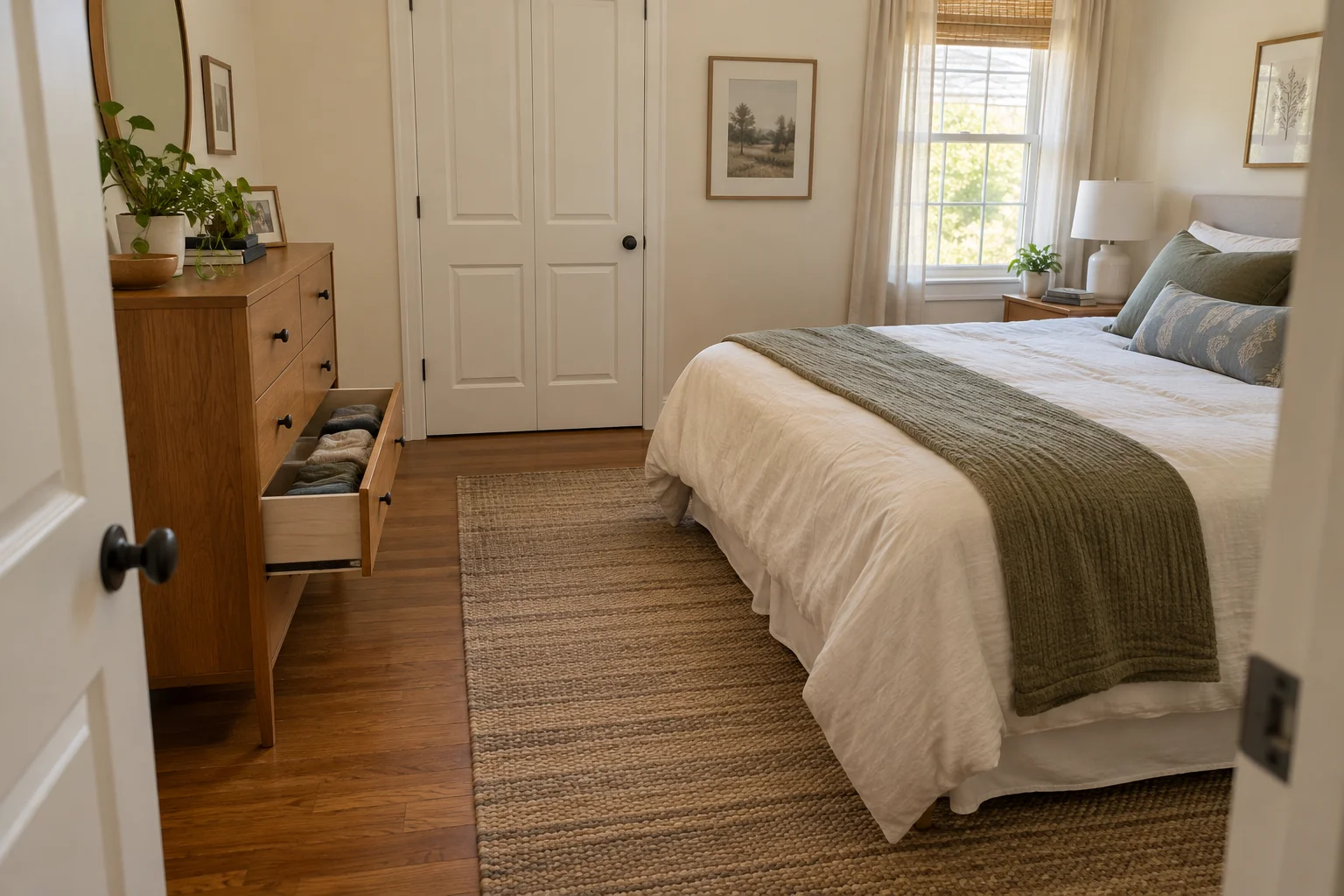
A dresser can fit against a bedroom wall and still be impossible to use. The bottom drawer may hit the bed frame, or open into the only place you can stand.
If you want to keep the dresser, find its place with the drawers open. Start with the furniture you own and check whether you can reach its contents without crowding the bed, doors, or route through the room.
01
Start with the parts of the room that cannot move
Before shifting the dresser, sketch the bedroom or take a photo from the doorway. Mark the doors, windows, outlets, any heater, and the route from the door to the bed. Include the sides people use to get in and out. Two sleepers may need access on both sides; one person may be comfortable with a bed against the wall.
Leave room to open the closet and reach its contents, even if its doors slide. U.S. Fire Administration guidance says to keep doors and windows in a home escape plan unblocked. The wall below a window may also have a heater. Our guide to arranging furniture around baseboard heaters covers that constraint; check your heater's instructions before placing furniture nearby.
Start with the current bed position and look at the wall sections left for the dresser. If none works, a different bed orientation may open up a usable spot.
02
Make room for the open drawers
Measure the dresser you have, including any handles that project beyond its front. Then pull out each drawer, one at a time, as far as it normally opens and measure from the back of the dresser to its farthest point. The closed depth helps you find possible spots. The open depth may rule some of them out.
Leave space for the person using it, too. Stand in front of the open bottom drawer, take out a folded shirt, and put it back. Bend or kneel if that is how you normally reach it. Can you do so without pressing against the bed or standing in a doorway? Check the widest drawer and any handle near the bed frame.
To test a position without moving furniture, mark the dresser's closed outline and full drawer extension on the floor with painter's tape or paper. Stand where you would use it and open the bedroom and closet doors.

There is no universal clearance number: drawer travel, bed height, and how you reach lower drawers all affect the space you need.
03
Compare the positions that pass both tests
Compare the spots that passed the room and drawer tests. The most useful position may be off center.
Opposite the bed
- When it can work
- There is enough space to open drawers and stand between the two pieces.
- What to check
- The foot of the bed, drawer handles, and the route past an open drawer.
Beside the bed
- When it can work
- The dresser can replace a separate bedside piece without crowding bed access.
- What to check
- Drawer movement, reach from bed, and the closet or door beyond it.
Under a window
- When it can work
- A low dresser leaves the window usable and no heater or other obstruction makes the position unsuitable.
- What to check
- Sill height, window operation, curtains, and the drawer space in front.
Inside a closet
- When it can work
- The dresser fits without blocking hanging clothes or making its drawers awkward to reach.
- What to check
- Clear opening width, closet depth, door movement, and access to stored clothes.
| Possible position | When it can work | What to check |
|---|---|---|
| Opposite the bed | There is enough space to open drawers and stand between the two pieces. | The foot of the bed, drawer handles, and the route past an open drawer. |
| Beside the bed | The dresser can replace a separate bedside piece without crowding bed access. | Drawer movement, reach from bed, and the closet or door beyond it. |
| Under a window | A low dresser leaves the window usable and no heater or other obstruction makes the position unsuitable. | Sill height, window operation, curtains, and the drawer space in front. |
| Inside a closet | The dresser fits without blocking hanging clothes or making its drawers awkward to reach. | Clear opening width, closet depth, door movement, and access to stored clothes. |
If the dresser's lower drawers hit the foot of the bed, a short wall might free them. Check that the new position also clears the closet door and the route into the room.
Beside the bed, a dresser can provide clothing storage and a bedside surface if its drawers face open floor. Reject the spot if an open drawer blocks the side of the bed someone uses. Our nightstand alternatives guide covers how to use the top for glasses or a lamp.
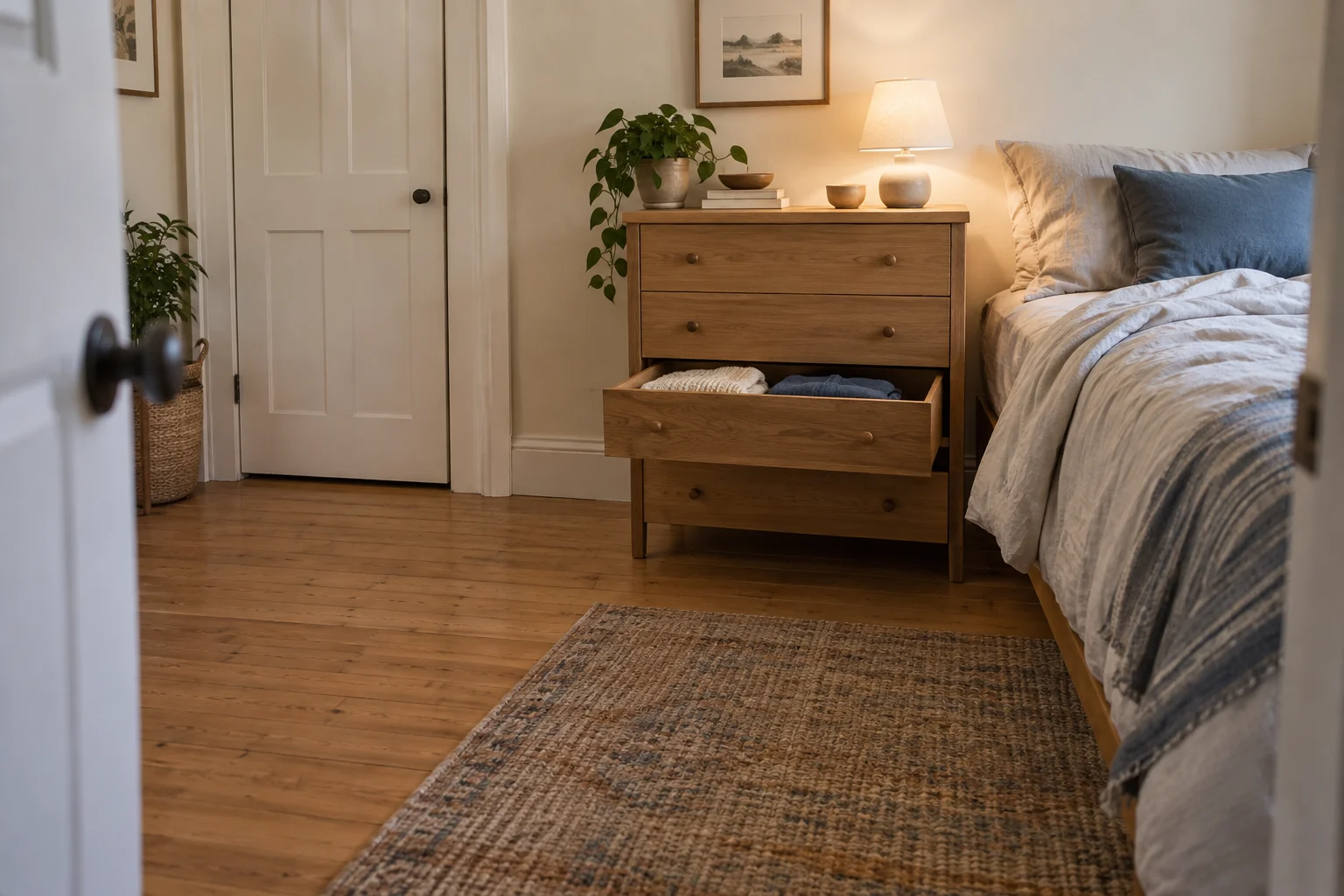
For a dresser under a window, check the actual sill, curtains, anything below the window, and whether it still opens and serves your escape plan. A closet location can free floor space, but its opening and depth must allow you to use the drawers.
04
If the dresser has no workable place
If the bed and dresser cannot both work in the bedroom, ask what the dresser holds and how often you need it.
Some clothes could move to an existing closet, shelf, or dresser elsewhere in the home. Or the whole dresser might work in an adjacent room. The extra walk may be worthwhile if the storage stays easy to use and does not crowd that room.
If you change the bed's orientation, check access for each sleeper, the doors, and the route through the room again.
Consider a replacement once you know which dimension fails. A narrower dresser may still project as far when open; a shallower one may hold too little. A taller chest saves wall width but still needs drawer space and anchoring. List what must stay in the bedroom, then measure the space available to use a replacement.
05
Live with the proposed layout before committing
Try a promising position at full size. If you move the dresser for the trial, follow its handling and anchoring instructions. Open each drawer in turn, along with the doors and window you expect to use. Put away laundry, walk in carrying clothes, and get into and out of bed.
If you have to move a basket every time you open the bottom drawer, the basket needs another home or the dresser does. Stepping around an open drawer to get to bed will be tiresome too. And a drawer that opens fully is still awkward if you have to lean over the mattress to reach the clothes at the back.
For the final position, follow the dresser manufacturer's assembly and anchoring instructions. The U.S. Consumer Product Safety Commission recommends anchoring dressers to the wall; pushing one against a bed or wall does not secure it. Check the exact heater's manual before leaving furniture close to it. King Electric's K-series instructions and Stelpro's UBB instructions give different clearance conditions, so neither applies to every heater.