The arrangement is worth keeping when the shelves you can reach hold what you use regularly, and the hidden shelves offer occasional storage you can still retrieve. That gain has to justify pulling the sofa into the room. Putting the bookcase beside it may give you more useful storage from exactly the same piece of furniture.
A low bookcase with its openings facing away from the sofa leaves you approaching from the other side. A tall bookcase against the wall puts the sofa between you and some of its shelves. Both sit behind the seating, but they need different access checks.
In this guide
01
Start with what you need to take off the shelves
Choose a few belongings that will tell you whether the position works. For this guide, imagine paperbacks you reach for most evenings, a board game used each week and large art books opened occasionally. Keep those same belongings in mind through each arrangement.
Look at the shelf opening as well as the shelf itself. A game box may sit neatly inside a compartment but need space in front to slide out while you hold it. A paperback might come out through a smaller opening, yet still be awkward to return if the sofa hides the spot where it belongs.
Work through the movement with each item. Where would you stand or crouch? Can you grip it and draw it clear of the shelf, then put it back? Touching a spine from the sofa may be easy even when removing the book would disturb its neighbors.
Moving furniture for an art book a few times a year may suit you. Having to do it for the weekly game may soon become a nuisance. Consider who will use each shelf, especially anyone who cannot comfortably reach over the sofa or crouch behind it.
02
A low bookcase works differently when its shelves face the room
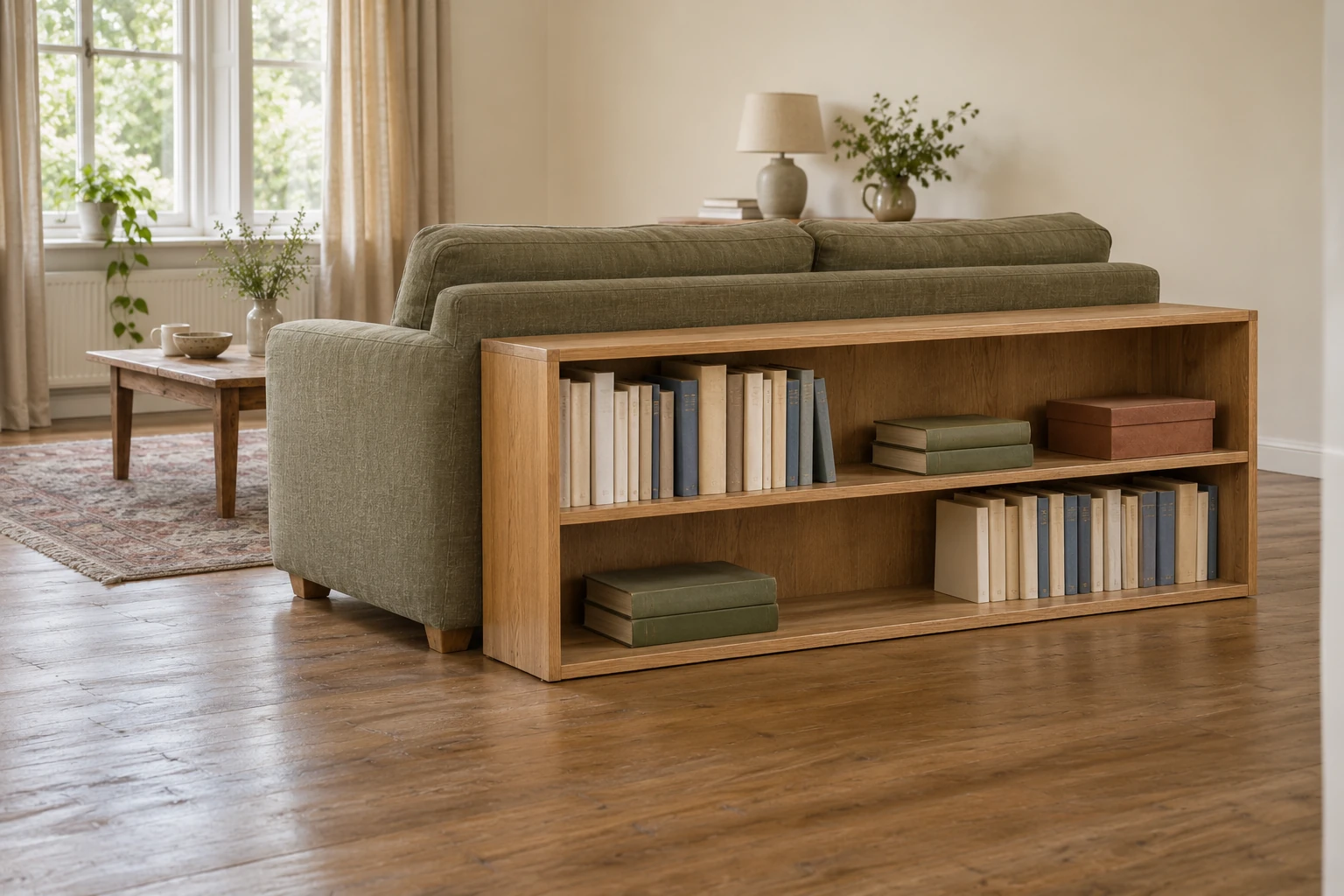
With a low outward-facing unit, the sofa sits behind the closed back of the bookcase, and you approach its openings from the other side. The sofa does not hide the lower shelves. First establish that the unit can be secured as its instructions require in that position; otherwise, leave this option out. Then assess whether you have enough usable space on the open side to get things out.
Picture taking the game box from a lower compartment. You approach from the passage behind the sofa, crouch in front of the opening, slide the box toward you and stand with it. Your body and the withdrawn box occupy space beyond the bookcase's footprint. A strip of floor that lets you walk past may not accommodate that movement.
Try the paperback from an upper compartment too. If another person can pass while you select a book but must wait while you retrieve the game, decide whether that occasional pause is reasonable. If you have to step into a doorway or put the box down in the main route, reconsider the position.
The furniture must also be suitable for the proposed placement. The U.S. Consumer Product Safety Commission advises anchoring bookcases securely to the wall, and its Anchor It guidance says to follow the manufacturer's securing instructions. A sofa behind a unit does not replace anchoring. If the intended location cannot meet the furniture's instructions, rule it out; being low does not by itself establish that a bookcase can stand in the middle of a room.
A low unit may make every opening accessible while holding fewer belongings than the tall bookcase you already own. If the art books do not fit, they still need a place. An already crowded cabinet elsewhere does not solve that problem.
For a concrete size comparison, the Aheaplus 63-inch four-compartment bookcase, in the white two-tier version, is listed at 63 inches wide, 13 inches deep and 30.7 inches high. Its dimension diagram labels an opening 29.1 inches wide and 11.8 inches high. Those broad openings are worth comparing with your game box, although the outside depth does not establish usable shelf depth or room to withdraw it. The listing includes two anti-tip kits; the full securing instructions were not available to verify this outward-facing placement. Treat it as a size and compartment example, not an approved unsupported sofa divider. Choose it only for a position that can meet its securing instructions, and confirm the internal depth before buying.
03
A tall wall bookcase may keep only some shelves convenient
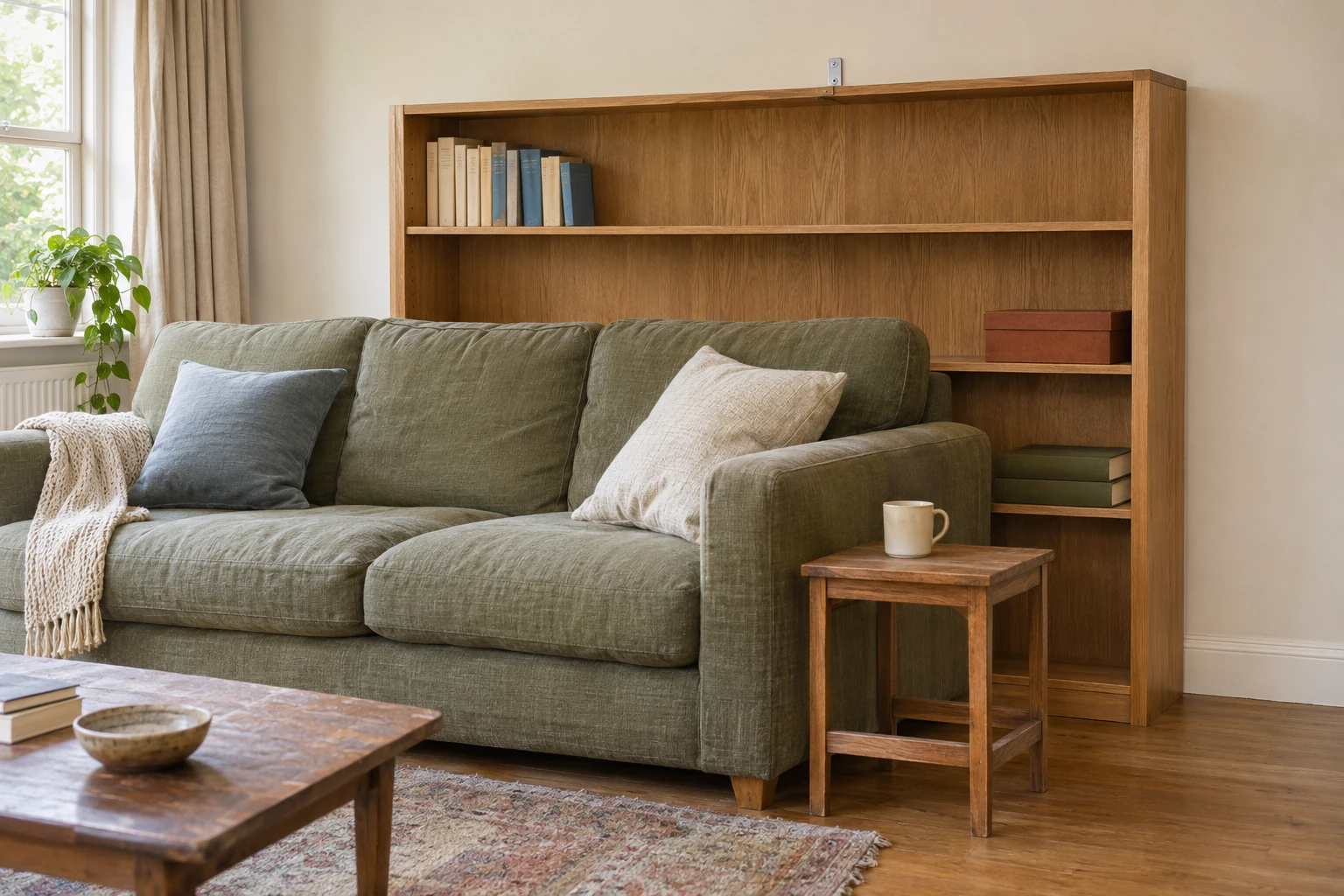
When a tall bookcase stands against the wall and the sofa sits in front, assess the shelves separately. Exposed upper shelves, openings beside a sofa arm and compartments directly behind the sofa back may offer very different access.
An upper shelf can remain visible without being comfortable to use. Check whether you can take out and return the paperbacks from a normal standing position beside the sofa. If the only approach involves stretching across the seating, it may be a poor home for books used every evening.
At the ends, distinguish reaching an item from getting it out. A book near the outer edge might slide forward beside the sofa arm. A game box farther along the same shelf may meet the arm before it clears the opening. Moving the box toward the accessible end could solve that problem, provided the other contents still have workable places.
Lower shelves can remain useful for occasional storage. Apartment Therapy's account of a narrow living room describes bookcases placed behind the sofa and suggests keeping less-used belongings on the concealed shelves. That is a reasonable compromise when you can actually retrieve those belongings when needed.
For the art books, work out where the sofa would go while you use the shelf. There needs to be somewhere for both the furniture and the person retrieving the books. Emptying the room each time is a substantial chore for occasional storage. Leaving the sofa farther forward avoids that move but takes space from the seating area.
04
Would the same bookcase earn its space beside the sofa?
Compare the same tall bookcase in both locations before replacing it with a lower one. Moving it beside the sofa can restore access to lower shelves, but it also claims a section of wall and may displace something already useful.
Imagine a room where the tall bookcase stands behind the sofa and could move to a wall beside one arm. A small side table already occupies that spot. The paperbacks, weekly game and occasional art books all need to stay in the living room. This is an illustrative planning example, not a physically tested layout.
Tall bookcase behind the sofa
- What happens to the belongings
- Paperbacks go on reachable exposed shelves; art books can remain low if furniture movement makes retrieval practical. The game needs an opening from which the whole box can be removed.
- What the room gives up
- The sofa moves forward by the depth needed for the bookcase and any planned access behind it.
Same tall bookcase beside the sofa
- What happens to the belongings
- Lower openings become available from the room, subject to checking the actual approach. The game no longer has to clear the sofa back or arm if its opening faces unobstructed floor.
- What the room gives up
- The side table loses its position, including its convenient place for a drink.
Suitable low unit with openings facing away from the sofa
- What happens to the belongings
- Lower shelves can be approached directly from the open side. Check that all the books and the box fit, and that there is room to withdraw them.
- What the room gives up
- The unit and space to use it occupy floor behind the sofa; its capacity may be smaller.
| Arrangement | What happens to the belongings | What the room gives up |
|---|---|---|
| Tall bookcase behind the sofa | Paperbacks go on reachable exposed shelves; art books can remain low if furniture movement makes retrieval practical. The game needs an opening from which the whole box can be removed. | The sofa moves forward by the depth needed for the bookcase and any planned access behind it. |
| Same tall bookcase beside the sofa | Lower openings become available from the room, subject to checking the actual approach. The game no longer has to clear the sofa back or arm if its opening faces unobstructed floor. | The side table loses its position, including its convenient place for a drink. |
| Suitable low unit with openings facing away from the sofa | Lower shelves can be approached directly from the open side. Check that all the books and the box fit, and that there is room to withdraw them. | The unit and space to use it occupy floor behind the sofa; its capacity may be smaller. |
In this example, first try assigning the weekly game an accessible opening in the existing arrangement. If it fits there alongside the everyday books, keeping the bookcase behind the sofa may preserve the useful side table while leaving only occasional retrieval behind the seating.
If the game must stay blocked, moving the bookcase beside the sofa becomes more attractive. But the side table's job still needs an answer. Can a reachable existing surface hold a drink? If none can, include that loss in the decision. Easier shelf access has to be weighed against that everyday use.
Before substituting a low unit, find a destination for everything it cannot hold. If the art books must move elsewhere, name the available shelf they will go on.
Where the new position affects the entrance, check it against the living-room layout around the front door. Gaining access to books is a poor exchange for making the main arrival route awkward.
Bookcase behind the sofa
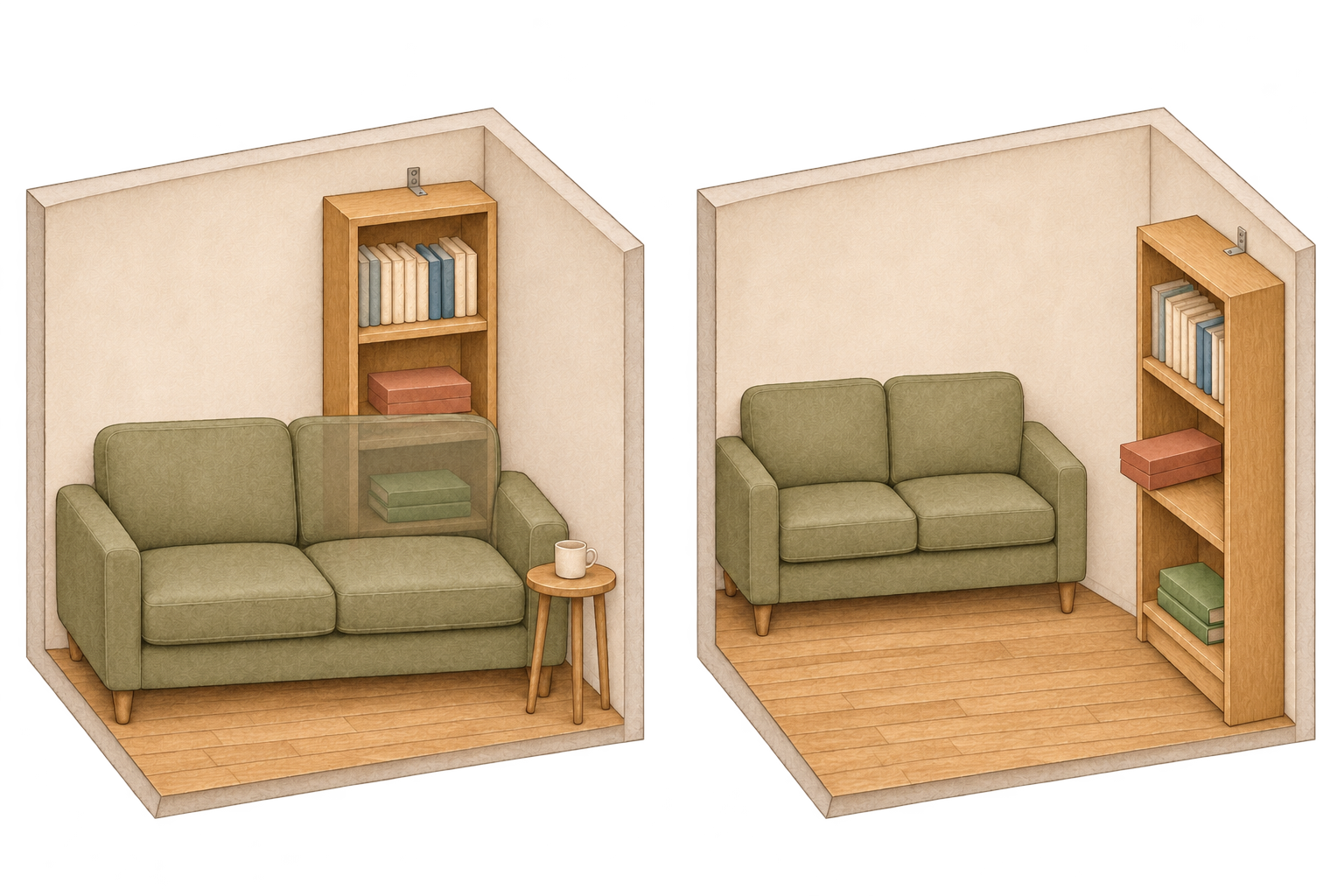
Bookcase beside the sofa
05
Try the retrieval before committing to the layout
For a proposed purchase, mark the furniture edges on the floor and compare its internal shelf openings with the belongings it needs to hold. Use the actual game box to understand its movement into the surrounding space. Tape can help reveal a conflict; it cannot establish reach over a solid sofa back or verify furniture stability.
For an existing bookcase, check the assembly, placement, anchoring and load instructions before arranging a physical trial. Plan any furniture move accordingly; moving the bookcase means checking and restoring its required anchoring before use. Once properly positioned and secured, take out and return the everyday books, the wider box and an occasional item. Keep the sofa and any reclining mechanism within their own instructions too.
Then use the seats while someone crosses the room. Notice whether accessing a shelf blocks the only route, requires another person to get up or depends on moving a coffee table with nowhere practical to put it. Include access for cleaning behind the seating, rather than assuming the gap will take care of itself.