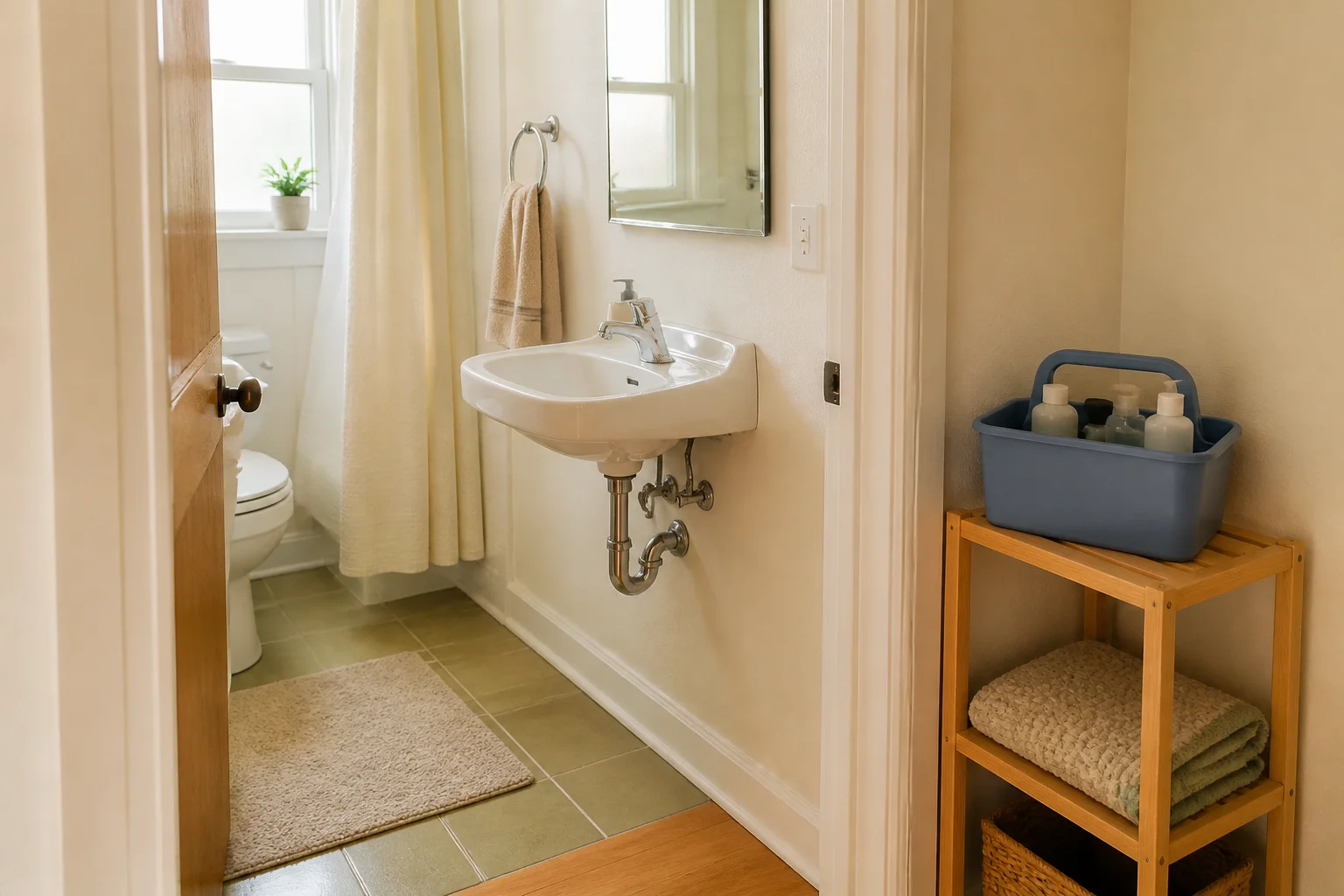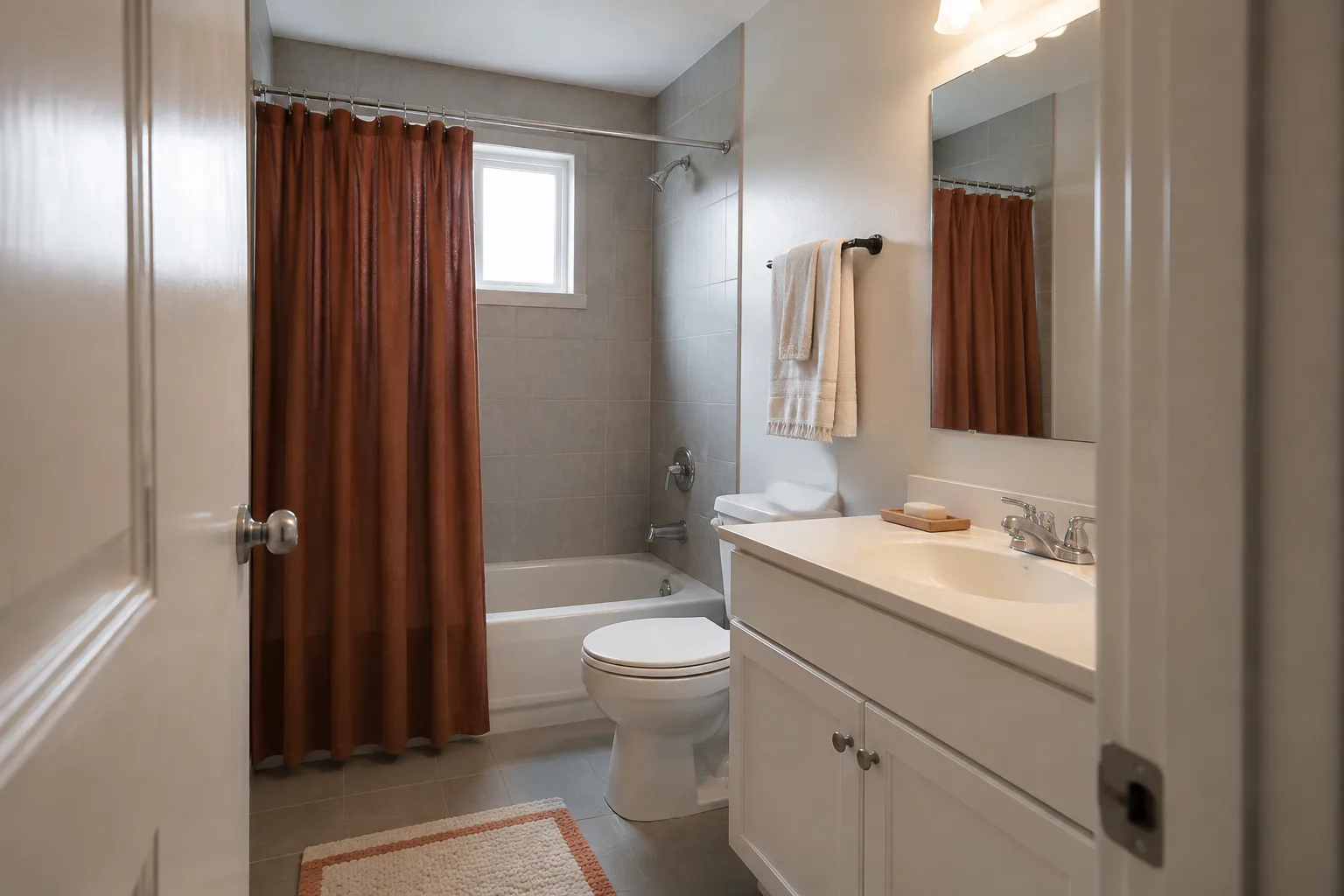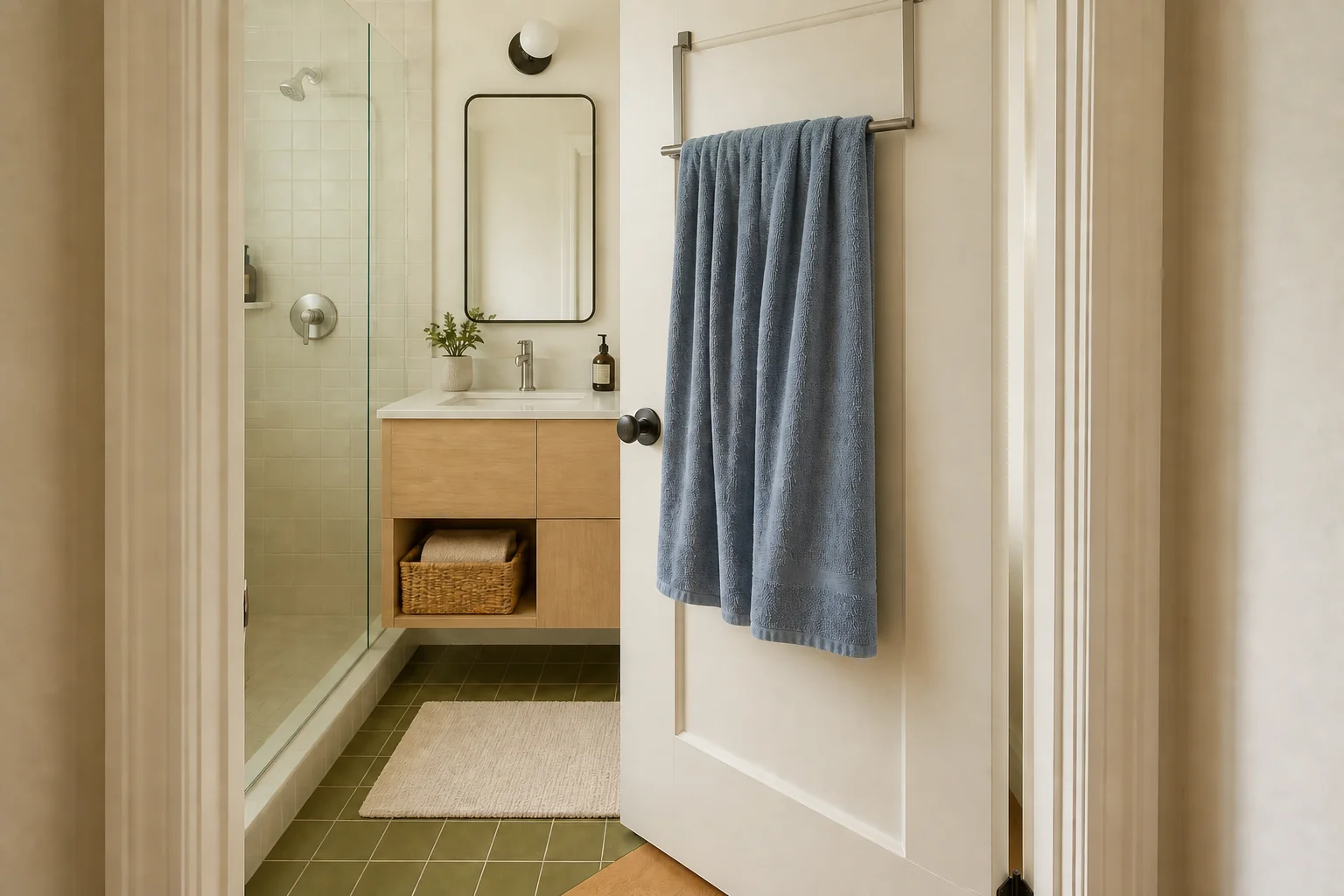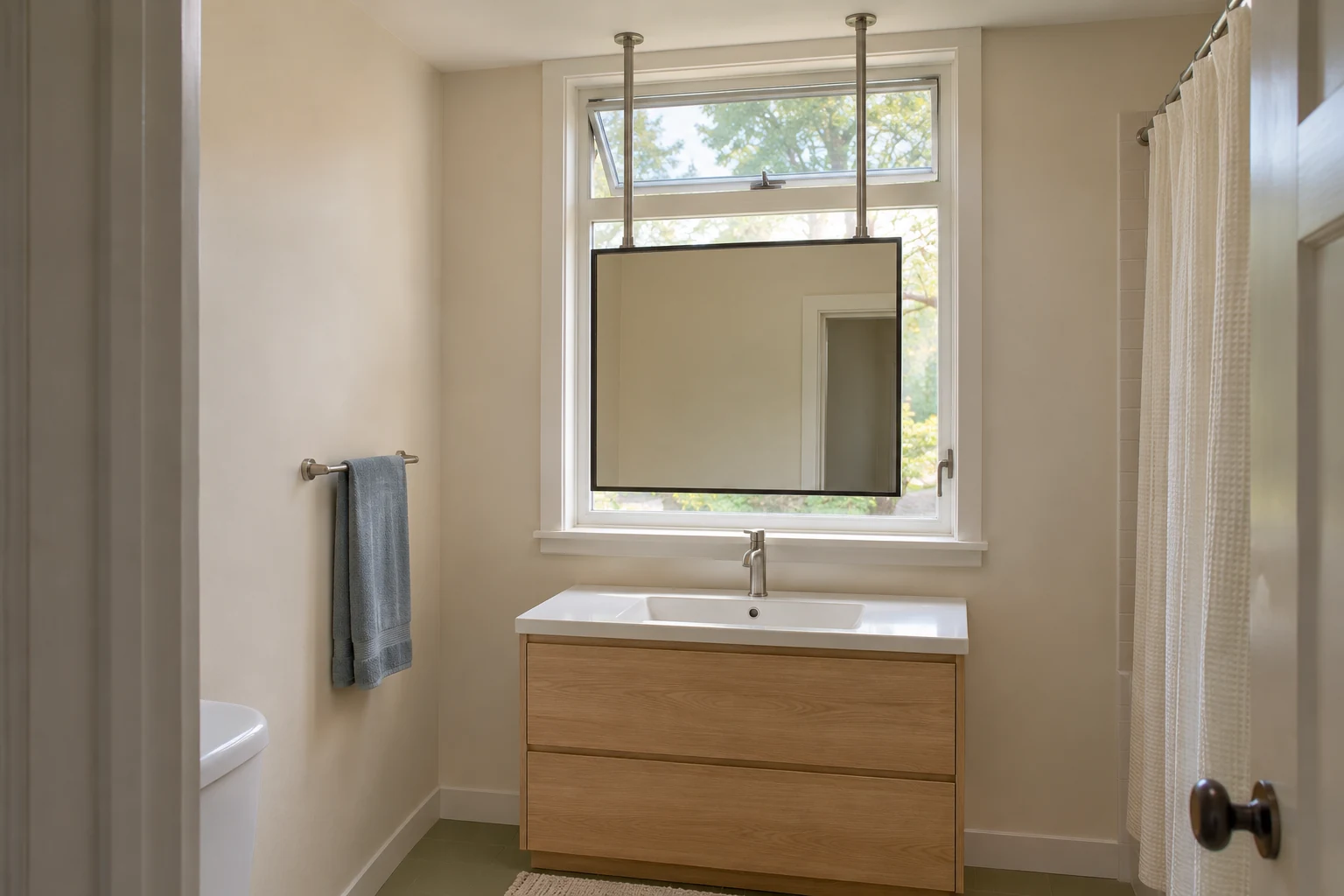
If you need a forward-facing reflection for shaving or washing, consider a fixed mirror in front of the window or a purpose-designed movable mirror that reaches a useful position. An adjacent wall can work when you can turn or step toward it comfortably. Longer grooming tasks may fit better at a separate mirror, leaving a smaller reflection near the sink.
Before choosing a shape or finish, think through an ordinary morning in each position. A mirror that looks right in the room may still be too low, too small or awkward to use.
In this guide
- Start with what you need to see at the sink
- Put a fixed mirror in front of the window when facing forward matters most
- Use an adjacent wall when the reflection works from a comfortable position
- Choose a movable mirror only if it works both extended and folded away
- Give longer grooming tasks a separate position when necessary
- Check the chosen arrangement before buying hardware
01
Start with what you need to see at the sink
Think about the moments when you look up: seeing your whole face while shaving, checking that you have rinsed away cleanser, or arranging your hair with your head and shoulders in view. Which tasks require the tap, and which could happen elsewhere?
Include everyone who regularly uses the room. A position that works for one person's height and reach may not suit another. Note where each person stands without leaning over the basin or squeezing beside the toilet.
Compare each position against that routine:
Fixed in front of the window
- Where you use it
- Facing the basin
- What must work
- Useful reflection for each user; retained window access
- What may rule it out
- Permanent obstruction or unsuitable support
On an adjacent wall
- Where you use it
- Turned toward it or standing beside the basin
- What must work
- Comfortable stance with access to what the task needs
- What may rule it out
- Twisting, leaning or insufficient standing room
On a movable arm
- Where you use it
- At the basin with the mirror brought into position
- What must work
- Suitable viewing area and reach; clear movement path
- What may rule it out
- Inadequate reflection or collisions in use or at rest
At a separate grooming spot
- Where you use it
- Away from the basin
- What must work
- A workable place for longer tasks
- What may rule it out
- The task still needs running water or the new spot crowds another activity
| Mirror position | Where you use it | What must work | What may rule it out |
|---|---|---|---|
| Fixed in front of the window | Facing the basin | Useful reflection for each user; retained window access | Permanent obstruction or unsuitable support |
| On an adjacent wall | Turned toward it or standing beside the basin | Comfortable stance with access to what the task needs | Twisting, leaning or insufficient standing room |
| On a movable arm | At the basin with the mirror brought into position | Suitable viewing area and reach; clear movement path | Inadequate reflection or collisions in use or at rest |
| At a separate grooming spot | Away from the basin | A workable place for longer tasks | The task still needs running water or the new spot crowds another activity |
A small magnifying mirror and an ordinary grooming mirror serve different purposes. Look for a normal, non-magnifying view as well as any close-up side on a movable model. Even with both, the viewing area may be too small for your routine.
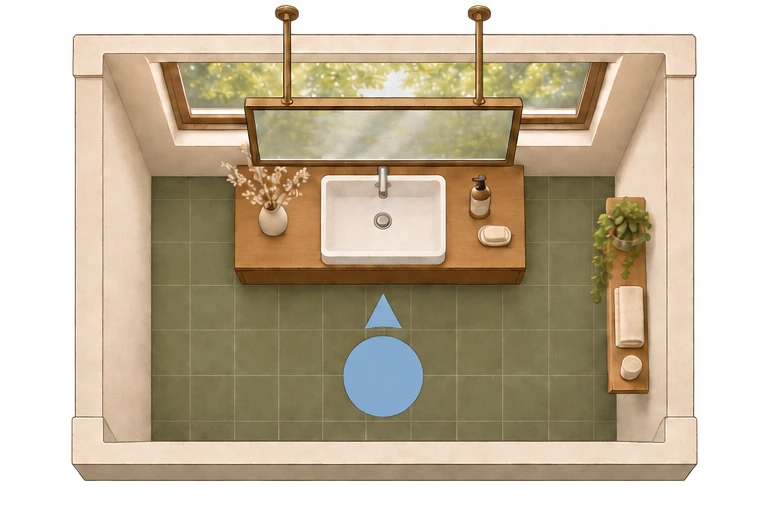
Fixed in front
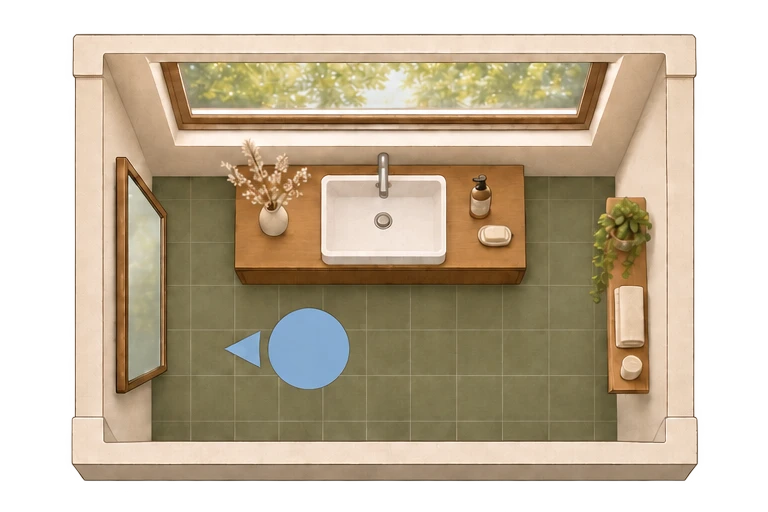
Adjacent wall
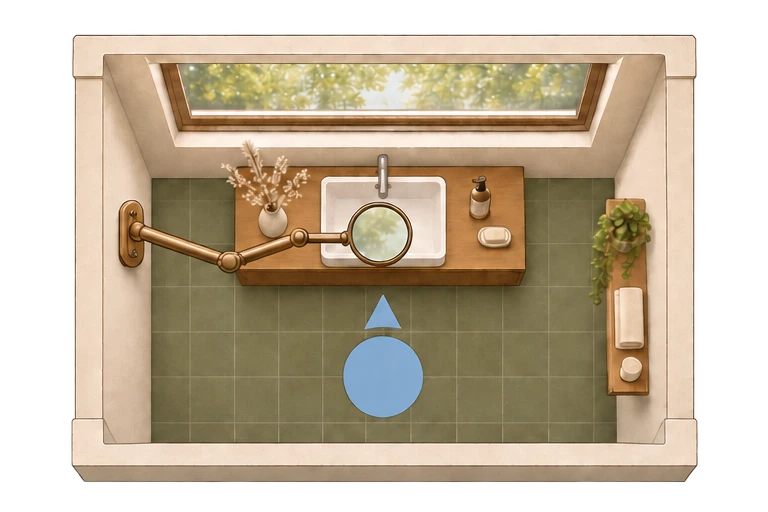
Movable mirror
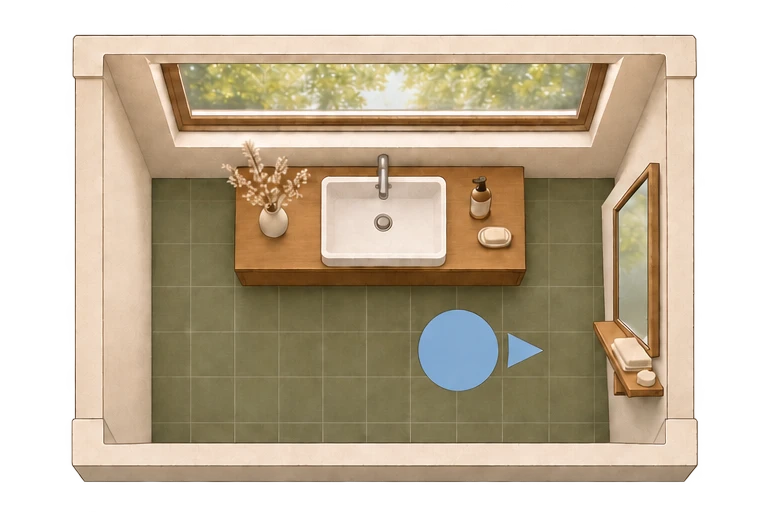
Separate grooming spot
02
Put a fixed mirror in front of the window when facing forward matters most
A fixed mirror lets you look straight ahead while spending time at the sink, without adjusting anything. It may be the simplest arrangement to use each morning, even if it takes more planning to install.
Once you have a position that gives you the reflection you need, look at how much window it covers. Can you still operate the handle, open the sash, use the blind and clean behind the mirror? A small gap in a photograph may leave too little room for your hand or a cleaning cloth.
In their own window-over-sink bathroom project, Young House Love considered different user heights, the inconvenience of turning toward another mirror, daylight loss and window access. Those are useful checks for your room too; their mounting arrangement is not a specification for yours.
Settle those questions before choosing the mirror's shape. A narrow mirror might leave more glass visible but cut off the view someone needs. A larger one might give the right reflection while blocking the window's opening path. The window's proportions alone cannot settle the choice.
Use a system intended for the proposed mounting position, with support confirmed for that installation. Do not assume the glazing, window trim or frame can carry it. If suitable support cannot be provided without work you are unwilling or unable to do, move on to another position.
03
Use an adjacent wall when the reflection works from a comfortable position
An adjacent-wall mirror can leave the window unobstructed and use a conventional wall position. It works best when there is somewhere sensible to stand facing it.
Look at the floor below that empty wall. A toilet, projecting vanity or door swing may occupy the place you need to stand. A mirror above the toilet may allow a quick sideways check from the basin without giving you a comfortable position for a longer routine.
Turning for a glance is different from staying turned while using both hands. If you have to keep your feet at the sink and twist your head sideways to shave, a side-wall mirror has not solved the need for a forward-facing reflection. It may work well if you can step beside the basin, face it comfortably and still reach what you need.
Notice where you would put products down. Moving the mirror should not leave you carrying an open bottle back and forth or setting things on an unsuitable ledge. If storage is already tight, give the daily toiletries a practical home without crowding the sink.
04
Choose a movable mirror only if it works both extended and folded away
A movable mirror can leave more of the window clear between uses. Choose it by where the reflective surface reaches when you need it.
Read the dimension drawing for the exact model, following the arm from its mounting point through each joint to the mirror. A stated arm length alone does not show that the mirror will sit in front of your face from the available wall.
The viewing surface needs a separate check. The KIBI KMM100 in chrome, for example, has normal 1x and magnifying 5x sides. Its manufacturer's specification drawing shows a head diameter of 7⅞ inches and maximum overall extension of 17¼ inches. That extension is not the distance to the mirror's center. The head diameter does not establish the exact size of the usable glass, which we have not separately verified.
This is a small cosmetic mirror to assess for close grooming or brief checks. It will not automatically replace a larger mirror. Skip it if you need a broader view or its joints cannot place the reflection where you stand. Its installation guide recommends mounting to a wall stud, so confirm the support before choosing the position.
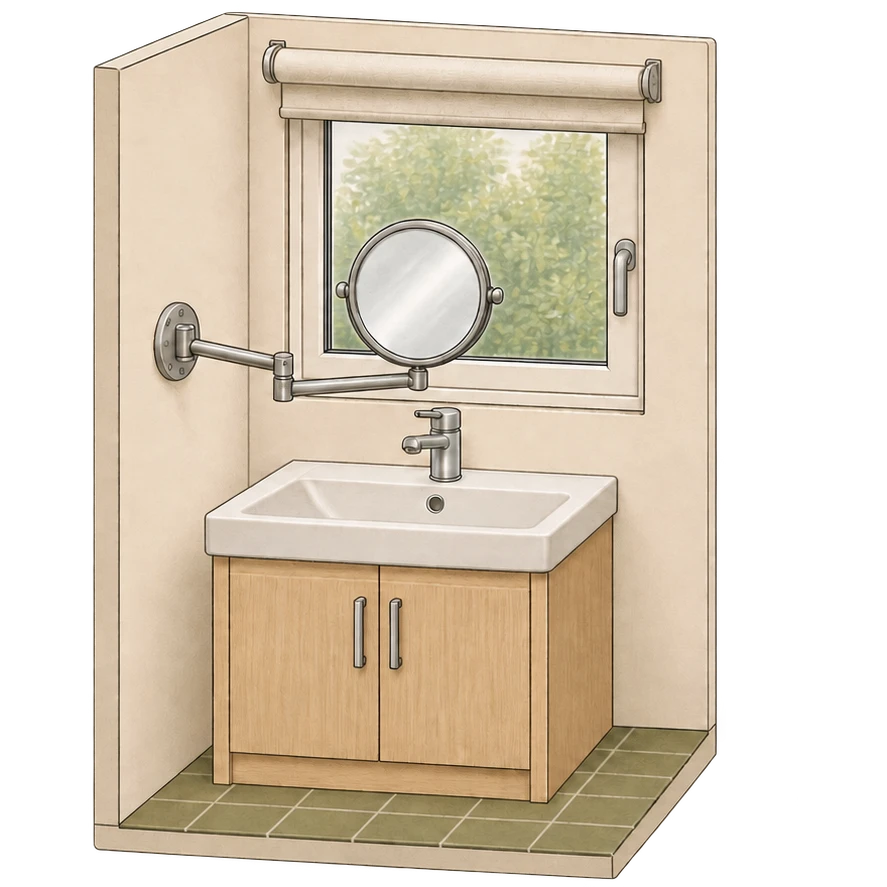
Follow the whole movement from stored to extended. Does the mirror pass the tap? Can it reach its useful position without striking the window handle or blind? Once extended, does it occupy space someone else needs at the basin? When folded, does it obstruct the window or a nearby cupboard?
Extended for use
Folded away
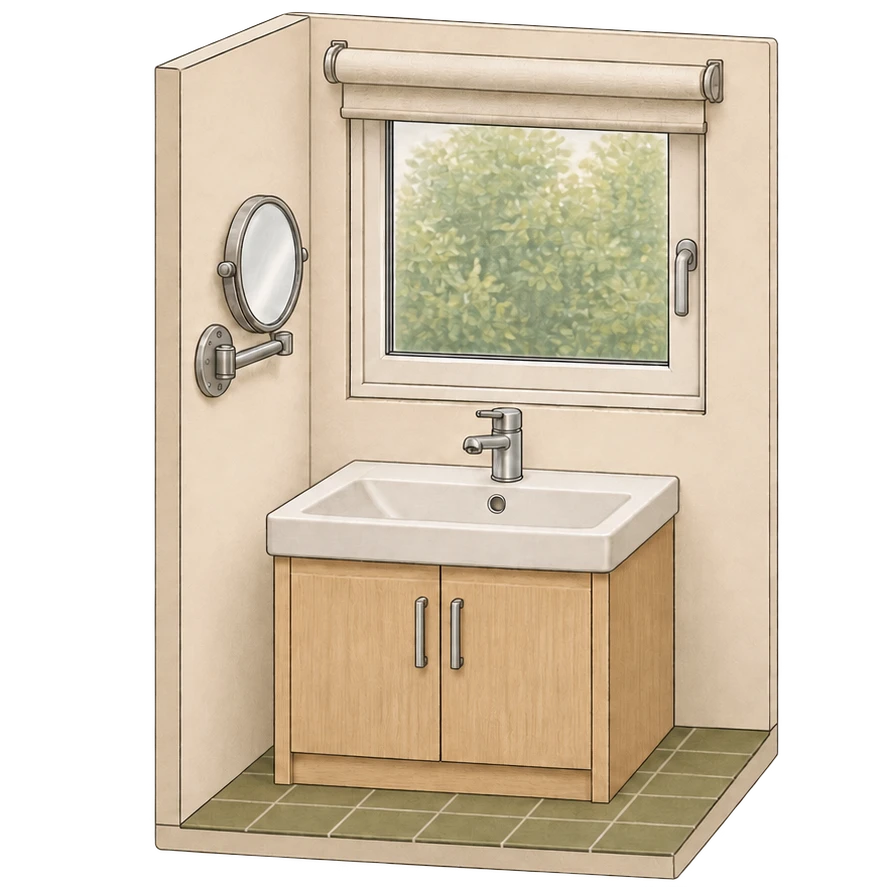
Think about how often you will move it, too. You may adjust it once for a brief daily check, or two people may reposition it repeatedly through a busy morning. If the only comfortable view requires the arm to remain extended, treat that as its everyday footprint.
05
Give longer grooming tasks a separate position when necessary
Some bathrooms work better when the sink and the main getting-ready mirror have different jobs. A nearby wall or bedroom dressing spot may accommodate hair and makeup, while a mirror at the basin handles the tasks that need water.
You need room to stand or sit at the separate mirror, usable light and somewhere for the items you use there. Look at the reflection under your usual lighting, including early mornings and evenings. A crowded bedroom corner may leave you with the same inconvenience elsewhere.
These two illustrative situations show how the routine changes the choice. A guest-bathroom photograph alone cannot tell you what will work at home.
A bathroom used for daily shaving and skincare
the sink is beneath an opening window, with a narrow wall beside it and no usable sill. A small arm mirror looks promising, but the available model cannot provide the desired view from a comfortable stance. The side wall also puts the user behind the basin rather than beside it. Those options fail the routine. A fixed mirror remains worth investigating if suitable support and necessary window access can be retained. If it cannot, move the tasks that do not need water elsewhere and continue looking for a suitable basin mirror; a bedroom mirror alone has not solved shaving at the sink.
A guest bathroom used mainly for washing and brief checks
suppose the same layout has an accessible larger mirror elsewhere in the room. A smaller movable mirror may be sufficient near the basin if its normal reflection and reach suit the users. That compromise changes if a guest needs the room for daily grooming.
In Emily Henderson's own guest-bathroom reveal, the vintage articulating mirror is accompanied by a larger mirror on another wall. She acknowledges the antique's limited usefulness. Keep that larger mirror in mind when judging a similar arrangement: the small one is not doing every job on its own.
06
Check the chosen arrangement before buying hardware
Start with dimensions and access. Record the window opening, handle and blind positions, the tap's projection, available wall space and each user's standing position. Compare the candidate's full dimensions, including its frame, brackets and movement, against those constraints.
A paper or card outline can help you judge scale and how much window would be covered. It cannot establish what you will see. The reflected view depends on the mirror's position and angle relative to you, consistent with the law of reflection explained by OpenStax.
Before committing to a difficult installation, ask the supplier or installer how to check the actual viewing position safely. Do not balance an unsecured mirror above the basin or attach one temporarily to glazing to try it out. If you cannot yet confirm the view, account for that uncertainty before buying.
Read the exact installation instructions before ordering. A mirror intended for wall mounting is not automatically suitable for suspension; this round-mirror installation guide, for instance, explicitly prohibits ceiling suspension. Its supplied wall plugs are specified for solid stone or brick, so included hardware is not proof that a fixing suits your wall. Confirm the proposed support and bathroom suitability for the particular system, and check mounting permission if you rent.