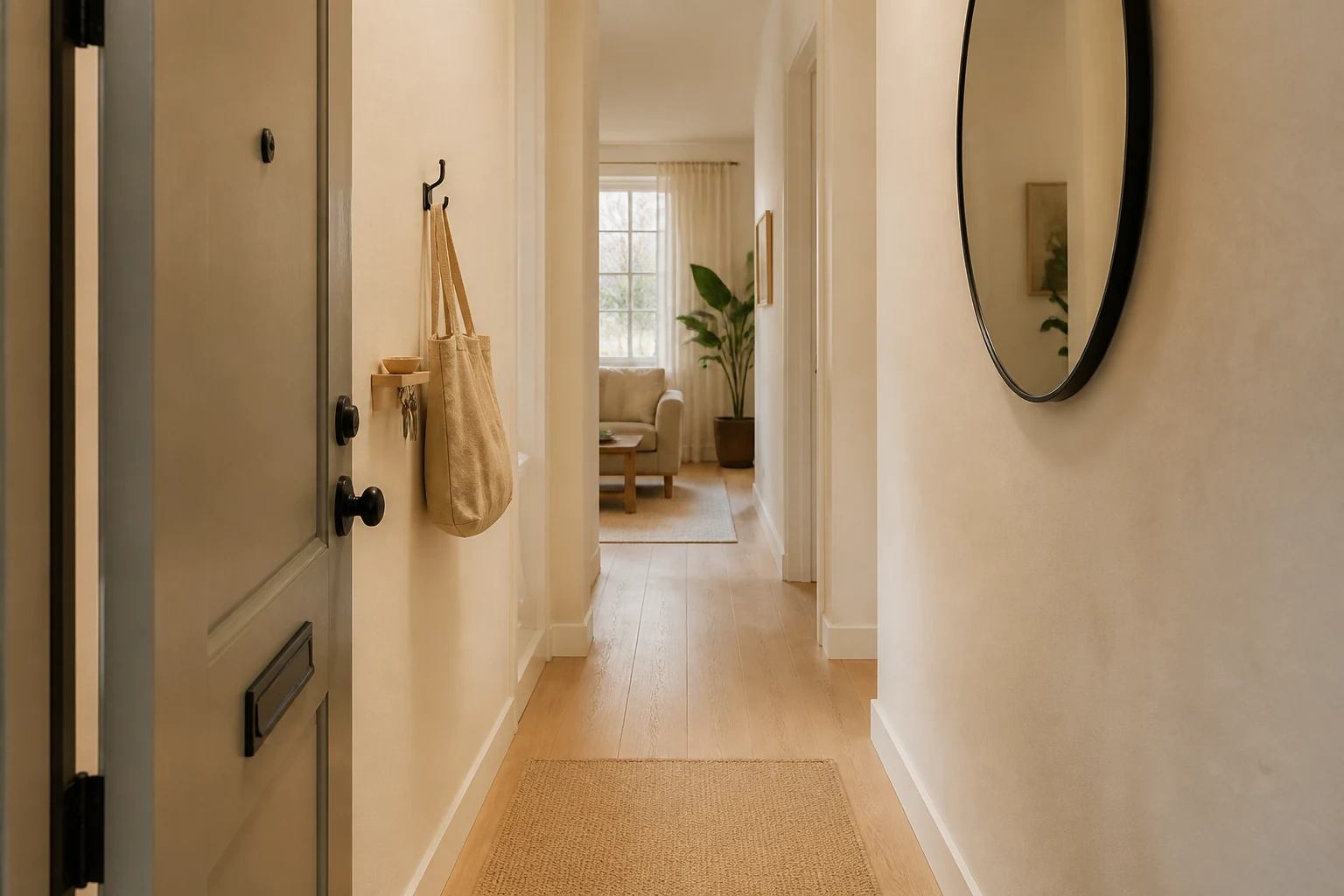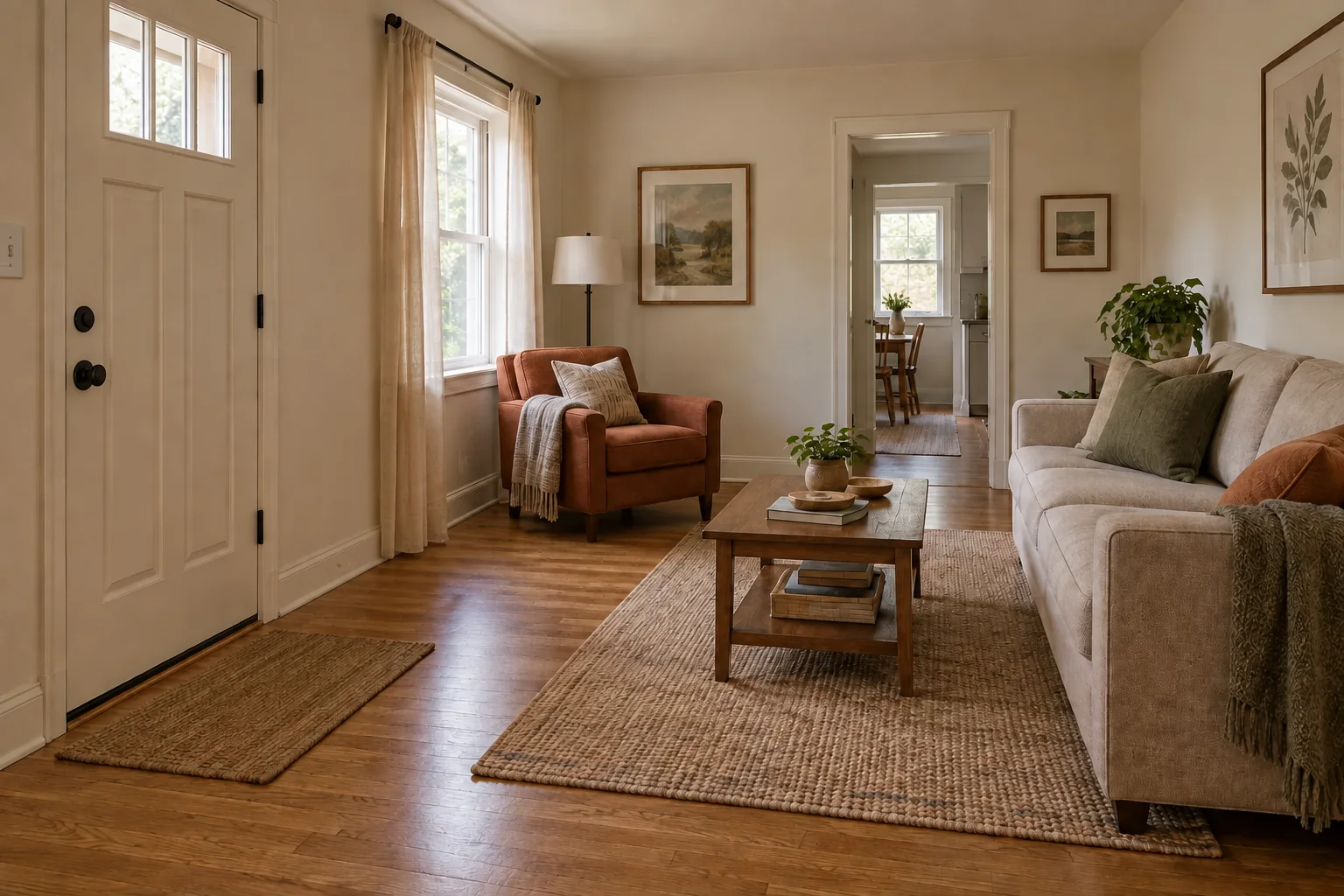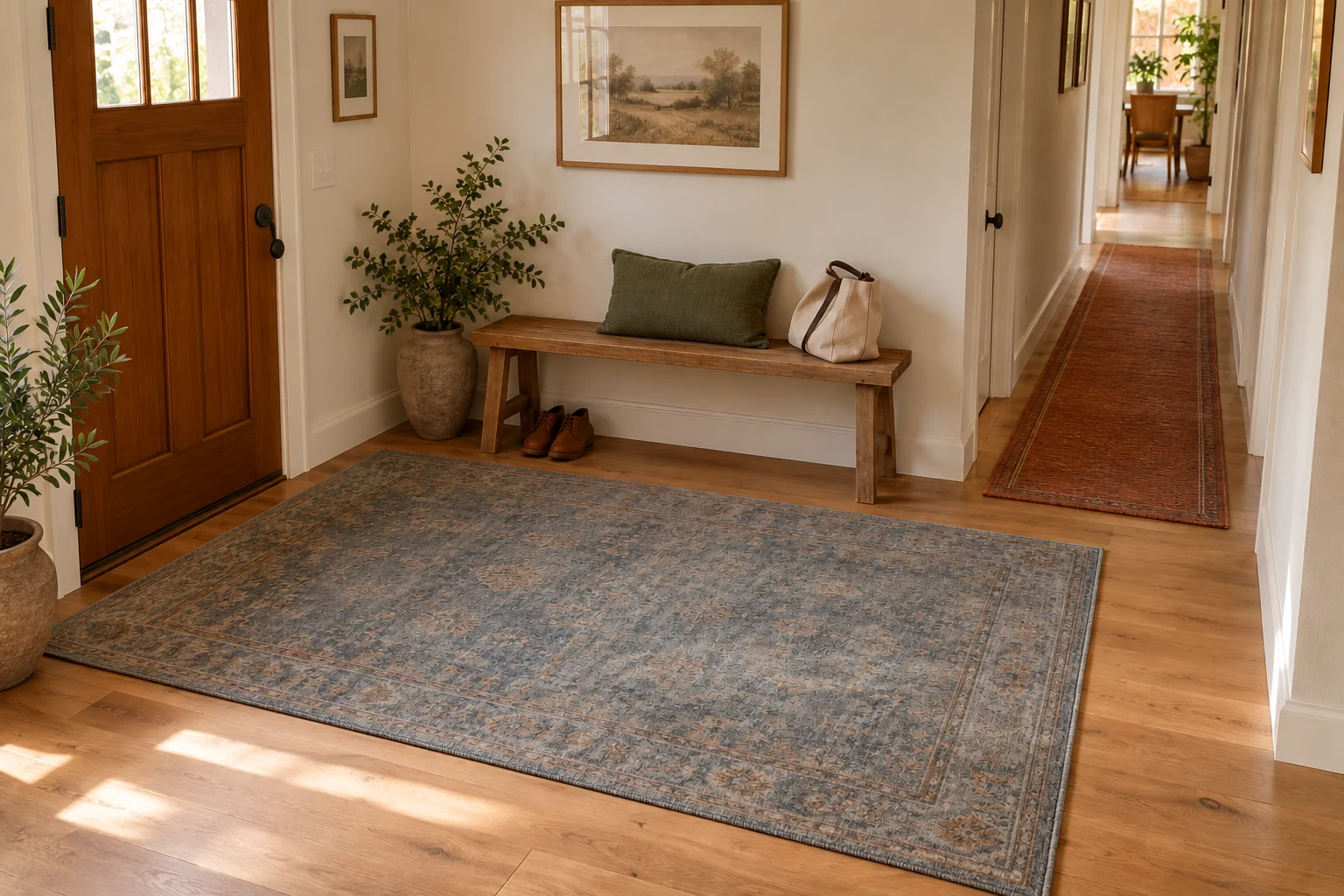
A runner can look right down the hallway and still miss the place where you take off your shoes. Add a mat at the door, and the two pieces may look disconnected. A larger rug seems simpler until it reaches the shoe cabinet or catches beneath the door.
Start with the floor you use when you arrive. Give that area a suitable mat or rug, then decide whether the passage beyond it needs another covering. One rug works when its shape serves the connected space. A mat and runner can suit an entrance that changes direction or width. Sometimes the mat is enough.
In this guide
01
Find the arrival area before choosing a rug
Come through the door as you normally would, carrying a bag if that is part of your routine. Notice where you stand to close the door, where the bag goes and where you remove your shoes. Then follow the route into the house.
Those movements may use a wider patch of floor than the hallway beyond. A rug centered between the walls can leave you standing beside it while you untie a shoe. Move it closer to the threshold, and it may stop short of the shoe bench.
In one Reddit entryway discussion, the family turned right after entering rather than walking toward the shoe bench. The author was considering a rug near the bench as well as a doormat. Where people stopped mattered as much as how the rugs looked together.
Keep necessary furniture in place while comparing rug arrangements. If the bench is inconvenient or a cabinet crowds the door, resolve that first. Our guide to a narrow entryway without a console table helps identify which arrival tasks need space and which furniture can be left out. A rug cannot make an awkward storage location easier to reach.
02
Compare three layouts in the same entrance
Imagine a broad landing with the front door near its left end. The door opens inward against the left wall. A shoe bench sits opposite it, while a narrower hallway leaves from the right side. You enter toward the bench, remove your shoes, then turn right into the house.
Dashed oval: the shoe-changing spot. Blue arrows: the arrival and onward route. The room and bench stay the same in all three illustrative plans; these are not measured installations.
Runner misses the bench
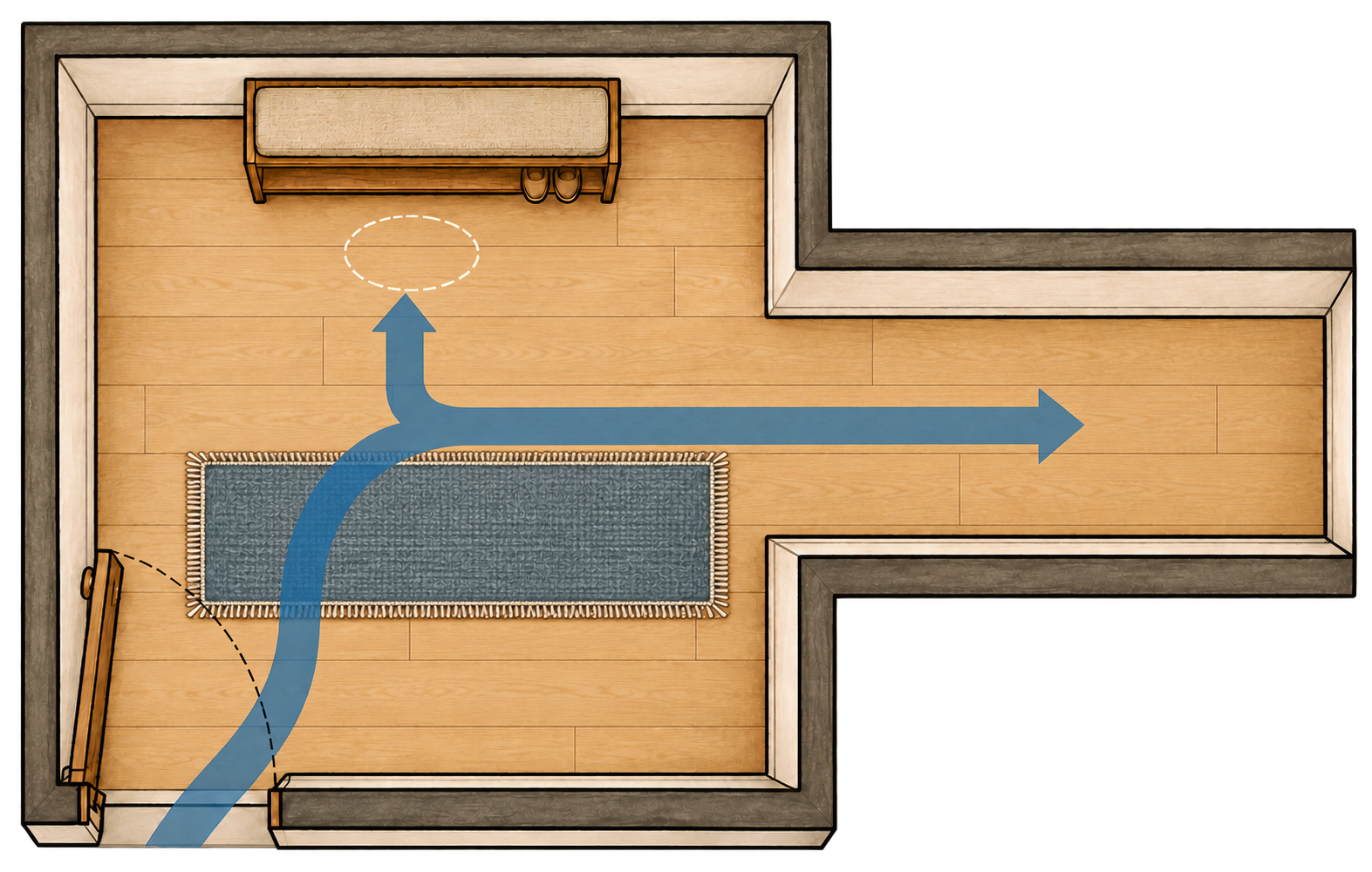
A runner stretched from the doorway toward the right-hand passage makes a strong line through the entrance. But in this room, people first move toward the bench. If the runner is too narrow to reach that standing area, it covers the onward route while missing part of arrival.
Rotating the rug toward the bench may put it under your feet where you need it. It now stops at the landing instead of continuing into the hall, but that can be a complete arrangement: a single rectangular entry rug with bare floor beyond it.
Try a wider rectangle if it can cover the useful landing without extending into furniture or creating an awkward projection at the passage opening. A 3-by-5-foot option such as the ZHXXUJ entryway rug in Beige/Grey/Brown gives you a footprint to mark out: does that width reach your standing spot, and can the length stop before the turn? If it crowds the furniture, choose another size. Do not keep increasing its size just to reach around the turn. A rectangular rug cannot bend around an L-shaped route; covering both arms with one rectangle also covers the floor between them.
One rug works when it covers the connected area you need. If getting enough width beneath your feet means buying more length than the room can use, try separate pieces.
Landing mat + runner
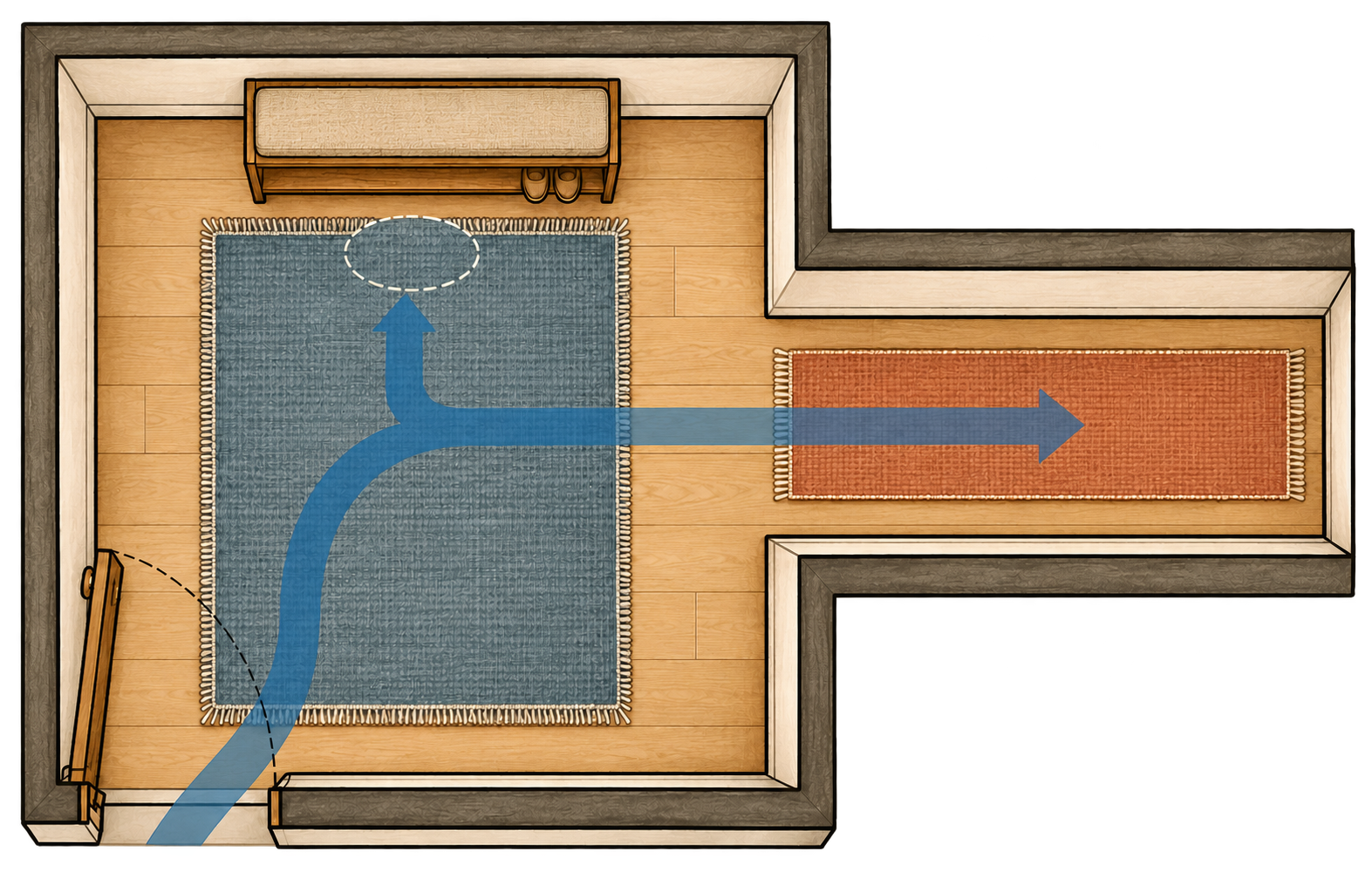
Place the mat around the door-to-bench arrival area, then give the narrower passage its own runner. The two pieces can have different widths because they serve different parts of the floor. The EARTHALL woven runner in Orange/Tan/Brown, for instance, is listed at 2 by 6 feet: a narrower footprint to try along the onward route. Its seller warns that washing can cause shrinkage, so avoid an arrangement that depends on an exact fit. These are individual size examples; choose their colors and patterns to suit your room.
The runner is worth adding when you want a textile underfoot farther along the hallway and a single rug cannot serve both spaces well. Some bare floor between the pieces can make sense at the turn. You do not have to fill it.
Check where that break falls. If you naturally turn with one foot on an edge, try moving the runner farther down the hall or changing the mat's footprint. If the pieces must overlap to fit, reconsider their sizes or leave the runner out.
Both rugs should have room to sit properly and a reason to be there. A runner that needs constant repositioning or leaves an awkward sliver beside the mat may be more trouble than it is worth.
Landing only
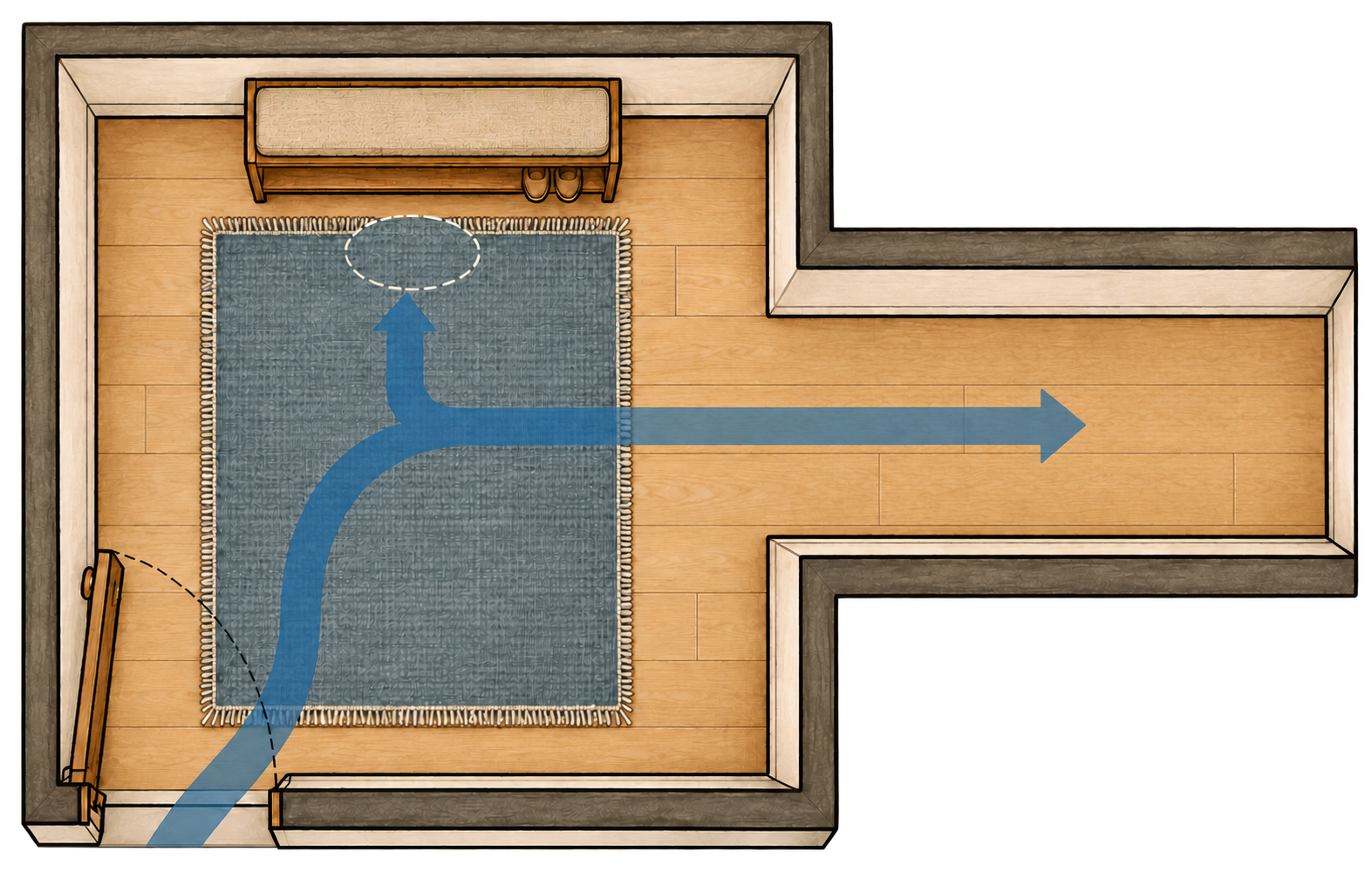
Keep the same landing mat and remove the hallway runner. The entrance still has a defined place for arriving and changing shoes; the onward floor remains visible.
If the passage does not need more softness or decoration, there may be little reason to buy a second rug. Look from the adjoining room before assuming the bare hall looks unfinished.
The mat must still serve arrival. A tiny rectangle immediately inside the threshold is not equivalent to a landing mat that reaches the shoe-changing spot. If your feet land on bare floor at the bench and you want that area covered, change the mat's size or position.
Stay with the mat alone when it covers arrival and the hallway works well bare. Add another covering only if it improves the onward route.
03
Place the edges around the turn and the furniture
Judge the rug against the floor left available by the furniture. A shoe cabinet projecting from one wall can shift the usable passage away from the hallway's geometric center. Equal borders against the walls may then put the rug partly beneath the cabinet while leaving the walking line uncovered.
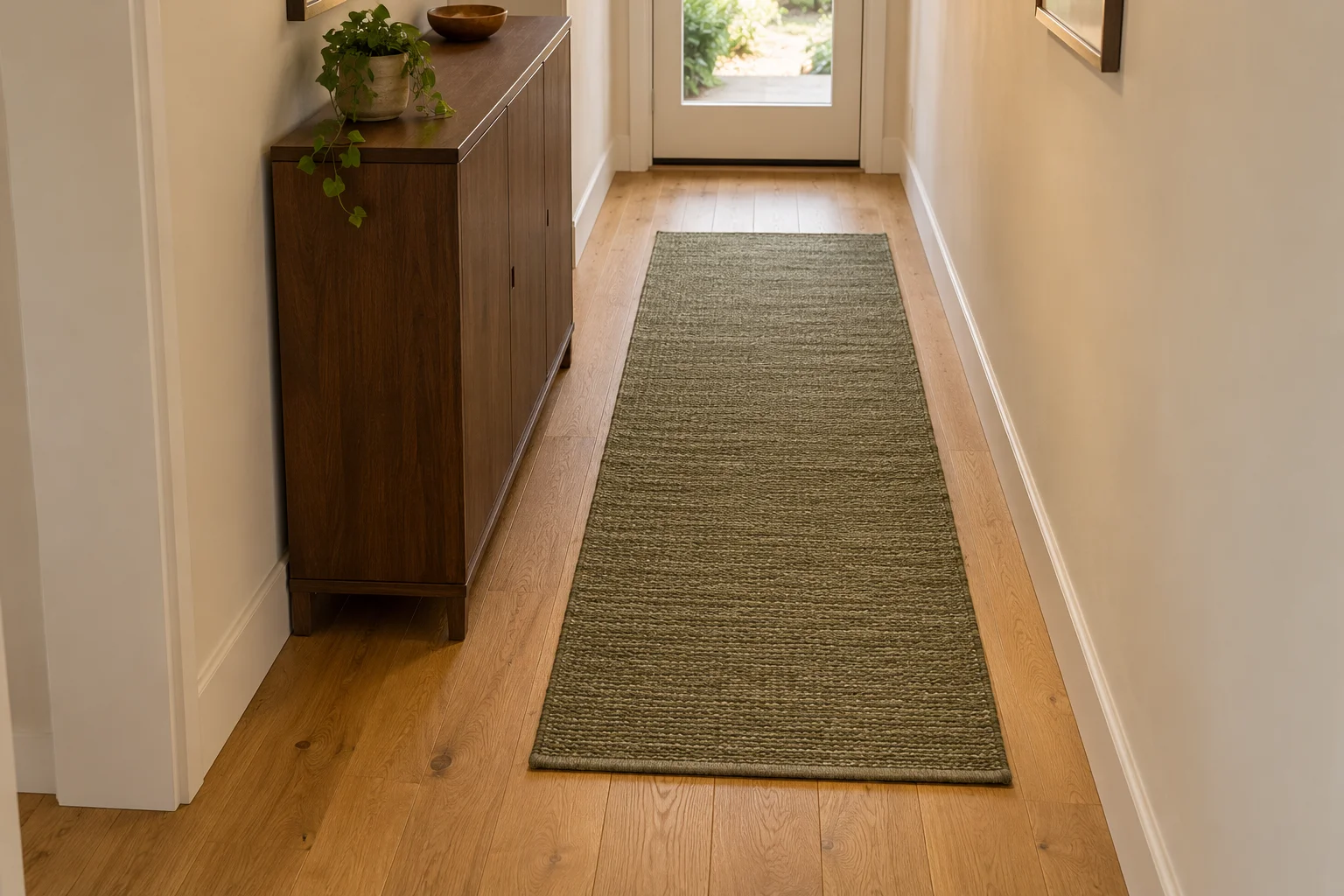
Mark the proposed outline with removable tape approved for your floor finish, following its application and removal instructions. Include the rug's finished edges and any fringe. Stand at the bench, reach into the shoe storage and carry a bag through the turn. An outline cannot show height or grip, but it can expose a rug that reaches into the wrong place.
With two rugs, adjust their ends around the junction rather than trying to maintain a prescribed gap. Keep their loose edges separate. Look at the arrangement from the front door and from the hallway: a wider break can look sensible where the room changes direction.
Once placement works, consider their appearance together. Repeating a background color can connect different patterns; a quieter mat can sit beside a more patterned runner. Matching rugs are also an option, provided their available sizes suit the floor. Do not accept a poor fit just to complete a set.
If the entrance opens into seating, judge the rugs alongside that room's arrangement. The guide to a front door opening into the living room explains how to preserve the route without forcing a separate foyer into the seating area.
04
Check the door with the rug and pad together
A floor outline that fits does not prove the door will clear the actual rug. Account for its backing, bound edges and any separate pad. Revival's entryway guidance specifically advises considering both rug and pad when checking door clearance.
Check beyond the word "thin" in a listing. ZHXXUJ lists a 0.15-inch thickness and TPR backing; neither establishes clearance or compatibility with your floor. EARTHALL lists a 0.19-inch body and 0.38-inch reinforced edges, while its specifications give a 0.39-inch item thickness. That discrepancy remains unresolved, and the seller warns that edges may lift. Skip that runner where a raised edge conflicts with your turn or door sweep; you still need to check that it stays in place despite its rubber backing.
Measure the gap beneath the door through its sweep, then test the actual combination or representative samples at the tightest point before committing where possible. Operate nearby closet doors and storage fronts too. If the door drags, gathers the rug or pushes an edge, choose a suitable thinner combination or another position.
Check the rug and pad manufacturer's instructions for your floor. A rug sold with an integrated backing may have different requirements from one intended for a separate pad. Do not remove necessary grip merely to gain clearance.
The Consumer Product Safety Commission's home safety checklist for older consumers calls for flat, slip-resistant walking surfaces and highlights potentially wet entryways. A shifted or curled rug needs attention even if its original placement looked right.
05
Try an ordinary arrival before committing
Rehearse the most promising outline while carrying what you usually bring home. Close the door, put down the bag, remove your shoes and walk on. Have another person use the entrance with you if that is normal for your household.
Notice whether you step outside the proposed mat at the bench, turn across a rug edge or move the runner to open storage. Adjust whichever part gets in the way, then repeat the trip. Tape can help you choose a footprint; the actual rug still needs its separate door and stability checks.